

LeRobotDataset v3 changed robot-data scale through chunked episodes and streaming
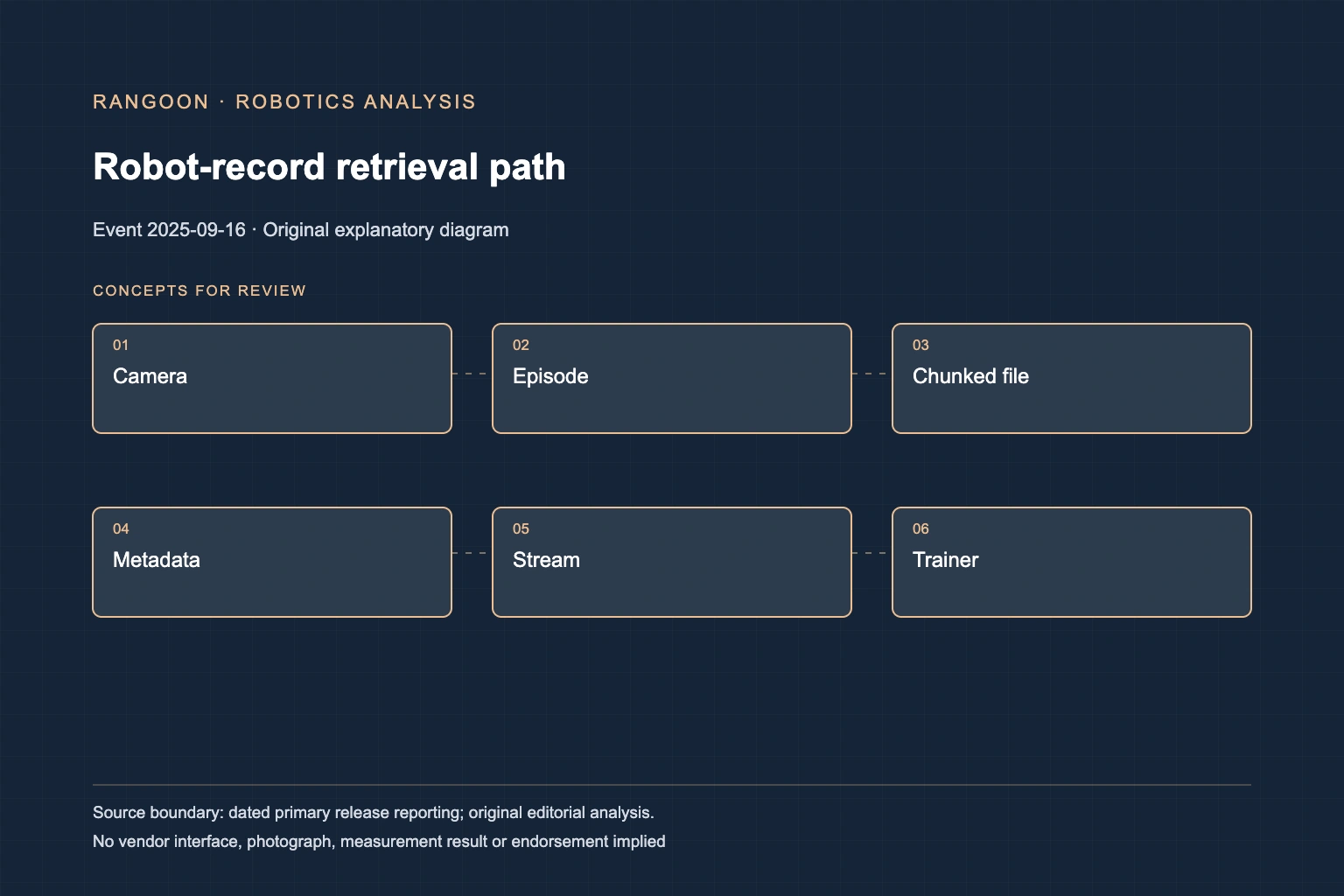
Hugging Face released LeRobotDataset v3.0 on September 16, 2025, combining multi-episode files, relational metadata and streaming for larger robot-learning collections.
Historical reporting: Hugging Face announced LeRobotDataset v3.0 on September 16, 2025. Its launch record says the format groups multiple episodes in a file, uses relational metadata to retrieve episode-level records and supports streaming access. Maintained LeRobot documentation describes the format and migration path, but is later operational context rather than proof of an unchanged September implementation. The vendor’s scale and throughput framing is useful design context, not a guarantee for every storage system, network or training run.
Key takeaways
- The September event was a data-format release for robot-learning records, not a new robot policy or a promise of universal model quality.
- Chunking, relational metadata and streaming address different parts of the data path and do not remove the need to inspect collection quality and licenses.
- A format migration can preserve usable records only when a team also validates schema, media, metadata and downstream training behavior.
The release focused on how robot episodes are stored and found[source 1]
On September 16, 2025, Hugging Face announced LeRobotDataset v3.0, a dataset-format update for robot learning. The announcement says earlier LeRobotDataset versions stored one episode per file, a layout that could create file-system pressure as a collection grew. Version 3 instead groups multiple episodes in a file and uses relational metadata to retrieve the records that belong to an individual episode. That is infrastructure work: it changes the path from recorded observations to training or evaluation inputs. It does not make a robot more dexterous by itself, establish that a collection is representative, or prove that a model trained on the data will generalize outside its test conditions.
Streaming changes access behavior without making every dataset local or small[source 1][source 2]
The launch also described native streaming access, allowing a consumer to process data without first downloading an entire dataset locally. This matters when robot recordings combine cameras, state readings and teleoperation context, because transfer and decode behavior can become as important as model code. Streaming is an access pattern, not evidence that a run has no bandwidth cost, no cache behavior, no authorization boundary or no data-quality problem. A team still needs to establish which records are fetched, how failures are retried, whether a sample can be reproduced and whether source permissions permit the intended use. The September record supports a narrower conclusion: LeRobot added a way to work with larger collections through a standardized data path.
Metadata structure made episode identity a first-class operational concern[source 1][source 2]
Hugging Face described unified structured metadata and a conversion path from v2.1 to v3.0. That makes an important distinction visible: video bytes, sensor values, task labels and episode identity are related but not interchangeable. A conversion tool can rewrite a format while leaving unresolved questions about timestamps, camera calibration, annotation meaning or corrupted source media. The maintained documentation is helpful for learning the format’s concepts and supported workflows, yet it cannot retroactively prove that every later tool, plug-in or policy existed on the launch date. For an engineering organization, the useful outcome is a reviewable migration boundary: compare pre- and post-conversion samples, preserve provenance, and test the readers that will consume the result.
Scaling records did not turn collection volume into a deployment claim[source 1]
The announcement framed v3 around data volumes that can become awkward for an episode-per-file layout. That framing should not be collapsed into a claim that a larger corpus makes a physical deployment safe, complete or economically justified. A vision-language-action policy still depends on task coverage, observation and action definitions, hardware assumptions, evaluation design and supervisory controls. A dataset format can make those inputs easier to store and retrieve; it cannot determine whether they describe the target environment well enough. The historical event is therefore useful as evidence of an open-source robotics data-system change. It is not independent confirmation of any particular benchmark, robot capability or customer outcome.
Sources
Continue reading
Related reading
 News analysisLeRobot v0.4 joined scalable datasets, plug-ins and simulation without merging their evidence3 min read
 News analysisHugging Face and Pollen introduced Reachy Mini as an open desktop robot with an SDK and simulation path3 min read
 News analysisSmolVLA put a 450M action policy and community robot data into an open package3 min read