

SmolVLA put a 450M action policy and community robot data into an open package
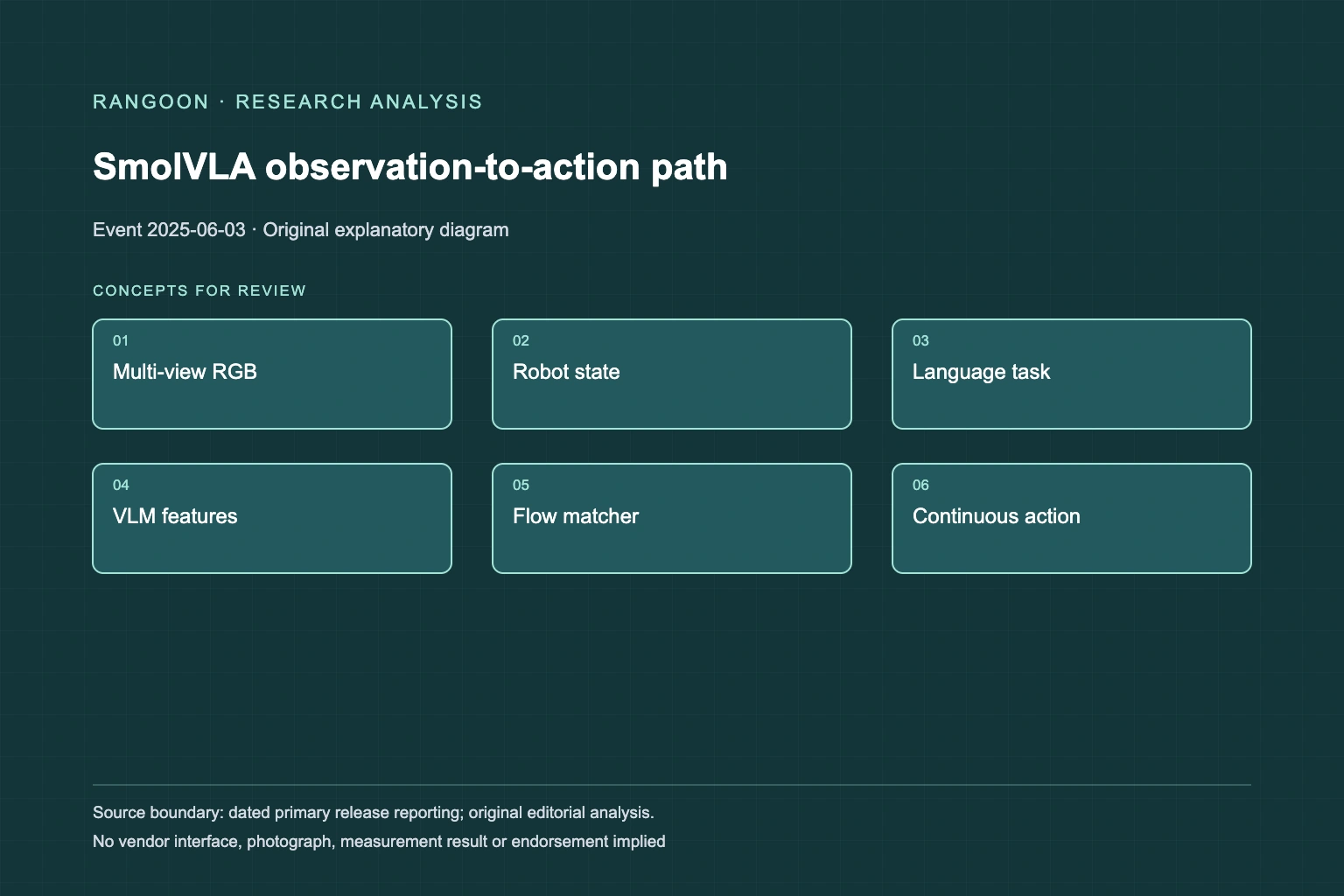
Hugging Face introduced SmolVLA on June 3, 2025: a 450M vision-language-action model using multi-view images, robot state, language, and continuous actions.
Historical reporting: Hugging Face introduced SmolVLA on June 3, 2025 as a 450M open-source VLA trained on compatibly licensed LeRobot community datasets. Its paper was submitted June 2. A currently maintained LeRobot model card identifies Apache-2.0, multi-view image and state inputs, optional language, flow matching, and continuous action output; that card is later artifact context rather than June launch-date proof.
Key takeaways
- SmolVLA used multi-view images, sensorimotor state, optional language, and flow-matched continuous actions, so it needs a matching robot observation and action interface.
- Open code and an Apache-2.0 base-model card do not clear data rights, hardware safety, or the suitability of a checkpoint for a new robot.
- Simulation and SO100/SO101 results are Hugging Face measurements; they do not demonstrate general control of arbitrary robots or tasks.
The June release positioned a smaller VLA for accessible robotics[source 1][source 2]
Hugging Face introduced SmolVLA on June 3, 2025 as a 450M-parameter open-source vision-language-action model. The launch said it was pretrained on compatibly licensed community-shared datasets under the LeRobot tag and released with code, pretrained models, and training data. The news was about lowering the compute and data-access barrier for a robot policy, not about making a model interchangeable across every robot arm or manipulation problem.
A smaller policy changes some operating constraints, but not the physical-world requirement for fit. A robot still needs cameras with the expected views, state values in the expected convention, action scaling, timing, and a task-specific evaluation. The paper describes consumer-grade deployment targets, yet hardware affordability should not be confused with a claim that an arbitrary setup has adequate guarding, calibration, torque limits, stop behavior, or human oversight.
The architecture conditioned continuous actions on images, state, and instruction[source 1][source 2]
SmolVLA takes a sequence of multi-camera RGB images, the robot’s sensorimotor state, and a natural-language instruction. Its vision-language component encodes those inputs into contextual features that condition an action expert, which generates a continuous sequence of actions through flow matching. The maintained model card describes the same basic contract: multi-view images, proprioception or state, optional language, and continuous action output.
That contract explains both the model’s promise and its limitation. A text instruction gives a desired behavior, while images and state anchor the command to a particular scene and mechanism. But a policy trained with one camera layout or joint convention can fail when observations are missing, mirrored, delayed, poorly calibrated, or mapped to a different embodiment. “Continuous” action output is not a physical safety layer; it is a representation that still has to be bounded by the robot controller.
Community data and asynchronous inference were part of the release recipe[source 1][source 2]
The launch describes pretraining followed by task-specific post-training, using fewer than 30,000 training episodes. It attributes efficiency to choices including fewer visual tokens, partial vision-layer skipping, and interleaved attention blocks. It also introduced asynchronous inference, separating action execution from model inference so that the robot can continue moving while the policy processes a new observation. This is a system design choice, not a guarantee that stale or delayed observations are harmless.
Hugging Face reported roughly 30% faster completion and twice the task throughput for its asynchronous setup while similar task success was observed in its tests. Those are project measurements on its selected tasks and timing implementation. Faster response can help a control loop, but a robot needs end-to-end latency measurement, state synchronization, and a recovery policy before a result from SO100 or SO101 is used to support a claim about another hardware platform.
The model card’s license is an artifact fact, not a deployment verdict[source 1][source 2]
The official LeRobot model card currently labels `smolvla_base` Apache-2.0 and describes it as a base model to fine-tune for a specific use case. That is useful artifact-level context for a user choosing the published checkpoint. It should be kept distinct from the June announcement and from rights in any new robot recordings, cameras, customer site, or task data used during adaptation.
Hugging Face reported simulation and real-world comparisons against larger VLAs and baselines, including SO100 and SO101 tests. Those results are vendor-reported experimental evidence under named setups, not a safety guarantee or an autonomy certificate. Before a new task, operators need to test the exact checkpoint and robot at limited speed with defined stop conditions; the open release does not supply that validation by itself.
Sources
Continue reading
Related reading
 News analysisLeRobotDataset v3 changed robot-data scale through chunked episodes and streaming3 min read
 News analysisLeRobot v0.4 joined scalable datasets, plug-ins and simulation without merging their evidence3 min read
 News analysisHugging Face and Pollen introduced Reachy Mini as an open desktop robot with an SDK and simulation path3 min read