

smolagents launched with code-writing agents and sandbox boundaries in the foreground
Hugging Face introduced smolagents on December 31, 2024 as a compact agent library with code agents, tool-calling agents and optional sandboxed execution.
Historical reporting: Hugging Face published the smolagents launch post on December 31, 2024. The article does not claim current provider, sandbox or package behavior.
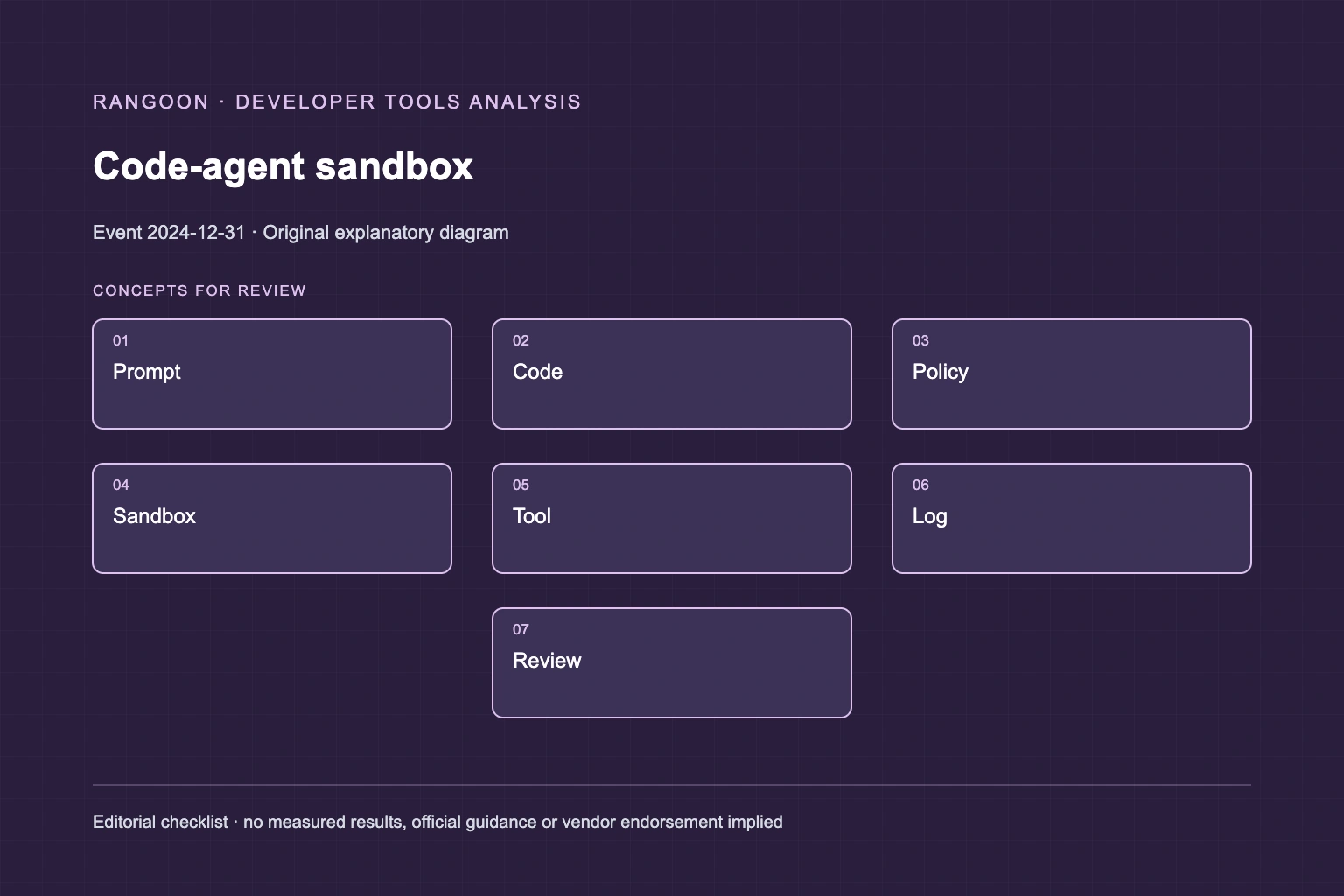
Key takeaways
- smolagents framed code as an action language for agents.
- Generated code requires a runtime policy beyond the model’s instruction.
- Model agnosticism does not make outputs or tools equivalent across providers.
The year-end launch made code actions a first-class agent pattern[source 1][source 2]
Hugging Face published “Introducing smolagents” on December 31, 2024. The post described a small library with first-class CodeAgent support, a conventional ToolCallingAgent, Hub integrations and model-provider flexibility. It said code-agent actions could execute in sandboxed environments through E2B. The repository’s current overview preserves the code-agent and model-agnostic framing. These sources document the launch’s stated design; they do not prove that arbitrary generated code is safe or that every provider behaves consistently.
The launch contrasted an agent that writes actions in code with one that writes JSON or text tool calls. That was a framework-level choice about action representation, not a claim that generated programs should run with broad host access. The article therefore treats sandboxing as a design requirement to investigate, rather than a label that settles execution safety.
Code actions move the security boundary into an execution environment[source 1][source 2]
A code-writing agent emits a program that can combine many operations inside one action. That can be expressive, but it makes language runtime, filesystem, process, network, package installation and secret exposure part of the trust boundary. A tool-calling agent has a narrower, declarative interface only if tools enforce schemas and permissions. Neither pattern is automatically safer. Choose based on the task’s required capabilities and the controls you can test and operate.
Code execution can also hide several actions behind one artifact: reading a file, calling an API, transforming data and emitting a report. Require the runtime to expose outbound connections and mounted paths before execution. This turns an opaque code block into an inspectable capability request, which is essential when the agent’s task crosses data classifications.
Sandbox policy needs resource and egress limits[source 1][source 2]
For executable agent output, define permitted language versions, package sources, workspace mount, network destinations, CPU, memory, wall-clock limit, output size and secret access. Keep generated code and execution logs with the result, then scan the diff between proposed and executed code if a repair loop changes it. Test blocked network access, an infinite loop, a large output, a missing dependency and an attempt to read an excluded path.
Use an ephemeral workspace by default, then explicitly promote only reviewed output artifacts. If a run needs an input corpus, mount it read-only and log its version. This prevents one agent invocation from leaving executable residue that alters a later run, while preserving enough evidence to reproduce a reported result.
Analysis: compare agent styles through side-effect visibility[source 1][source 2]
A useful evaluation asks what an operator can see before action: tool arguments, generated code, environment, expected output and permission request. It also asks whether a failed run can be replayed without repeating a harmful effect. The smolagents announcement supplies the historical code-agent context; the visibility criteria are original operational analysis for selecting an agent pattern.
Choose code actions when the task benefits from local composition and the sandbox can enforce its limits. Choose fixed tools when narrow operations and predictable audit events matter more. This is a workload decision, not a permanent ranking of agent styles. The deciding evidence should include failed-run behavior, not only the best successful demonstration.
Sources
- Hugging Face: Introducing smolagents (December 31, 2024)
- Hugging Face smolagents repository (December 31, 2024)
Continue reading
Related reading
 News analysisHugging Face and Pollen introduced Reachy Mini as an open desktop robot with an SDK and simulation path3 min read
 News analysisLeRobotDataset v3 changed robot-data scale through chunked episodes and streaming3 min read
 News analysisLeRobot v0.4 joined scalable datasets, plug-ins and simulation without merging their evidence3 min read