

Intel’s April 2025 18A risk-production statement made status explicit
Intel said on April 29, 2025 that 18A was in risk production and expected volume manufacturing that year. Risk production is not volume output or customer qualification.
Historical reporting: Intel’s April 29, 2025 Foundry Direct Connect statement said Intel 18A was in risk production and expected volume manufacturing that year. An Intel press kit separately recorded the event’s roadmap and ecosystem context; analysis below is editorial.
Key takeaways
- Intel described 18A as in risk production, a state before volume manufacturing.
- Risk production generates process and product evidence under constrained conditions.
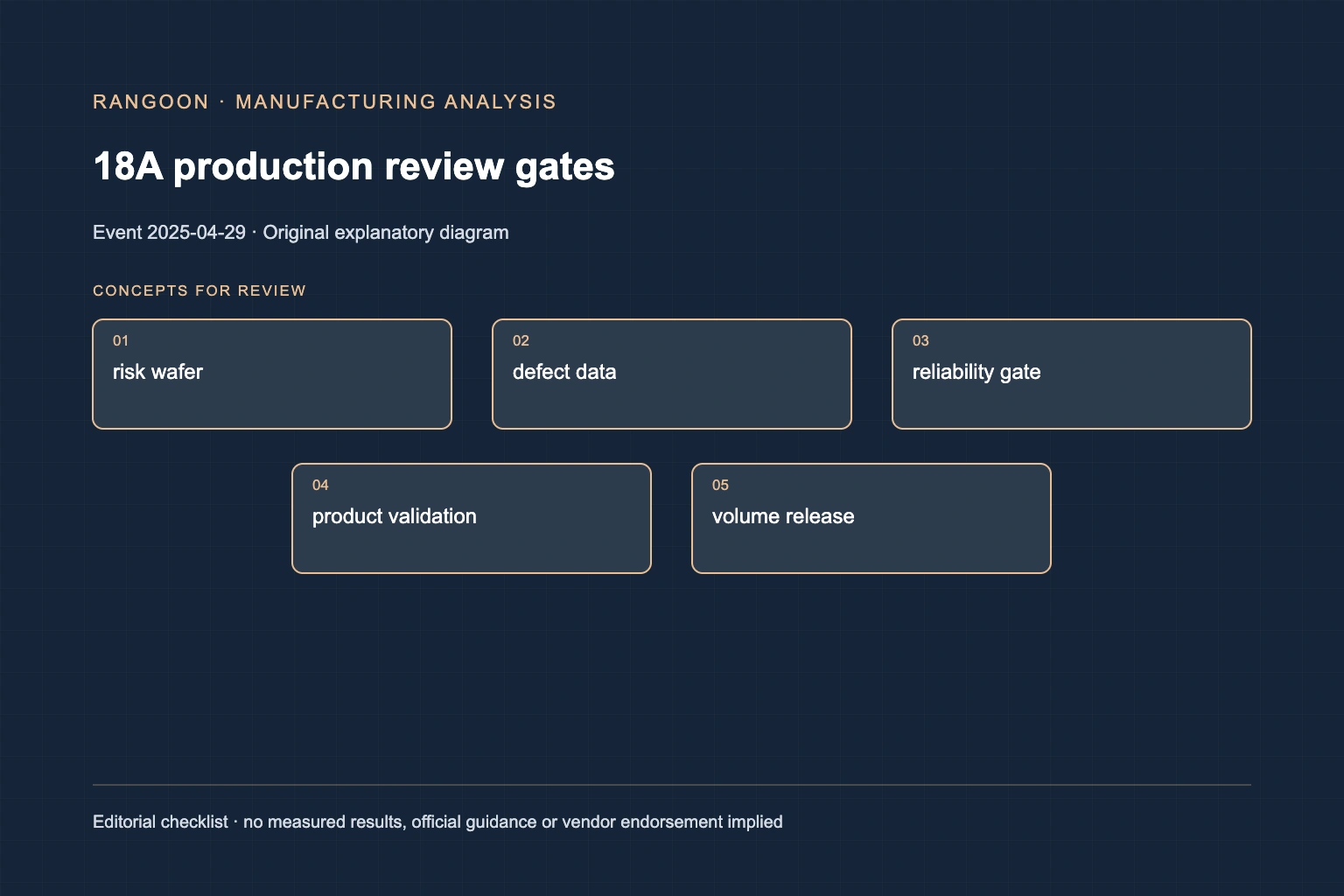
- Yield, reliability, customer qualification, and capacity remain separate gates.
What Intel said[source 1][source 2]
On April 29, 2025, Intel said at Foundry Direct Connect that Intel 18A was in risk production and expected to reach volume manufacturing later that year. The statement is useful because it uses a specific manufacturing term instead of collapsing every pre-volume activity into ‘production.’
Intel’s separate Direct Connect press kit described the same day’s process-roadmap, advanced-packaging, manufacturing-capacity, and ecosystem focus. Together, the records establish the dated risk-production statement and its event setting. They do not demonstrate that every customer design, wafer lot, or product had reached the same stage, nor do they establish yield or reliability results.
Editorial analysis: risk production is evidence collection
Risk production is a manufacturing stage where wafers can be run on a production-intended flow while teams gather data on defects, variability, performance, reliability, and design interaction. It is more meaningful than a laboratory demonstration, but it is not the same as sustained high-volume output with mature capacity and customer qualification.
A good status record identifies the process revision, test vehicle or product, fab, measurement window, observed yields where disclosed, reliability evidence, and decision remaining before volume release. This allows a program manager to use the milestone without pretending it resolves every supply or product risk.
Editorial analysis: process and product gates differ
A process can reach a readiness milestone while a specific processor still needs design validation, packaging integration, firmware, platform testing, and commercial launch preparation. Conversely, an early product can reveal a process issue that changes the manufacturing schedule. Link the two records, but do not merge their status fields.
For a first product, track design tapeout, wafer start, silicon return, electrical characterization, reliability, package qualification, system enablement, and shipment separately. Each transition should be supported by an observed result or a clearly labeled plan. This makes it clear whether a delay belongs to the process, the product, or a supplier interface.
Editorial analysis: status words should survive the summary
When reporting a node, carry the supplier’s state word into the summary. ‘Risk production’ means something different from ‘volume manufacturing,’ and ‘expected’ means something different from ‘achieved.’ Those distinctions are not cautious filler; they are the information a hardware roadmap user needs to plan dependencies responsibly.
Intel’s April 2025 18A statement offers a clean example. It reported an important progression while retaining a future qualifier. A useful retrospective keeps both parts: the milestone reached and the gate that still remained.
Editorial analysis: track yield evidence by lot
Process maturity should be supported by dated lot-level evidence, not a broad node label. Track defect density, electrical yield, parametric distribution, reliability screening, and rework by relevant process revision. This lets a product team understand whether a yield issue is isolated, trending, or resolved, and prevents a public risk-production milestone from being mistaken for a guaranteed wafer-output level. Link the lot data to the test vehicle and product revision, because process results can differ across layouts and operating targets.
Sources
- Intel: Foundry Direct Connect 2025 priorities (April 29, 2025)
- Intel: Press Kit for Foundry Direct Connect 2025 (April 29, 2025)
Continue reading
Related reading
 News analysisIntel’s Crescent Island announcement made a future inference GPU a roadmap record, not available capacity3 min read
 News analysisIBM Cloud made Gaudi 3 available first through VPC regions, then mapped a broader path3 min read
 News analysisNVIDIA’s memory codesign post highlights a practical boundary between capacity and usable agent throughput3 min read