

Isaac GR00T N1.5 made synthetic-trajectory provenance part of robot learning
NVIDIA announced Isaac GR00T N1.5 on May 19, 2025, pairing a humanoid-model update with a blueprint for generating synthetic motion data.
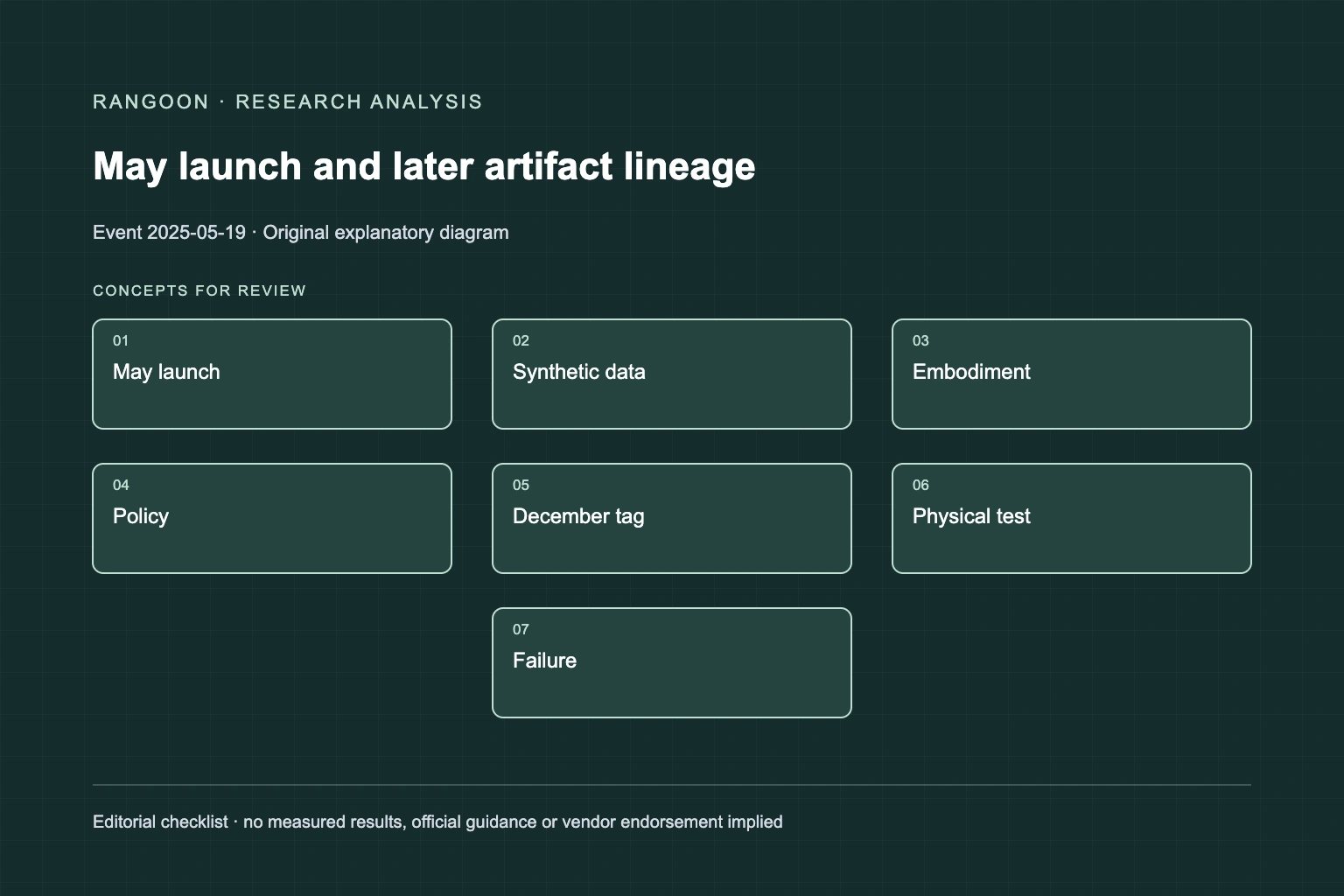
Historical reporting: NVIDIA announced GR00T N1.5 on May 19, 2025. The project repository’s n1.5-release tag is dated December 15, 2025 and is retained only as later artifact lineage, not evidence for the May launch. Synthetic trajectories and supplier demonstrations are not evidence of physical-world safety, robustness or deployment approval.
Key takeaways
- GR00T N1.5 was announced as an update alongside synthetic-motion-data tooling.
- Synthetic data needs provenance, task coverage and sim-to-real evaluation.
- A robot model update does not replace hardware-specific stop, recovery and authorization controls.
The update connected policy development to data generation[source 1][source 2]
NVIDIA announced Isaac GR00T N1.5 on May 19, 2025, describing it as an update to its open humanoid foundation model and pairing it with the GR00T-Dreams blueprint for synthetic motion data. The announcement records a model-and-tooling event, not an independent physical evaluation. The repository’s n1.5-release tag is dated December 15 and does not supply May-release evidence. Synthetic trajectories can increase the variety of training examples, but their usefulness depends on whether their states, contacts, sensors and action distributions reflect the downstream task.
Synthetic motion data has a provenance and coverage problem[source 1][source 2]
A trajectory includes more than a visible motion. It encodes an embodiment, scene geometry, observation stream, control rate, contact assumptions, task reward and recovery behavior. A generated sequence may look plausible while missing friction, delay, occlusion or human interaction that matters after transfer. Policy training should record which examples were real, simulated or synthesized; which generator revision produced them; and how each task class was sampled. Without that ledger, an apparent improvement can be impossible to attribute to a model update rather than a dataset shift or selective evaluation.
Simulation gains are not physical safety results[source 1][source 2]
Robotics reports should separate simulation success, teleoperation data, controlled physical trials and open-environment operation. Each environment exposes different failures. A policy can exploit an artifact in synthetic data or recover from a simulated collision that a real actuator cannot safely reproduce. Model openness also does not create a safety perimeter. Hardware limits, emergency stop, speed control, access boundaries and trained supervision are system responsibilities. This article makes no claim that GR00T N1.5 meets any safety standard or is suitable for a particular robot deployment.
Transfer evaluation should make data origin visible[source 1][source 2]
Build a fixed evaluation suite with task variations not represented in the synthetic generator’s prompt set. Run the same policy in simulation and on the named physical robot, then classify disagreement by perception, planning, control, contact or recovery. Include sensor latency, an unavailable target and a human interruption. Publish the number of trials, intervention rate and failure mode rather than only a favorable completion montage. A held-out real-data set helps determine whether synthetic examples improved useful generalization or merely increased score on a related simulated distribution.
Analysis: robot data pipelines need receipts as much as models do[source 1][source 2]
GR00T N1.5’s historical contribution is to make the data pipeline part of the robot-model story. Every training result should carry a receipt for trajectory origin, embodiment, generator, policy revision and physical test outcome. That enables a reviewer to ask what actually transferred. The May announcement documents an update and a synthetic-data blueprint; it does not prove that synthetic motion closes a sim-to-real gap, nor that a learned policy can be deployed without task-specific testing, operational limits and accountable human oversight.
Synthetic trajectories should be disclosed as such, because their value lies in coverage, task distribution, contact diversity and controllability, not in an assumption that visual plausibility equals physical truth.
Sources
- NVIDIA: GR00T N1.5 announcement (May 19, 2025)
- NVIDIA Isaac GR00T: later n1.5 repository release (December 15, 2025)
Continue reading
Related reading
 News analysisIsaac GR00T N1 made humanoid action generation a deployment-boundary question3 min read
 News analysisGoogle’s Gemini Robotics On-Device put a vision-language-action model on the robot3 min read
 News analysisGemini Robotics 1.5 joined robot motor control with a separate embodied-reasoning model3 min read