

Isaac GR00T N1 made humanoid action generation a deployment-boundary question
NVIDIA introduced Isaac GR00T N1 on March 18, 2025 as an open humanoid-robot foundation model with a reported dual-system architecture.
Historical reporting: NVIDIA announced Isaac GR00T N1 on March 18, 2025 and posted an accompanying research paper. Demonstrated robot skills do not provide safety certification, site authorization or a claim about untested hardware.
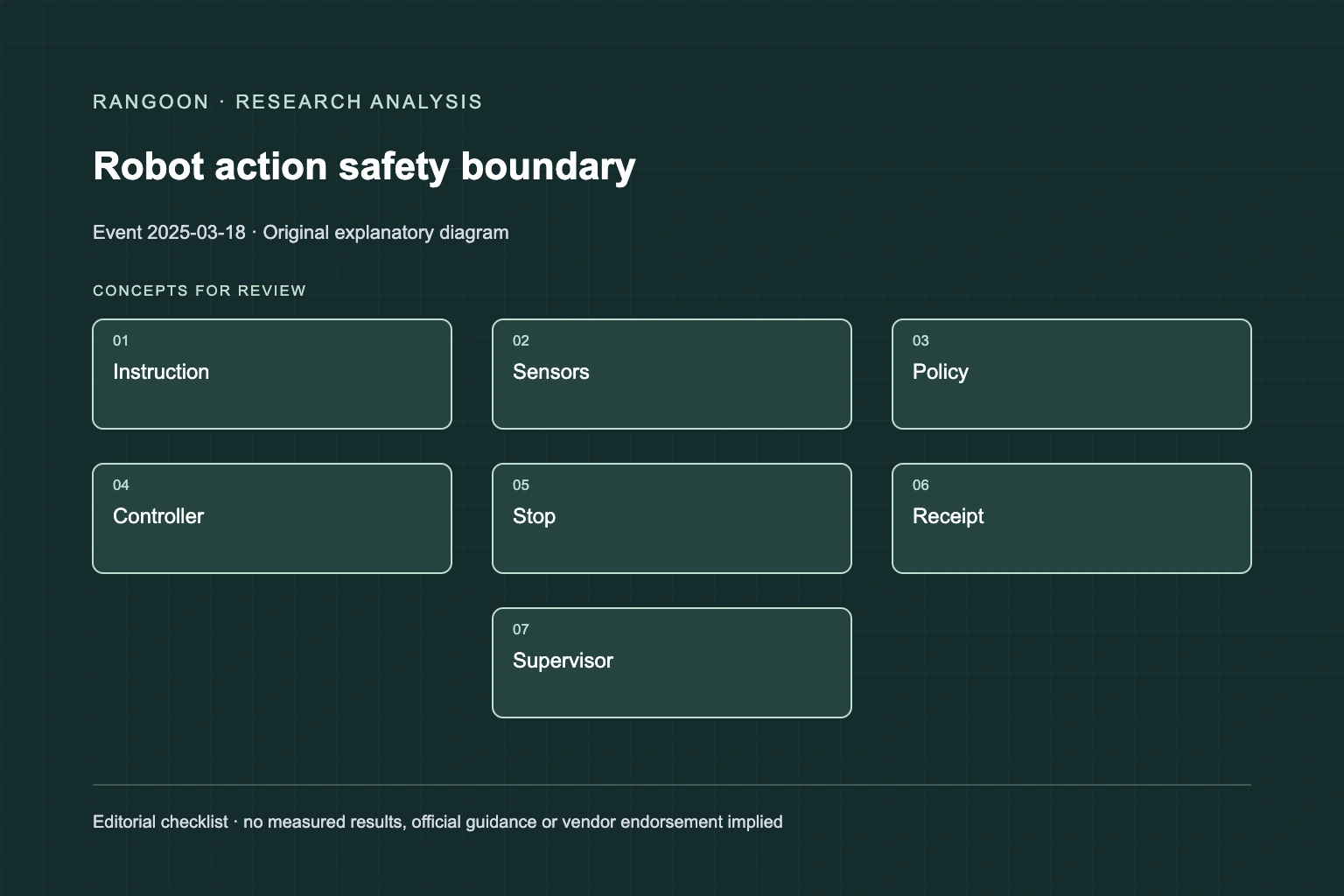
Key takeaways
- GR00T N1 was introduced as a humanoid-robot foundation model, not a safety system.
- Vision-language-action behavior needs tests across hardware, sensing, latency and environment changes.
- A demonstrated task must remain separate from authorization for physical deployment.
NVIDIA announced an open humanoid foundation model[source 1][source 2]
NVIDIA announced Isaac GR00T N1 on March 18, 2025, describing an open foundation model for humanoid-robot reasoning and skills. Its technical material characterizes a dual-system architecture joining a vision-language component with an action-generating component. The release documents a model and development framework direction. It does not establish that a robot using the model is safe in a workplace, reliable around people, compatible with every actuator stack or authorized to perform a task where a failure could cause harm.
A robot policy sits inside a larger control system[source 1][source 2]
Vision-language-action models map inputs such as instructions and observations toward action representations, but a physical robot also needs state estimation, low-level control, collision handling, timing guarantees and a recovery path. Training demonstrations and simulation data define only part of that system. An action model can produce a reasonable next move while the sensor frame is stale, the calibration is wrong or an end effector has slipped. The GR00T N1 paper is a research record for the reported architecture and evaluations; it is not a substitute for the hardware-specific control and safety case.
Skill demonstrations are not a safety certificate[source 1][source 2]
A robot demonstration often occurs within a curated task layout and a constrained set of objects. Generalizing beyond that layout requires testing perception changes, different lighting, occlusion, failures, people entering the scene and unexpected contact. An open model also does not supply a site’s permissions, emergency-stop wiring or operator training. Reports should identify robot embodiment, controller, sensor suite, policy version, action rate, task success definition and human override behavior. Those details turn an appealing video into a claim another lab can evaluate without inflating it into a broad deployment conclusion.
Physical evaluation needs explicit stop and recovery conditions[source 1][source 2]
Start with a controlled task and predefine success, failure, intervention and stop criteria. Repeat it across object variations, camera perturbations and hardware resets, then count near misses and recovery quality rather than reporting only completed runs. Test latency spikes and a lost perception stream while an independent controller enforces a safe state. Keep simulation results separate from physical runs, and make a human supervisor able to halt every trial. This study approach is original robotics analysis; it does not describe NVIDIA’s internal testing or certify any robot.
Analysis: open weights expand review but do not transfer responsibility[source 1][source 2]
GR00T N1’s open-model framing can help researchers inspect and adapt a policy, yet responsibility remains with the team that integrates it into hardware. The key report is a deployment receipt: which robot, which task space, what protective constraints, what failures and who halted the run. This is editorial analysis. The March 2025 announcement establishes a research and developer release. It does not prove universal humanoid capability, reduce the need for a safety assessment or grant authority for autonomous physical action in an untested environment.
Humanoid generality should be measured by observed behavior after faults and variation, because a success montage cannot show the constraints that prevented unsafe action.
Sources
- NVIDIA: Isaac GR00T N1 announcement (March 18, 2025)
- arXiv: GR00T N1 (March 18, 2025)
Continue reading
Related reading
 News analysisIsaac GR00T N1.5 made synthetic-trajectory provenance part of robot learning3 min read
 News analysisGoogle’s Gemini Robotics On-Device put a vision-language-action model on the robot3 min read
 News analysisGemini Robotics 1.5 joined robot motor control with a separate embodied-reasoning model3 min read