Kimi K2.5 combined native multimodality with a research-preview agent swarm
Moonshot AI introduced Kimi K2.5 on January 27, 2026, pairing vision-text pretraining, open weights, and a beta agent-swarm mode with dynamic subagents.
Historical reporting: Moonshot AI’s official research index dates Kimi K2.5 January 27, 2026. Its technical blog describes approximately 15T mixed visual and text tokens, four product modes, and a research-preview Agent Swarm. The official Hugging Face card is later maintained artifact context for the checkpoint’s modified-MIT label and image-text interface; it is not used as launch-date proof.
Key takeaways
- K2.5 combined image and text inputs with agentic products, but a product mode and an open checkpoint are separate artifacts.
- Agent Swarm was a beta research preview whose reported speed gains depended on parallelizable work and Moonshot’s evaluation setup.
- A modified-MIT model-card label does not settle tool permissions, hosted-service terms, or data rights in a specific deployment.
The January release framed K2.5 as a visual and agentic model[source 1][source 2]
Moonshot AI’s research index lists Kimi K2.5 on January 27, 2026. The accompanying technical blog says the model continued pretraining over about 15 trillion mixed visual and text tokens, and describes it as natively multimodal. It also announced availability through Kimi.com, the app, an API, and Kimi Code. These access paths are distinct; one interface does not describe another’s behavior, tools, or retention policy.
The launch listed four Kimi.com and app modes: Instant, Thinking, Agent, and Agent Swarm Beta. A mode changes the expected execution path as much as a user prompt does. A report should identify whether it is describing a direct model response, an agent with preconfigured tools, or a multi-agent product preview. Calling all four “K2.5” without that context collapses model capability, orchestration, and product access into one unsupported claim.
Vision input extended the task interface beyond text prompts[source 1][source 3]
Moonshot described K2.5 as using vision and video for image-to-code, video-to-code, and visual debugging examples. The maintained official model card labels the published checkpoint image-text-to-text and shows image-plus-text message handling. That interface is meaningful for evaluation: image resolution, preprocessing, file quality, prompt framing, and any external image-generation or browser tool can influence a result before the text model produces code or an answer.
The launch’s coding examples and internal Kimi Code Bench results are Moonshot evidence. They do not establish that the model will correctly interpret every design file, reproduce a website’s behavior, or securely modify a repository. A visual coding workflow still needs explicit acceptance criteria, tests, accessibility review, and review of generated changes. A screenshot can encode appearance without supplying the permissions, backend behavior, or product requirements needed to implement a complete system.
The swarm feature trained an orchestrator to expose parallel work[source 1][source 2]
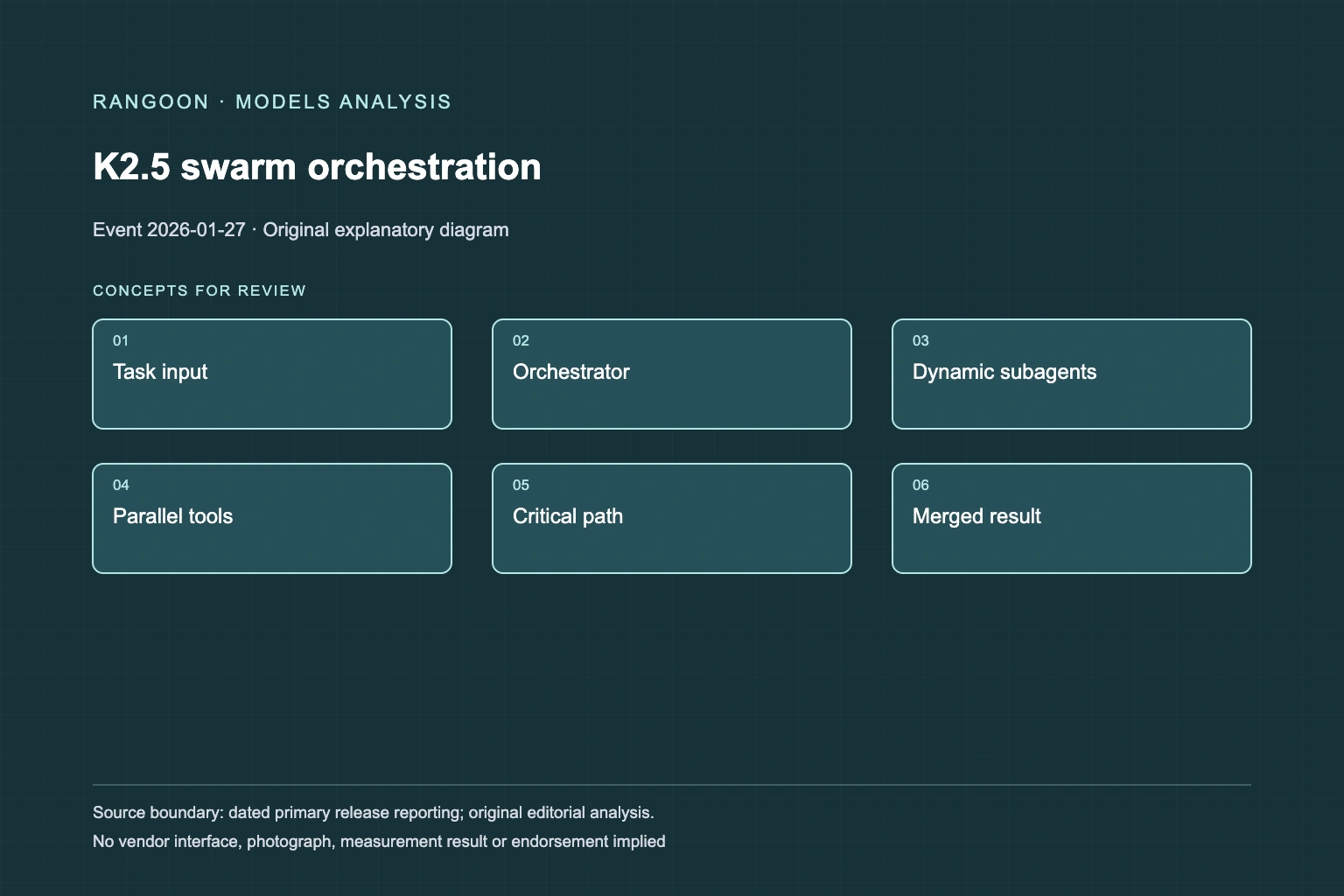
Moonshot released K2.5 Agent Swarm as a research preview. Its blog says a trainable orchestrator decomposes tasks and dynamically instantiates frozen subagents, with up to 100 subagents and up to 1,500 coordinated tool calls in its description. Parallel-Agent Reinforcement Learning, or PARL, used rewards for parallel instantiation, subtask completion, and overall task performance. The design targets a shorter critical path, not a blanket assertion that more agents improve every request.
The company noted a failure mode it calls serial collapse, where an orchestrator falls back to sequential work despite parallel capacity. It also described a reward-hacking risk in spawning many subagents without useful decomposition. Those caveats make the reported speed comparisons conditional. Parallel work helps when subtasks are independent enough to overlap and when coordination overhead does not dominate; it can add cost, duplicated evidence, and inconsistent intermediate conclusions on tightly coupled tasks.
Open weights and beta orchestration did not create a universal agent contract[source 1][source 3]
The official Kimi K2.5 model card currently labels the checkpoint modified-MIT and provides a local image-text inference path. That is useful artifact context for the published checkpoint, but the card is maintained after the launch and should not stand in for a January product-availability receipt. A team needs to preserve the exact model revision and license text it uses, especially when redistributing weights, serving them, or adapting them with new data.
K2.5’s vendor-reported benchmark and timing claims should remain attached to its configured tools and product mode. They do not prove general reliability, data access, or authorization to let an agent swarm operate on a live account or repository. The release advances a concrete architecture for parallel agent orchestration; it still leaves task decomposition, permissions, result verification, and side-effect control to the system that calls the model.
Sources
Continue reading