Kimi K2 Thinking update separated a reasoning mode from a turbo API tier
Moonshot AI’s November 7, 2025 forum announcement named Kimi K2 Thinking; its undated project page supplies separate technical context.
Historical reporting: Moonshot AI’s November 7, 2025 forum announcement is the dated event source. The linked Kimi K2 Thinking project page is official technical context but is undated; this article does not make a current access, price, benchmark, or capability claim.
Key takeaways
- The November update named separate Thinking and Thinking Turbo model identifiers.
- Moonshot described both for multi-step work, tool use, and function calling; these claims need task-specific tests.
- The linked technical page is supporting context, while the dated forum post fixes the historical event.
November 7 announcement named two thinking-model routes[source 1][source 2]
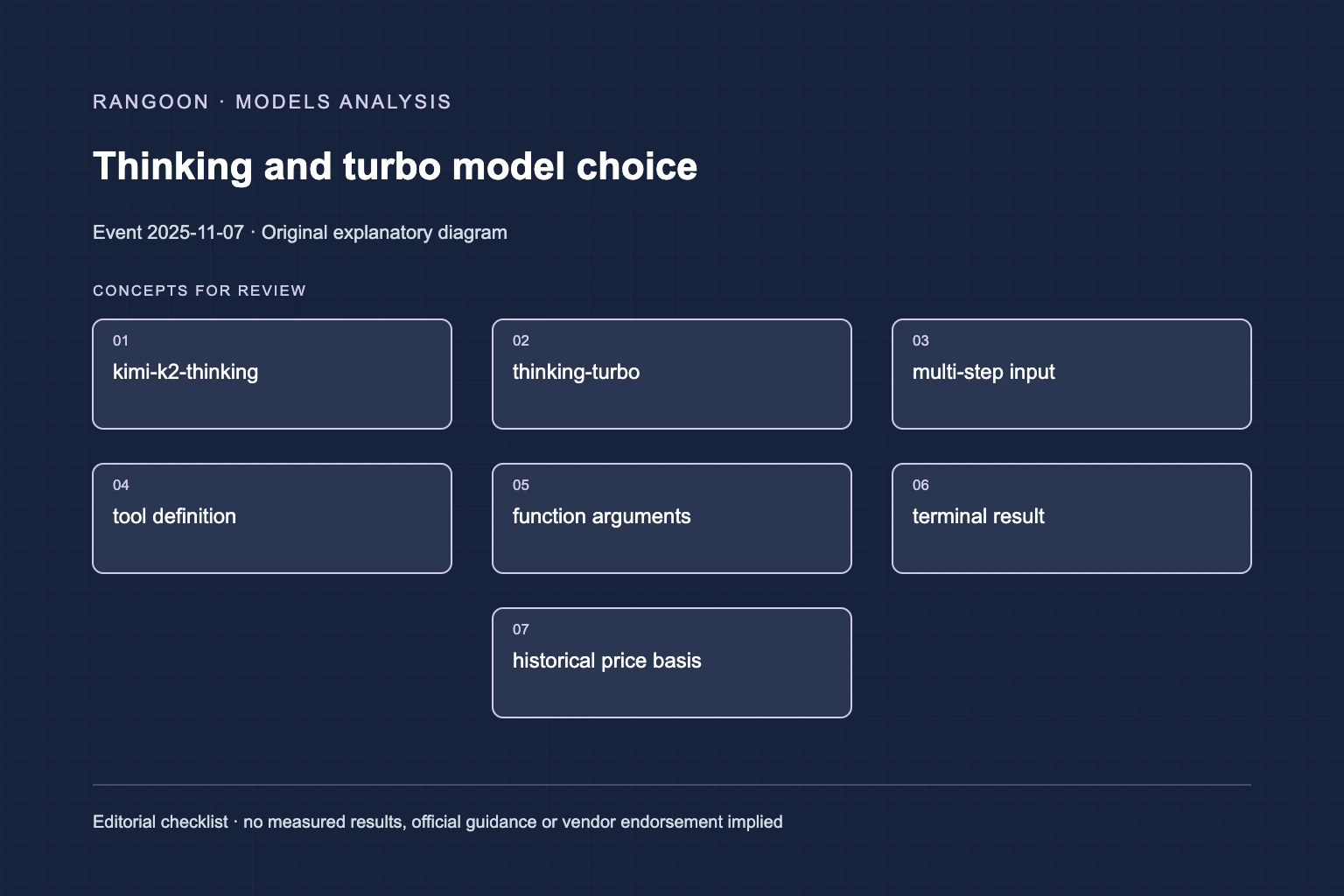
Moonshot AI’s November 7, 2025 forum announcement introduced `kimi-k2-thinking` and `kimi-k2-thinking-turbo`. The post described the pair as models for complex reasoning, multi-step instructions, and agent-like work such as tool use and function calling. It linked the official Kimi K2 Thinking technical page as further context, while the forum post supplies the date for this historical event.
Thinking Turbo arrived with a separate API pricing decision[source 1][source 2]
The same announcement paired the new model names with a price reduction for the existing `kimi-k2-turbo` model and said `kimi-k2-thinking-turbo` would launch at that new lower pricing. Moonshot explained the change through observed coding usage that was speed-sensitive and weighted toward large input contexts such as codebases, files, and histories. Those are supplier statements about the November API offer, not evidence that an application’s total agent cost or latency will match them.
Thinking and Thinking Turbo require explicit model-mode comparison[source 1][source 2]
The announcement supplies two identifiers, not a claim that they are interchangeable. A deployment should record which one handled a task, because model selection can alter response timing, context use, tool-call behavior, and the price basis attached to the run. The linked technical page is a useful source for model context, but its undated status means it should not be used to overwrite the dated announcement or infer a separate release day.
Analysis: long-input agent work needs a mode-aware measurement[source 1][source 2]
For this update, a meaningful evaluation holds the repository snapshot, tool definitions, request shape, and inference route fixed while comparing the two named models on multi-step coding and function-call fixtures. Measure whether the model selects the right tool, produces arguments that the host can parse, retains the relevant portion of a long input, and reaches a correct terminal result. That approach tests the November release claim in the area Moonshot identified, without converting a historical pricing or capability statement into a present-day service guarantee.
The announcement defined the intended task class before it supplied results[source 1]
Moonshot’s dated post places complex reasoning, multi-step instructions, tool use, and function calling in the stated task class for both new identifiers. It does not publish a task harness, a repository fixture, or a provider-independent comparison in the announcement itself. That boundary matters because the release names identify a model route, while an agent result also depends on tools, prompts, and the environment supplied by the caller.
The price change was part of the November API event, not a model-quality measurement[source 1]
The forum post says the lower turbo pricing took effect November 6 and that Thinking Turbo launched with the same new price structure. It explains the decision through coding workloads with large input material, including codebases, files, and histories. Those details describe the provider’s historical API offer; they do not show that either thinking model is cheaper or faster for a particular locally served workflow.
Sources
Continue reading