

Lightmatter’s Passage M1000 made photonic I/O a reference-platform claim
Lightmatter unveiled Passage M1000 on March 31, 2025, describing a 3D photonic-interposer reference platform for AI XPUs and switches with stated 114-Tbps optical bandwidth.
Historical reporting: Lightmatter unveiled the Passage M1000 3D Photonic Superchip on March 31, 2025. The company described a 4,000-square-millimeter multi-reticle active photonic interposer, 114 Tbps total optical bandwidth and planned summer 2025 availability. A later product page supplies maintained platform specifications. The announced bandwidth, power and connectivity figures are Lightmatter specifications or supplier claims, not an independent AI-workload benchmark, universal datacenter capacity or proof of customer deployment.
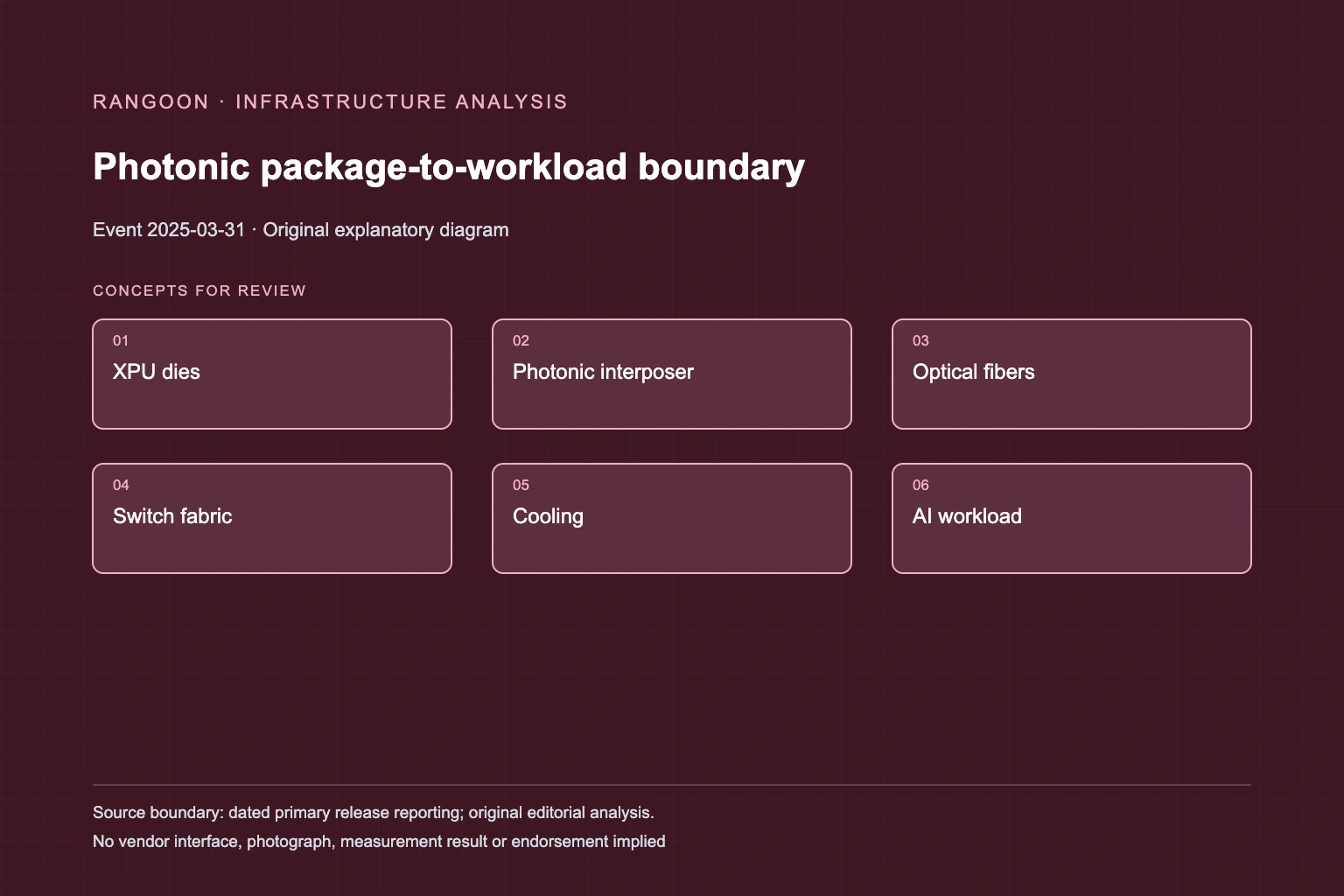
Key takeaways
- Passage M1000 was introduced as a reference platform for XPUs and switches, with availability planned for a later date.
- Optical-bandwidth figures describe a platform specification; application performance still depends on system topology and workload behavior.
- Large photonic packages add packaging, cooling, signaling and serviceability requirements that a bandwidth figure alone cannot resolve.
The M1000 announcement described a photonic reference platform[source 1][source 2]
On March 31, 2025, Lightmatter unveiled Passage M1000, which it called a 3D Photonic Superchip for next-generation XPUs and switches. The company described a multi-reticle active photonic interposer of more than 4,000 square millimeters and stated 114 Tbps of total optical bandwidth. Those details identify the announced platform’s intended scale and packaging approach. They do not show that the platform had been installed in a customer datacenter, connected to a particular accelerator or measured on a named AI model at the time of the release.
Lightmatter said M1000 would be available in summer 2025 with its Guide light engine. That is a planned availability statement, not proof of shipment, qualification or supply at the March event. A later product page gives maintained specifications and describes an evaluation-kit form, but a maintained marketing page should not be used to turn a future availability claim into a March deployment fact. Separating unveiling, planned availability and later platform documentation keeps the product chronology intact.
Photonic I/O addressed a physical packaging constraint, not every network constraint[source 1][source 2]
The company explained that conventional electrical I/O is constrained by chip edges, then presented the M1000’s photonic interposer as a way to place I/O across a larger package area. This identifies a hardware design argument about I/O density and die complexes. It does not remove all constraints above the package. A working AI system still needs accelerators, memory, electrical interfaces, optical links, switches, protocols, collective libraries, power distribution, cooling and software that schedules real jobs across the available hardware.
Lightmatter’s stated 114-Tbps figure is a platform specification. It does not translate directly into model-training throughput, inference latency or an accelerator count without a topology and workload. Effective bandwidth can be shaped by protocol overhead, traffic distribution, endpoint behavior, error handling and application communication. Comparing a photonic interposer with another interconnect therefore requires clear definitions: total versus usable bandwidth, unidirectional versus bidirectional accounting, link conditions and the system boundary being measured. The launch did not provide an independent cross-platform application benchmark.
A large package made power, thermal and service design relevant[source 1][source 2]
The March release listed 256 optical fibers, 1,024 electrical SerDes, eight wavelengths and stated support for 1.5 kW of power delivery in an integrated advanced package. Those are supplier specifications that help show why the product is a system-packaging story rather than a bare optical component. They do not prove that every supported configuration can run continuously at a particular power level or that a customer system reaches a stated efficiency. Thermal design, power conversion, laser integration, fiber attachment and mechanical serviceability become part of the engineering boundary.
The later M1000 product page adds maintained descriptions of optical fibers, power delivery and switching features. It is useful as a current artifact record, but the historical launch claims remain anchored to the March release. A specification page can also change as a product evolves. For a deployment claim, the relevant evidence would identify the evaluated hardware revision, cooling environment, optical assembly, firmware, traffic pattern and observation period. Without those details, the published figures should remain attributed to Lightmatter rather than generalized into a datacenter-performance result.
A photonic platform still needed system-level qualification[source 1][source 2]
Photonic interconnect can change how an AI system moves data, but it must coexist with electrical signaling, packaging processes and the operational practices of a rack or cluster. Qualification has to cover reliability, link errors, thermal cycling, service procedures and interactions with the surrounding compute and network design. A demonstration of a reference platform can be valuable engineering evidence, while it is not equivalent to a production deployment across many customer workloads. That distinction prevents a product unveiling from becoming a claim that broad AI infrastructure has already adopted the technology.
The March 2025 event establishes Lightmatter’s M1000 announcement and the company’s stated architecture, specifications and future availability. It does not establish delivered capacity, independent energy performance, customer volume or model-level acceleration. Later tests, orders or deployments could add each of those facts if they disclose configuration and results. Until then, the accurate account is a supplier reference-platform announcement for photonic scale-up connectivity, with product and deployment outcomes kept as separate questions.
Sources
Continue reading
Related reading
 News analysisUCIe 3.0 raised chiplet-link rates and added manageability work3 min read
 News analysisNVIDIA supply-chain capacity plans make packaging, test and optics explicit infrastructure constraints3 min read
 News analysisTSMC’s Arizona expansion announcement separated a $100 billion plan from current fab output4 min read