

NVIDIA supply-chain capacity plans make packaging, test and optics explicit infrastructure constraints
NVIDIA’s October capacity agreements show why an AI-factory plan needs separate evidence for substrates, packaging, test, optics and delivered systems.
Historical reporting: NVIDIA announced these capacity agreements on October 21, 2026. The figures, partner plans and timing are NVIDIA forward-looking statements, not records of completed factories, delivered systems or available compute. Analysis sections are independent operator guidance.
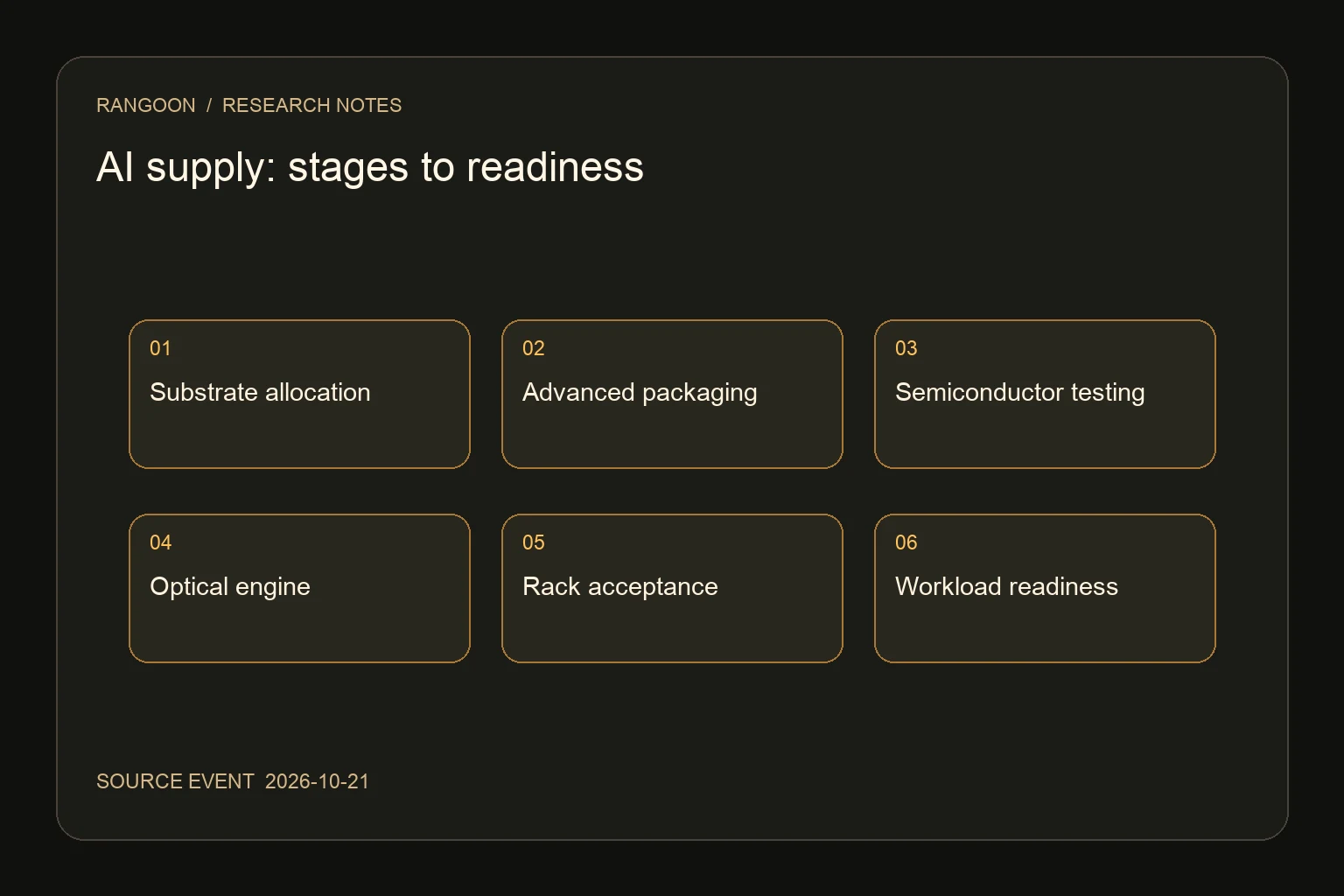
Key takeaways
- A capacity reservation or expansion target is a supply-chain commitment, not evidence that a data center has usable GPUs.
- Substrates, packaging, testing and optical engines each need their own readiness record because a bottleneck in one stage can delay the finished system.
- Procurement plans should track promised capacity separately from qualified parts, accepted racks and workload-ready clusters.
What NVIDIA announced[source 1]
NVIDIA said on October 21 that it had plans with Amkor, IBIDEN, KYEC, Samsung Electro-Mechanics, SPIL and Unimicron to expand its AI-infrastructure supply chain. The release names package substrates, advanced packaging, semiconductor testing and optical engines for co-packaged optics as distinct manufacturing stages. It describes projected expansion targets and future ramp dates. The stated plans include a 2.5-times increase in aggregate substrate capacity over three years, Amkor advanced-packaging expansion, a KYEC U.S. testing buildout supported by a capacity-reservation advance, and SPIL optical-engine expansion. These are vendor-reported plans and targets, not a report of currently installed capacity or shipped AI factories.
The timeline is uneven by design. NVIDIA describes some new testing volume as targeted for 2027, while several substrate and packaging targets extend into 2028. That matters because a finished accelerator depends on more than a die. It needs a substrate, packaging, testing and system integration before it can become a qualified component in a deployed rack. A public announcement can establish that suppliers intend to add capacity, but it cannot establish that a particular buyer will receive allocation, that yields will meet plan, or that a site has power and cooling ready when hardware arrives.
Analysis: use stage-specific readiness gates
An infrastructure program should avoid one undifferentiated label such as “GPU supply secured.” Replace it with a ledger that names each stage: supplier allocation, component qualification, assembly, factory acceptance, logistics, rack integration, network validation and workload acceptance. Each stage should have an owner, expected evidence, quantity and a date range. This makes a delay diagnosable. A missed test capacity date and a delayed facility energization need different mitigations, even if both move a deployment schedule.
Record dependencies in both directions. A rack may be available before a site’s network fabric is accepted; an optical-engine shortage may affect a planned topology without changing an accelerator purchase order. Conversely, an allocated component does not reserve a contractor slot, switch port, power transformer or operating team. A useful plan shows those joins explicitly. Reviewers should be able to ask which exact evidence moves an item from “reserved” to “accepted,” then find the purchase, serial, qualification or commissioning record rather than a marketing announcement.
Analysis: keep forecasts separate from operating claims
Capacity announcements can still justify scenario work: identify workloads sensitive to packaging lead times, architectures that depend on optical scale-out, and schedule margin a program needs. But a scenario is not a commitment. Keep base, constrained and accelerated cases separate, with a short explanation of which supplier date or local facility milestone changes each outcome. This prevents a capacity headline from becoming a promise to application teams.
For governed AI services, connect delivery evidence to authority evidence only at activation. A cluster should not receive production credentials merely because equipment was purchased or installed. Require a separate acceptance record for identities, network segmentation, observability, change control and rollback. That sequencing does not predict every supply-chain failure. It does make the handoff from hardware program to workload operator auditable and reduces pressure to treat an announced future capacity figure as present production capability.
Sources
Continue reading
Related reading
 News analysisNVIDIA’s memory codesign post highlights a practical boundary between capacity and usable agent throughput3 min read
 News analysisNVIDIA introduced NVLink Fusion for semi-custom AI infrastructure3 min read
 News analysisRTX PRO Blackwell made workstation selection a workload-placement decision3 min read