

Maine’s LD 1727 made consumer-facing AI-chatbot disclosure a state unfair-trade-practices issue
Maine signed LD 1727 on June 12, 2025, requiring clear notice when a consumer-facing AI chat may mislead a reasonable consumer into believing it is human.
Historical reporting, not legal advice: Maine’s official enacted law records LD 1727, “An Act to Ensure Transparency in Consumer Transactions Involving Artificial Intelligence,” as approved June 12, 2025, Public Law 2025 chapter 294. Maine’s codified text defines an AI chatbot and requires a clear and conspicuous notice when use in trade or commerce may mislead a reasonable consumer into believing the consumer is engaging with a human. The article does not claim the rule governs every noncommercial interaction, every automated service or every jurisdiction.
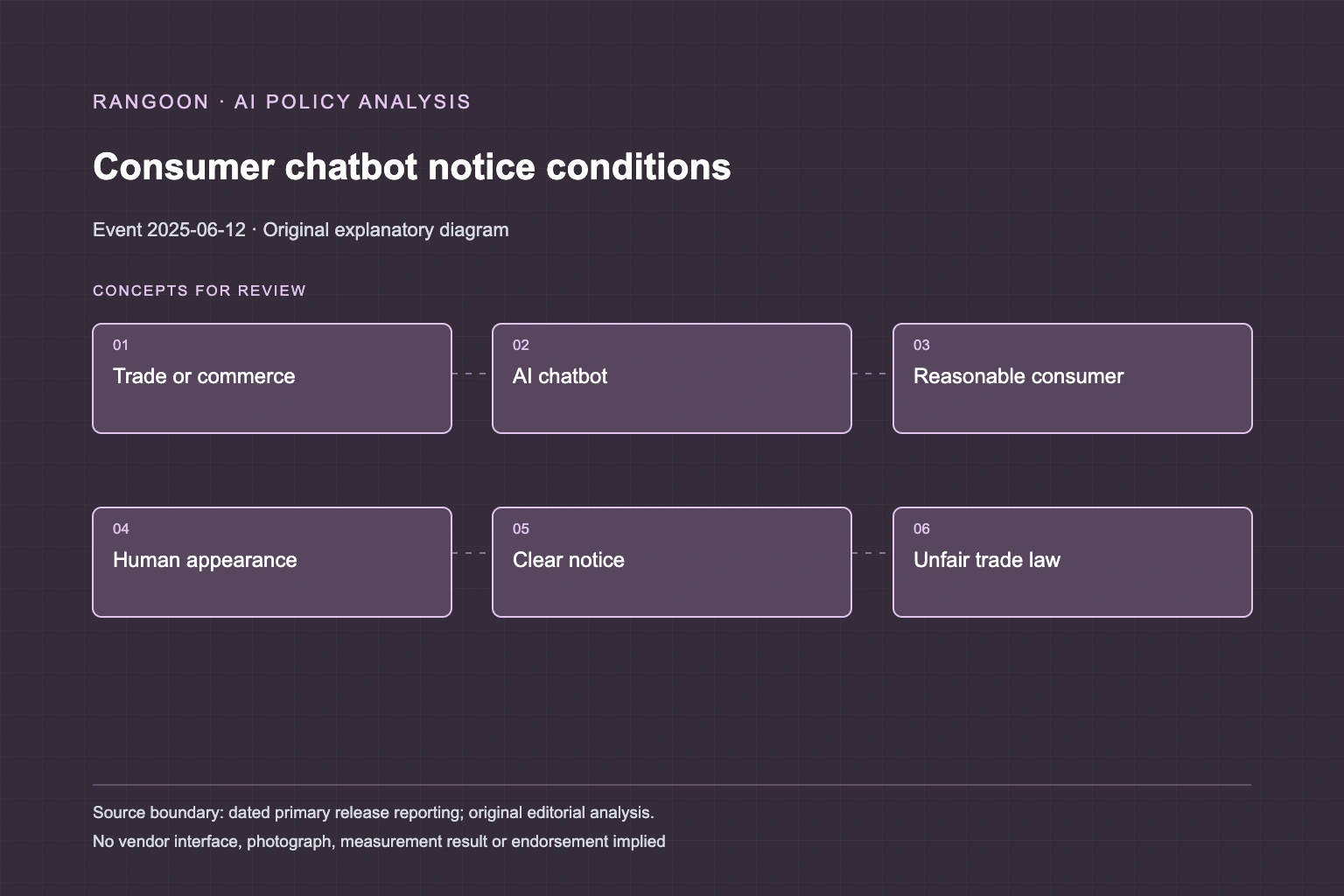
Key takeaways
- Maine’s June 12 event was a signed consumer-transactions law with a deception-focused disclosure test.
- The statute targets situations that may mislead a reasonable consumer into believing a chatbot interaction is human.
- A notice is one interface control; it does not prove output accuracy, fair dealing or appropriate handling of consumer data.
The official record dates the consumer-transparency act to June 12[source 1][source 2]
Maine’s Legislature records LD 1727 as enacted and signed by Governor Janet Mills on June 12, 2025, with the chapter designation Public Law 2025, chapter 294. The bill title identifies consumer transactions involving artificial intelligence, which is more precise than calling it a general state AI code. Its placement matters too: the enacted provision sits in Maine’s trade and commerce statutes. The event therefore belongs in a policy timeline about consumer-facing system design, not as proof that Maine licensed, certified or approved a class of AI products. The record establishes enactment on that date. It does not establish when every company learned of the change, changed an interface, received enforcement guidance or had a particular transaction reviewed by a court.
The statutory trigger turns on a potentially misleading appearance of human interaction[source 2]
Maine’s codified text defines an artificial intelligence chatbot as a software application, web interface or computer program that simulates human conversation and interaction through text or audio communications. It then prohibits a person from using such a chatbot, or other computer technology, in trade or commerce in a way that may mislead a reasonable consumer into believing the consumer is engaging with a human unless the person gives clear and conspicuous notice that the interaction is not with a human. This is not an article about whether a model can sound natural. It is a consumer-interaction rule with a stated condition and notice requirement. A transcript, a humanlike avatar or a brand name alone does not answer the statute’s full question; context and the actual communication flow remain material.
The law connects the notice rule to Maine’s unfair-trade-practices framework[source 1][source 2]
The statute says a violation of the disclosure requirement is a violation of the Maine Unfair Trade Practices Act. That link explains why the event is about consumer transactions rather than an abstract AI-ethics principle. It does not mean every disappointing automated answer is automatically a violation, and it does not establish a private result for a particular dispute. The law’s terms focus on trade or commerce, an AI chatbot or other computer technology, potential misleading human appearance and clear, conspicuous notice. Those are separate elements. A product team should avoid reducing the rule to a tiny footer placed outside the interaction or assuming that an initial label resolves later messages that adopt a human identity. This historical account records the statutory structure, while current application depends on the complete law and facts.
Disclosure design should remain inspectable across an entire consumer interaction[source 1][source 2]
A useful operational response is to preserve evidence of when and how a consumer was told they were interacting with automated technology. For example, a product can retain the interface version, notice placement, channel, locale, timestamps and any handoff to a human agent. Those records help distinguish a designed disclosure from an assumed one. They do not create a safe harbor or replace legal review. Teams also still need to handle accuracy, sensitive data, accessibility, escalation and false claims made by the system. Maine’s rule supplies one narrow consumer-transparency boundary: do not let a trade-or-commerce chatbot interaction potentially mislead a reasonable consumer that a human is present without clear and conspicuous notice. It does not certify a chatbot, authorize impersonation or supply a complete governance program.
Sources
Continue reading
Related reading
 News analysisOregon’s AI Advisory Council delivered a five-action state-government plan3 min read
 News analysisNevada’s AB 325 put human final-decision boundaries around emergency AI use3 min read
 News analysisConnecticut’s SB 10 put clinical-peer review ahead of AI or algorithms for a defined insurer decision3 min read