

Connecticut’s SB 10 put clinical-peer review ahead of AI or algorithms for a defined insurer decision
Connecticut signed SB 10 on June 24, 2025, barring health carriers from using AI or another algorithm instead of clinical-peer review for adverse determinations.
Historical reporting, not legal advice: Connecticut’s official bill history records Governor Lamont’s June 24, 2025 signature of SB 10 as Public Act 25-94. The enacted bill text says a health carrier may not use a system employing AI, or another algorithm, in lieu of a clinical-peer review to evaluate the clinical appropriateness of an adverse determination under the specified contract relationship. It is not a blanket prohibition on every health-care use of AI, a statement about all insurers or a finding about any particular claim.
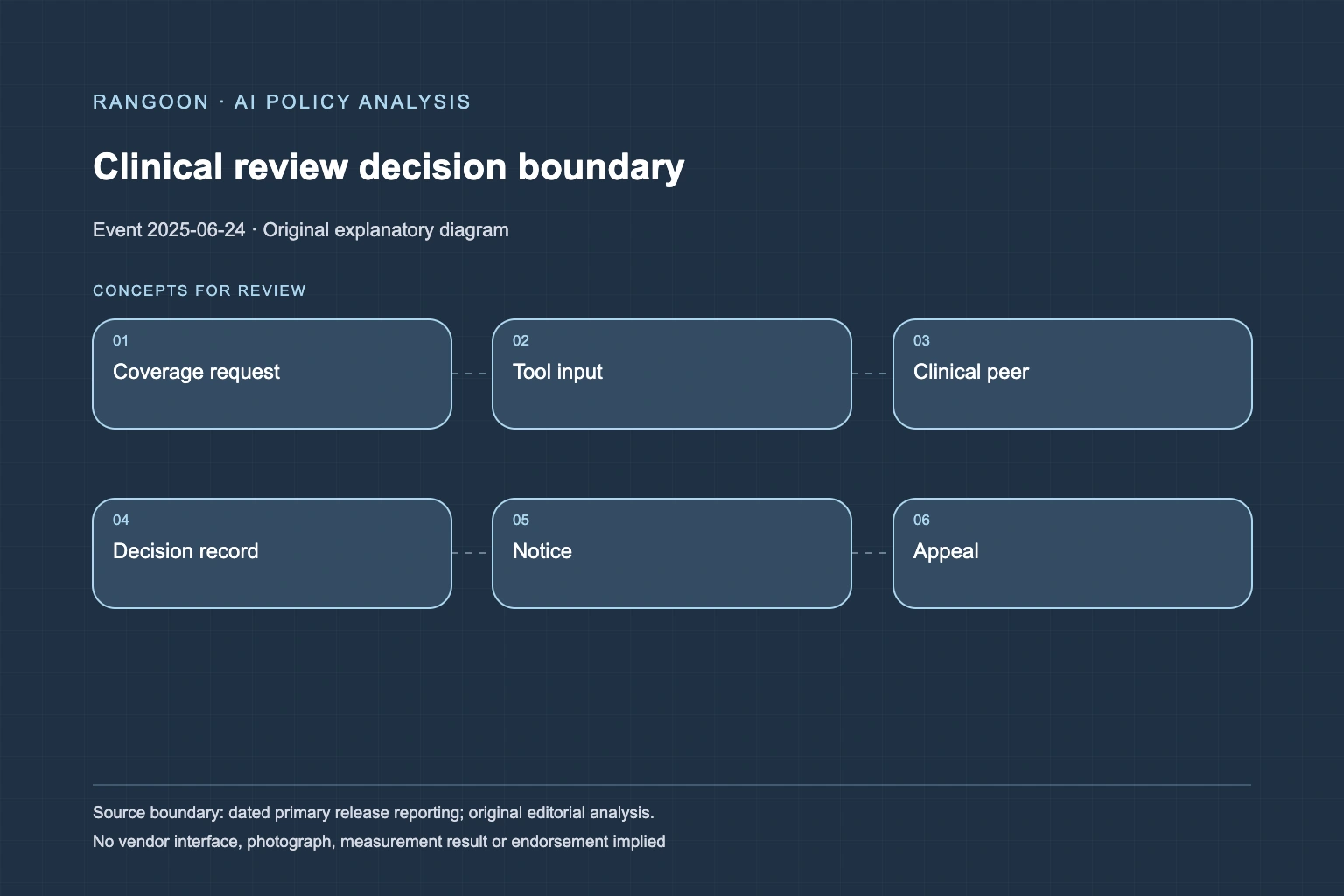
Key takeaways
- The event is a signed Connecticut public act with a narrow utilization-review rule, not a general ban on health-care AI.
- The operative comparison is between an AI or algorithmic system and a clinical-peer review for the specified adverse-determination evaluation.
- The bill’s separate effective-date structure matters: signature, public-act assignment and implementation dates are different facts.
The June event was a signing and public-act record, not an announcement of an AI product[source 1][source 2]
Connecticut Governor Ned Lamont signed Substitute Senate Bill 10 on June 24, 2025, according to the General Assembly’s official bill history. The General Assembly had assigned the measure Public Act 25-94 on June 11, after the two chambers completed their work. The act is a broad health-insurance and patient-protection measure; its AI-related language is one part of a larger package involving utilization review, coverage and other insurance rules. That sequence is important for an archive: legislative passage, public-act designation, gubernatorial signature and effective dates do not all occur on the same day. This article treats June 24 as the signed-policy event and does not describe the earlier calendar steps as a completed legal obligation.
The text addresses a clinical-peer review boundary for an adverse determination[source 1][source 2]
The enacted text directs health carriers not to use a system employing artificial intelligence, or any other algorithm, in lieu of review by a clinical peer when evaluating the clinical appropriateness of an adverse determination under the covered contractual arrangement. The wording is narrower than a claim that software can never assist an insurer. It identifies a decision point and preserves a clinical-peer review rather than allowing an AI or algorithm to stand in for it. The official legislative analysis describes the same relationship as a prohibition on AI or algorithms instead of a clinical peer for that evaluation. An adverse determination has defined meaning in the surrounding utilization-review framework; the provision should not be stretched into a statement about diagnosis, scheduling, provider documentation, consumer chat tools or every other health-data workflow.
The measure separates a signed act from later effective provisions[source 1][source 2]
SB 10’s text assigns different effective dates to different sections. The AI-related utilization-review language appears in the part of the bill made effective January 1, 2026, while other provisions in the broader act use other dates. That is why a timeline needs at least three labels: June 24, 2025 for the Governor’s signature; the relevant provision’s stated effective date; and any later operational or regulatory activity. A retrospective cannot assume that a signature instantly changed every carrier workflow or that every implementation question had already been answered. The legislative material establishes statutory text and dates. It does not supply records for every insurer’s systems, vendor contract, model configuration, human-review practice or appeal decision.
A clinical-review rule still needs traceable decision evidence[source 1][source 2]
For teams designing an AI-assisted review workflow, the policy lesson is evidence discipline rather than a generic claim of “human in the loop.” The relevant record should identify the decision type, the clinical peer who performed the required review, information considered, when a tool was used, and which person reached the documented conclusion. That design approach helps distinguish assistance from substitution. It also makes internal audit and appeal review possible without claiming that logging alone satisfies a statute. This reporting does not advise a carrier, provider or patient on compliance. It records that Connecticut created a defined clinical-peer boundary within its utilization-review law and that a real deployment must be assessed against the full current statute, regulations, contracts and facts of the case.
Sources
Continue reading
Related reading
 News analysisOregon’s AI Advisory Council delivered a five-action state-government plan3 min read
 News analysisNevada’s AB 325 put human final-decision boundaries around emergency AI use3 min read
 News analysisMaine’s LD 1727 made consumer-facing AI-chatbot disclosure a state unfair-trade-practices issue3 min read