

MiniMax-M1 paired a million-token context claim with two stated thinking budgets and vendor benchmarks
MiniMax introduced open-weight M1 on June 16, 2025, with a stated 1M-token context and separate 40K and 80K thinking-budget variants.
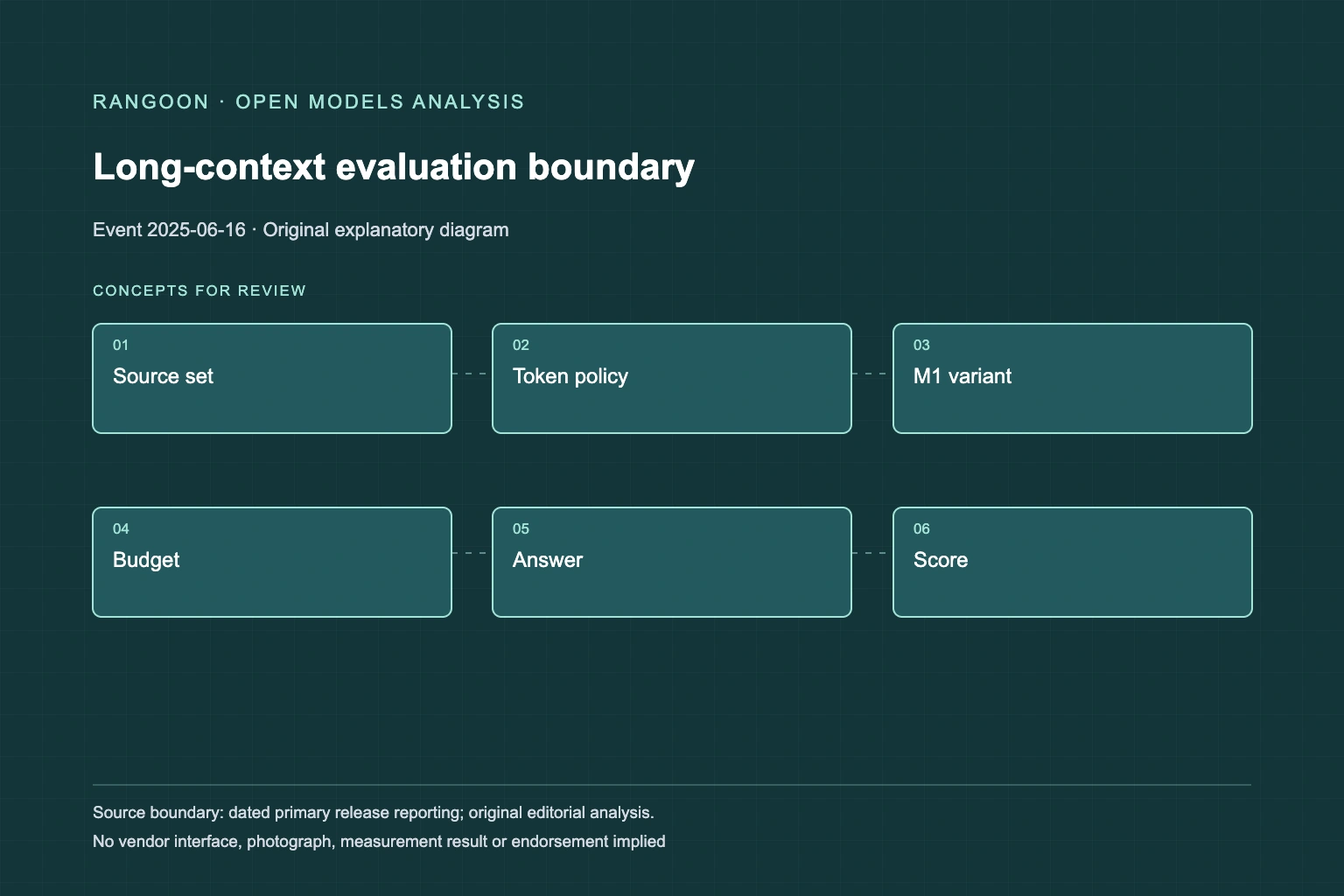
Historical reporting: MiniMax announced MiniMax-M1 on June 16, 2025. Its launch page described an open-source hybrid-attention reasoning model, a stated one-million-token context window, an 80K reasoning-output figure and links to official weights and technical report. The contemporaneous MiniMax technical report was submitted June 16 and distinguishes 40K and 80K thinking-budget versions. MiniMax’s cost, efficiency and benchmark comparisons are supplier-reported results tied to its methods; they do not prove another runtime can accept a million tokens, reproduce an evaluation, or make a tool-using workflow safe.
Key takeaways
- MiniMax-M1’s launch identified two thinking-budget variants, so “M1” was not a sufficient evaluation configuration.
- A stated one-million-token context ceiling is an input-capacity claim, not evidence that all relevant facts are retained or used well.
- Reported benchmark, cost and tool-use results need their named harnesses and do not transfer automatically to another stack.
The June 16 event combined a model release with a contemporaneous technical report[source 1][source 2]
MiniMax dated its M1 announcement June 16, 2025 and called it an open-source, large-scale hybrid-attention reasoning model. The linked technical report was submitted the same day and calls the release open-weight. It describes a hybrid mixture-of-experts architecture, built from the earlier MiniMax-Text-01, with 456B total parameters and 45.9B activated per token. The report also says MiniMax released two M1 versions with 40K and 80K thinking budgets. That is a meaningful configuration distinction: a family-level name does not identify how much test-time reasoning a selected artifact is meant to use. The date and artifacts establish a public release record; they do not establish service availability, compliance status or a completed deployment.
A one-million-token context claim and thinking budget describe capacity boundaries, not answer quality[source 1][source 2]
MiniMax said M1 supported a one-million-token context window and an 80,000-token reasoning output. The technical report says the 40K variant represented an intermediate phase of the 80K training. Context and reasoning budgets are different limits. Context affects how much material a request may supply, while a thinking budget affects work the model may perform before returning an answer. Neither tells an adopter which documents were relevant, whether a runtime accepts the same tokenization, whether the model ignored a critical passage, or whether an application can afford the resulting latency. A valid long-context evaluation needs an exact model version, input construction policy, truncation behavior, request time limit, output cap and evidence-based scoring for retrieval and final answer quality.
MiniMax’s benchmark and efficiency language remained tied to its published conditions[source 1][source 2]
The launch page reports MiniMax results on 17 benchmark sets, including SWE-bench validation, long-context tasks and TAU-bench tool use. It also compares its compute use and prices with other models. The report describes hybrid attention and a reinforcement-learning method called CISPO, then states its own training and evaluation results. These are material vendor claims, but they need their reported setup, version and scoring rules. A benchmark score does not prove that a different coding repository, a private document collection or a connected tool system has the same result. Tool-use evaluation is especially incomplete without the available tool list, schema validation, side-effect controls and terminal-condition checks. A result can show a model performed under one harness without supplying authority to perform real actions.
M1’s open release called for an artifact-to-runtime record rather than a generic model assertion[source 1][source 2]
MiniMax’s announcement says complete weights and a technical report were available through its official accounts and notes third-party inference projects. That makes an adoption path inspectable, but it also creates several mutable layers: source weights, a chosen 40K or 80K variant, conversion, runtime version, context policy, prompt format and tool adapter. A team should pin each layer and run a repeatable suite covering long input selection, timeouts, malformed outputs, tool arguments and failure recovery. Price and performance statements from June 2025 should remain historical claims, because availability, endpoint behavior and commercial terms can change. The bounded news conclusion is that MiniMax released the stated M1 artifacts and described their architecture and evaluation framing. It is not proof that a later model alias, a local port or an agent workflow has equivalent capability.
Sources
- MiniMax News: MiniMax-M1, the open-source hybrid-attention reasoning model (June 16, 2025)
- MiniMax: MiniMax-M1 technical report (June 16, 2025)
Continue reading
Related reading
 News analysisAI21 positioned Jamba 1.6 for private enterprise deployment, while keeping context and benchmark claims testable3 min read
 News analysisBoltz-2 put binding-affinity prediction beside structure prediction3 min read
 News analysisUltralytics released YOLO26 with optional NMS-free real-time vision inference3 min read