Boltz-2 put binding-affinity prediction beside structure prediction
The Boltz team introduced Boltz-2 on June 6, 2025, reporting an open model for joint biomolecular structure and binding-affinity prediction.
Historical reporting: the Boltz team announced Boltz-2 on June 6, 2025 and released its technical report. Predicted affinity and reported benchmark scores are not experimental binding confirmation or clinical guidance.
Key takeaways
- Boltz-2 joined a structure prediction task with a binding-affinity prediction task.
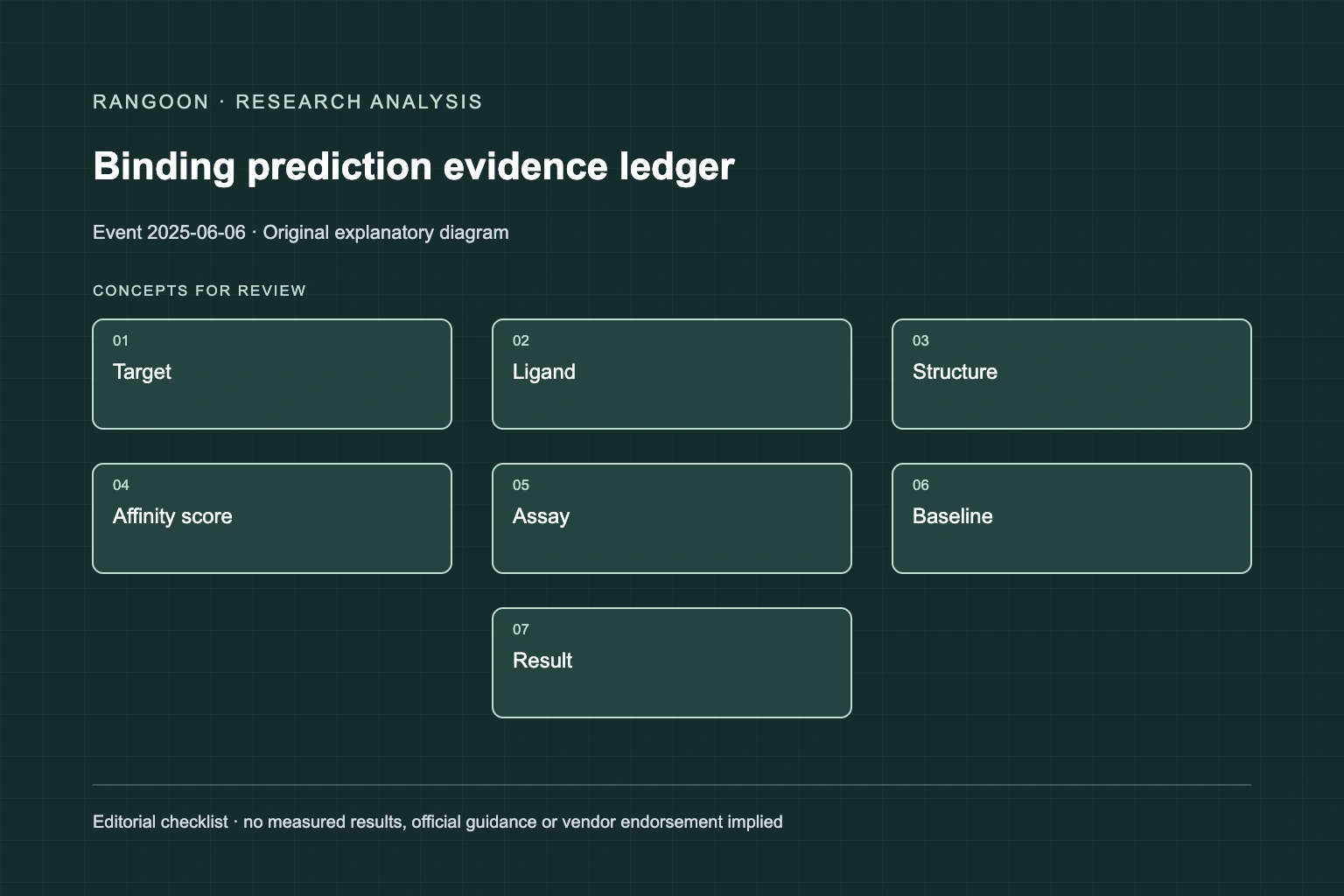
- Affinity evaluation needs target, ligand, assay and data-split context.
- In-silico ranking cannot establish potency, selectivity, safety or therapeutic value.
The June release expanded the target beyond structure[source 1][source 2]
The Boltz team announced Boltz-2 on June 6, 2025, describing an open biomolecular foundation model intended to predict both complex structures and binding affinities. This matters because a plausible complex geometry and a useful affinity estimate are different scientific targets. The release and technical materials support inspection of the authors’ method and reported comparisons. They do not establish that a predicted interaction binds in an assay, that a ranked molecule is selective, or that a computational result has a medical implication. Those require their own experimental and regulatory evidence.
Joint outputs should be judged against their separate observables[source 1][source 2]
Structure and affinity labels arise from different measurements and sources of uncertainty. A model can produce a geometrically plausible pose yet mis-rank a series when solvation, flexibility, assay conditions or data bias matter. Conversely, an affinity score may be useful for ranking within a defined set without proving a detailed mechanism. Evaluation must name the target family, ligand representation, split strategy, assay type, metric and baseline. A headline comparison with a physics-based method belongs to the stated benchmark conditions, not to every protein-ligand pair a user may submit.
Predicted binding is not a drug-development conclusion[source 1][source 2]
Binding is only one part of a compound-development decision. Potency, selectivity, permeability, metabolism, toxicity, formulation and clinical benefit are distinct questions. A model output should be reported as a computational prioritization signal, with model revision and input provenance attached, rather than as proof of efficacy. This article offers no molecule-design instructions or medical advice. It distinguishes model prediction from laboratory evidence because a single affinity number can otherwise be misread as a broad statement about a candidate’s value or safety.
Ranking studies need prospective and negative controls[source 1][source 2]
To evaluate a model for a new target, hold out a prospective set before scoring and compare the model’s ranked list with a transparent baseline. Include known non-binders or decoys where appropriate, then record assay conditions, replicate variability and failures to obtain material. Test whether a score remains useful across chemical series rather than only within one familiar scaffold. If a score triggers synthesis, preserve the decision threshold and all tested candidates so later analysis can assess enrichment rather than only count an isolated successful hit.
Analysis: co-folding claims should preserve the assay boundary[source 1][source 2]
Boltz-2 is a good archival example of an AI research release that spans two related but non-interchangeable molecular outputs. The reporting discipline is to keep pose, affinity and downstream biological claims on separate ledgers. The release calls out protein-small-molecule affinity prediction; that named output must be evaluated with a target, ligand set and assay definition rather than borrowed from a structure-only benchmark. Prospective measurements remain the evidence that turns an in-silico ordering into a scientifically useful ranking for a defined target series.
A binding-affinity model should earn confidence through prospective, measured rankings with explicit assay conditions, not through a structure image that makes a modeled complex appear experimentally observed.
Sources
- Boltz: Introducing Boltz-2 (June 6, 2025)
- Boltz project repository (June 6, 2025)
Continue reading