Mistral Medium 3 framed model choice around cost and deployment claims
Mistral introduced Medium 3 on May 7, 2025. Its benchmark, price, and deployment claims require a workload-specific quality and cost basis.
Historical reporting: Mistral’s May 7, 2025 Medium 3 release announced the model; its documentation records the version separately. The analysis below is original editorial analysis; it does not claim present availability, performance, or support.
Key takeaways
- On May 7, 2025, Mistral introduced Mistral Medium 3.
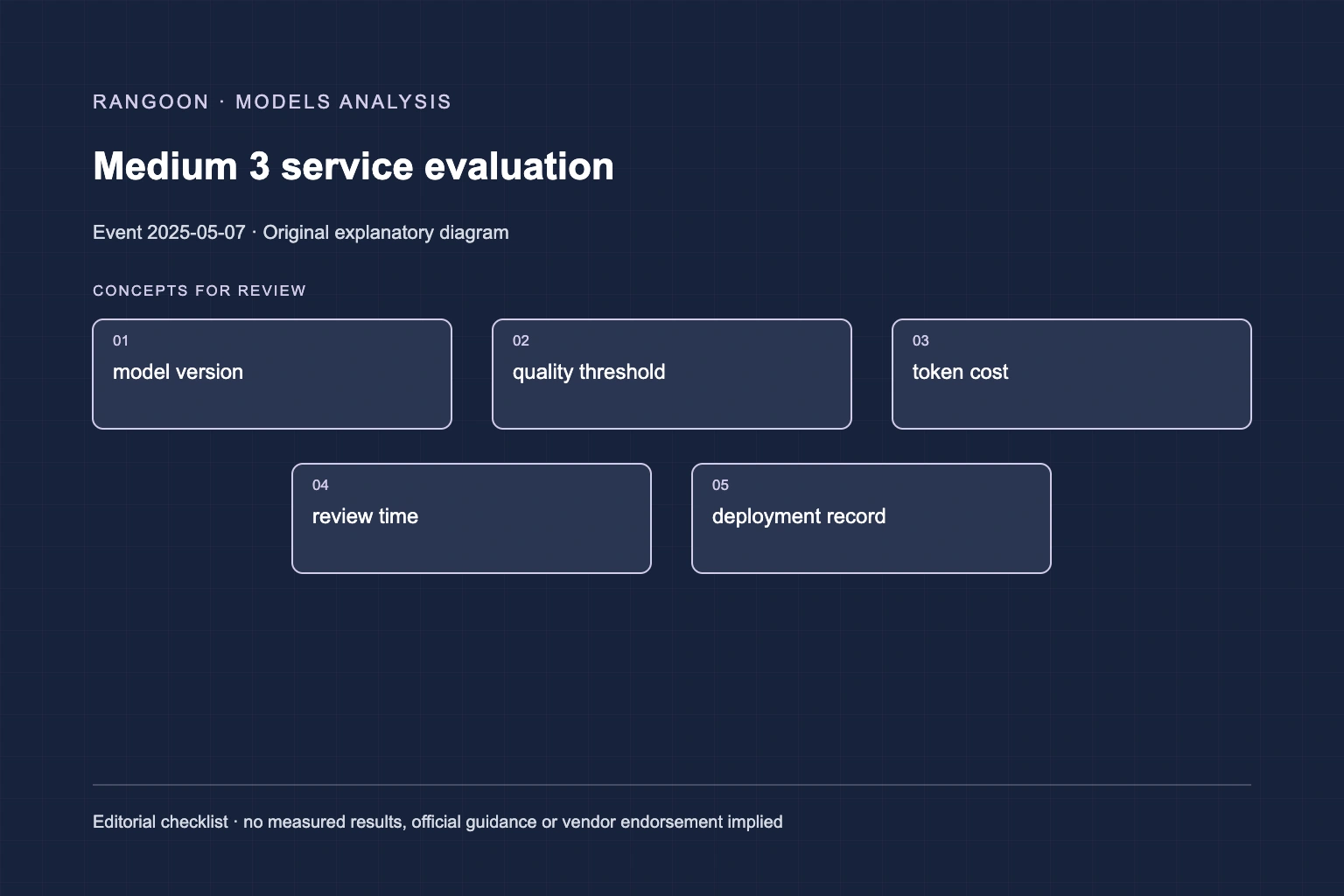
- Cost comparisons should include input tokens, output tokens, retries, context length, caching, parallelism, and the rate of human correction.
- Mistral’s May 2025 release is evidence of its stated Medium 3 positioning. It does not prove current pricing, capacity, or results in another environment.
What Mistral announced[source 1][source 2]
On May 7, 2025, Mistral introduced Mistral Medium 3. Its announcement positioned the model against larger systems with vendor-reported benchmark, cost, and enterprise-deployment claims. These are meaningful selection inputs because they name a model and intended use, but they remain conditional on Mistral’s stated configuration and commercial assumptions.
Mistral’s model documentation provides a distinct product record with the version identifier. It can establish which model family was documented, while the launch post carries the dated claims. Neither source is a bill for a particular traffic pattern or a proof that a local evaluation will match a supplier chart.
Editorial analysis: measure cost per accepted outcome
Cost comparisons should include input tokens, output tokens, retries, context length, caching, parallelism, and the rate of human correction. A cheaper completion that creates more review work is not necessarily a cheaper completed task.
Choose a quality threshold before optimizing cost. For an extraction job it may be parse validity and recall; for a support draft it may be factual grounding and tone; for a code path it may be passing tests. The threshold makes tradeoffs reviewable.
Editorial analysis: keep benchmark and workload separate
Vendor benchmarks reveal the provider’s reported measurement, not the acceptance conditions of an organization’s workflow. Re-run a small, versioned fixture set using the exact prompts, tools, documents, and output contract. Preserve errors and borderline cases.
If a comparison includes hosted and self-managed routes, report the operational differences too: patching, capacity reservation, data handling, incident ownership, and observability can change the decision even when one score is higher.
Editorial analysis: write the deployment basis
An adoption record should name the model version, serving route, quality gate, cost assumptions, failure policy, and reevaluation date. It should also state which claims came from Mistral and which were locally measured.
That separation lets a team revise one assumption without rewriting the historical release. It also prevents a dated launch announcement from becoming a current promise about price or availability.
Editorial analysis: retain the release boundary
Mistral’s May 2025 release is evidence of its stated Medium 3 positioning. It does not prove current pricing, capacity, or results in another environment.
A useful selection experiment is to run a hypothetical contract-review queue through two candidates with identical retrieval packets. Require each answer to cite the passage, flag missing terms, and produce a constrained summary. Then measure accepted work per dollar after reviewer corrections, not only first-pass preference. One model may look cheaper by token price while generating more unsupported summaries; another may meet quality but breach the interactive budget. This is why a vendor’s benchmark and price framing must be converted into a workload ledger. The scenario is illustrative editorial analysis, not a Mistral Medium 3 cost or quality measurement.
Keep the accepted examples and rejected examples in the decision record. They make a later price or quality revision visible without relying on recollection of a launch comparison.
Sources
Continue reading