Mistral Small 3.2 made a minor version a compatibility event
Mistral released Small 3.2 on June 20, 2025. A small-model update can still alter structured output, tool handling, latency, and downstream compatibility.
Historical reporting: Mistral’s change log records the June 20, 2025 Mistral Small 3.2 release; versioned documentation provides a separate model record. The analysis below is original editorial analysis; it does not claim present availability, performance, or support.
Key takeaways
- Mistral’s change log records the release of Mistral Small 3.2 on June 20, 2025, and its model documentation describes it as an update to the previous small model.
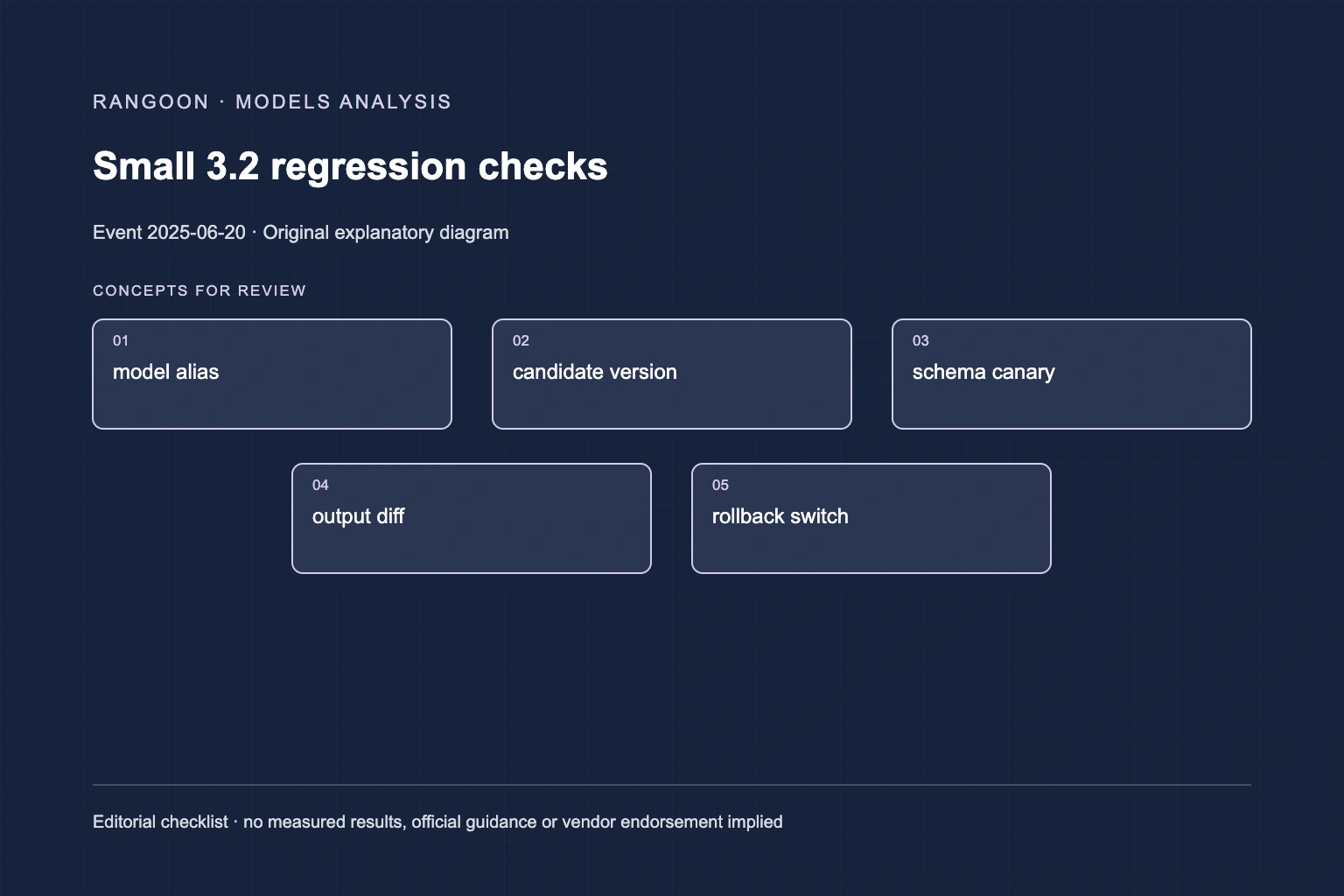
- Keep a canary set for schema validity, function arguments, stop sequences, prompt templates, language output, token limits, and latency.
- Mistral’s June 2025 material supports a Small 3.2 release and version record. It does not prove compatibility for a particular caller or current model lifecycle status.
What the version record establishes[source 1][source 2]
Mistral’s change log records the release of Mistral Small 3.2 on June 20, 2025, and its model documentation describes it as an update to the previous small model. This is a clean example of why a dot release is still an operational event: downstream callers may rely on behavior that is not visible in a family name.
The version page separately names mistral-small-2506 and lists declared features and context information. The changelog supplies the release date; the model page supplies product detail. Neither tells a caller whether an alias, hosted route, or local deployment switched on the same date.
Editorial analysis: test compatibility before alias movement
Keep a canary set for schema validity, function arguments, stop sequences, prompt templates, language output, token limits, and latency. Run it against the exact candidate version before changing an alias or default. This turns a minor-model update into an evidence-based compatibility decision.
If an application parses output, test malformed and adversarial inputs too. A model that improves average response quality can still introduce one token pattern that breaks a deterministic parser or an automation boundary.
Editorial analysis: use regression diffs
Compare old and new outputs side by side under locked prompts and sampling. Classify differences as intended quality changes, harmless variation, contract regressions, or unresolved. This is more useful than relying on a single aggregate preference score.
Monitor a small production-like cohort after a controlled rollout, but retain the pre-rollout fixture evidence. Live observations are influenced by user mix and surrounding system changes, so they should not replace the initial comparison.
Editorial analysis: keep model aliases auditable
Record which alias pointed to which dated version, when it changed, who approved it, and how to reverse it. Include the test report and any exceptions. This gives incident responders a clear configuration history.
The June release date remains a historical source fact. It should not be used as a claim that later aliases, integrations, or product states stayed unchanged.
Editorial analysis: retain the release boundary
Mistral’s June 2025 material supports a Small 3.2 release and version record. It does not prove compatibility for a particular caller or current model lifecycle status.
A minor-update canary should include a hypothetical response with valid JSON, one with a required null value, one ambiguous tool request, and one adversarial string containing quote characters. Validate byte-for-byte parse behavior and semantic field rules. If a change affects stop tokens or formatting, a natural-language evaluator may call the response better while an automation fails. Run the canary before and after a version move under fixed prompt and decoding settings. This is a subject-specific compatibility test for a small-model update, not an assertion that Small 3.2 changed any of those behaviors. It supplies the missing evidence between a release note and a safe alias change.
Maintain the canary in source control with a short explanation of each failure it guards against. The fixture then remains useful when later versions or serving frameworks change.
Sources
- Mistral Docs: change log (June 20, 2025)
- Mistral Docs: Mistral Small 3.2
Continue reading