

NIST’s preliminary Cyber AI Profile framed AI security in three linked roles
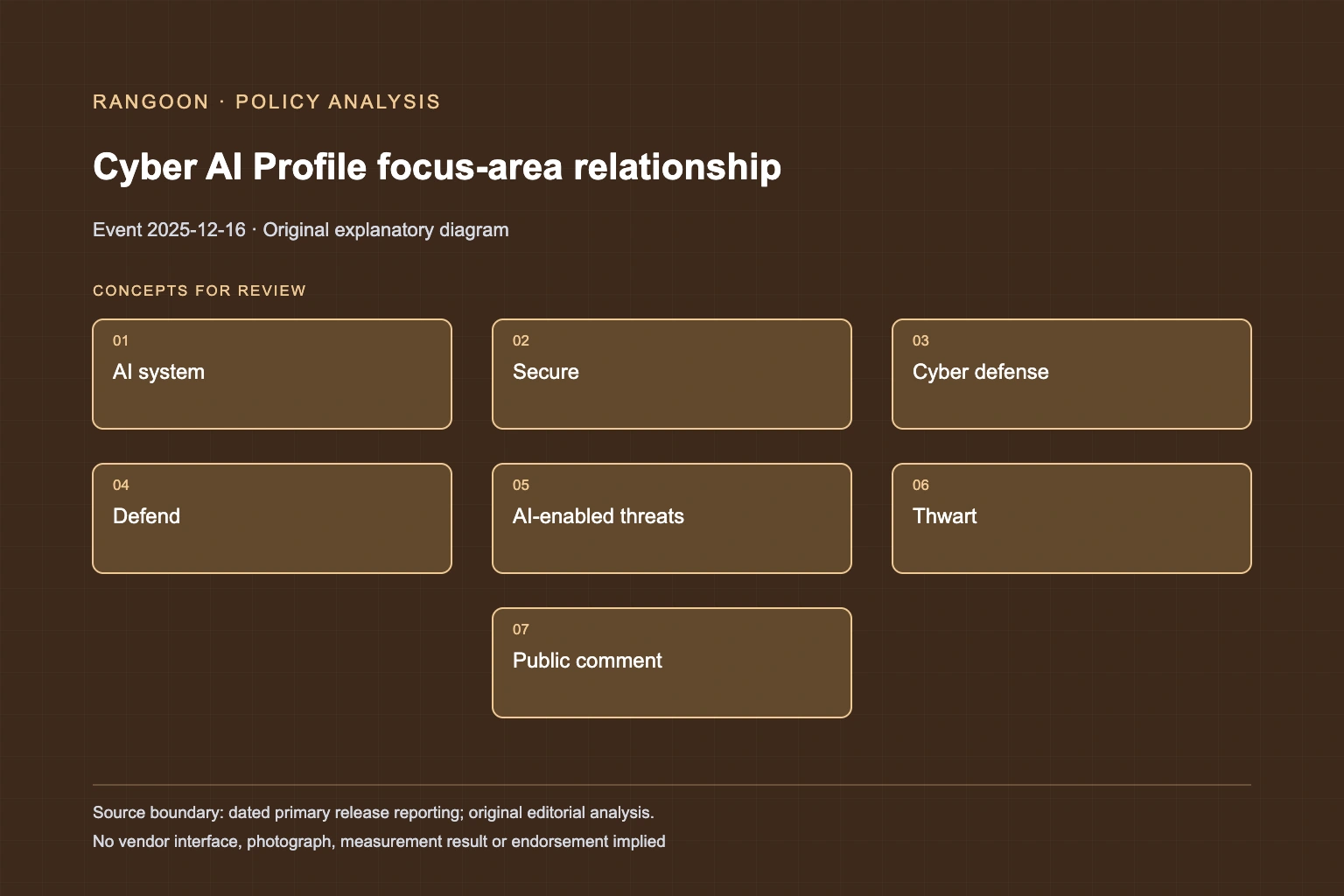
NIST released its preliminary Cyber AI Profile on December 16, 2025, framing AI cybersecurity around securing systems, defending with AI, and thwarting AI-enabled attacks.
Historical reporting: NIST released the initial preliminary draft of NIST IR 8596, Cybersecurity Framework Profile for Artificial Intelligence, on December 16, 2025. NIST invited public comments through January 30, 2026. The draft offers guidance under the Cybersecurity Framework; it is not a statute, regulation, or final mandatory control set.
Key takeaways
- The preliminary Cyber AI Profile organized AI-related cybersecurity work across secure, defend, and thwart focus areas.
- Its draft status and public-comment period were part of the publication’s meaning, not a detail to omit.
- A framework profile can structure risk discussions without establishing that any system is secure or compliant.
NIST released an initial preliminary draft for comment[source 1][source 2]
On December 16, 2025, NIST released the initial preliminary draft of NIST IR 8596, the Cybersecurity Framework Profile for Artificial Intelligence. NIST described it as a Cyber AI Profile and opened it for public comment through January 30, 2026. The publication was a draft profile, which means its release invited feedback rather than announcing a finished compulsory standard. Reporting that status accurately matters because guidance can influence technical planning long before it becomes a final NIST publication.
The profile joined securing AI with using AI in cyber defense[source 1][source 2]
NIST organized the preliminary profile around three overlapping focus areas: securing AI system components, conducting AI-enabled cyber defense, and thwarting AI-enabled cyberattacks. This structure avoided treating AI only as software that needs protection or only as a tool for defenders. It put both roles in one profile and added a third question about attacks enabled by AI. The resulting policy mechanism is a shared vocabulary for considering how a system’s own security, a defender’s use of AI, and an adversary’s use of AI can affect one another.
A single profile had to connect different security decisions without flattening them[source 1][source 2]
Securing a model, its data pipeline, and its deployment path concerns the integrity of an AI system. Using AI for defense concerns how an organization detects, investigates, or responds to cyber events. Thwarting AI-enabled attacks concerns the changed scale or shape of threats such as automation and targeting. Each focus area points at a different decision boundary: protecting model components does not answer whether AI-generated alerts are useful to defenders, and neither question resolves how automated adversarial capability should be assessed. NIST’s three-area design makes those distinctions visible while allowing teams to consider their interactions under the Cybersecurity Framework. It does not mean that one safeguard, metric, or control can answer all three questions, which is why the profile remains a planning framework rather than a certification result.
The preliminary profile was guidance with an explicit path for revision[source 1][source 2]
NIST said the draft followed an earlier concept paper, a workshop, and community-of-interest discussions, then offered a defined public-comment window. That sequence shows the December document as an input to further development, not the end of a rulemaking process. Public comment could test whether the three areas described the security questions practitioners faced. The profile can help an organization frame cybersecurity questions around AI, but it does not establish that a chosen model, vendor, architecture, or control set is secure. The dated news event is the publication of a preliminary framework for comment and the three focus areas it proposed, with final adoption left outside the December record.
Sources
- NIST CSRC: NIST releases preliminary draft of Cyber AI Profile (December 16, 2025)
- NIST NCCoE: NIST IR 8596 Initial Preliminary Draft (December 16, 2025)
Continue reading
Related reading
 News analysisNIST AI 100-2e2025 gave adversarial machine learning a shared taxonomy, not a risk tolerance rule3 min read
 News analysisUK published an AI cyber-security code with 13 voluntary principles and an implementation guide3 min read
 News analysisNIST, NSA and CISA publish voluntary SI incident-readiness practices3 min read