

DGX Spark’s 2025 story separated a desktop announcement from shipment
NVIDIA announced DGX Spark in March 2025 with reservations open, then reported partner shipping in October; the gap matters when testing a local AI development workflow.
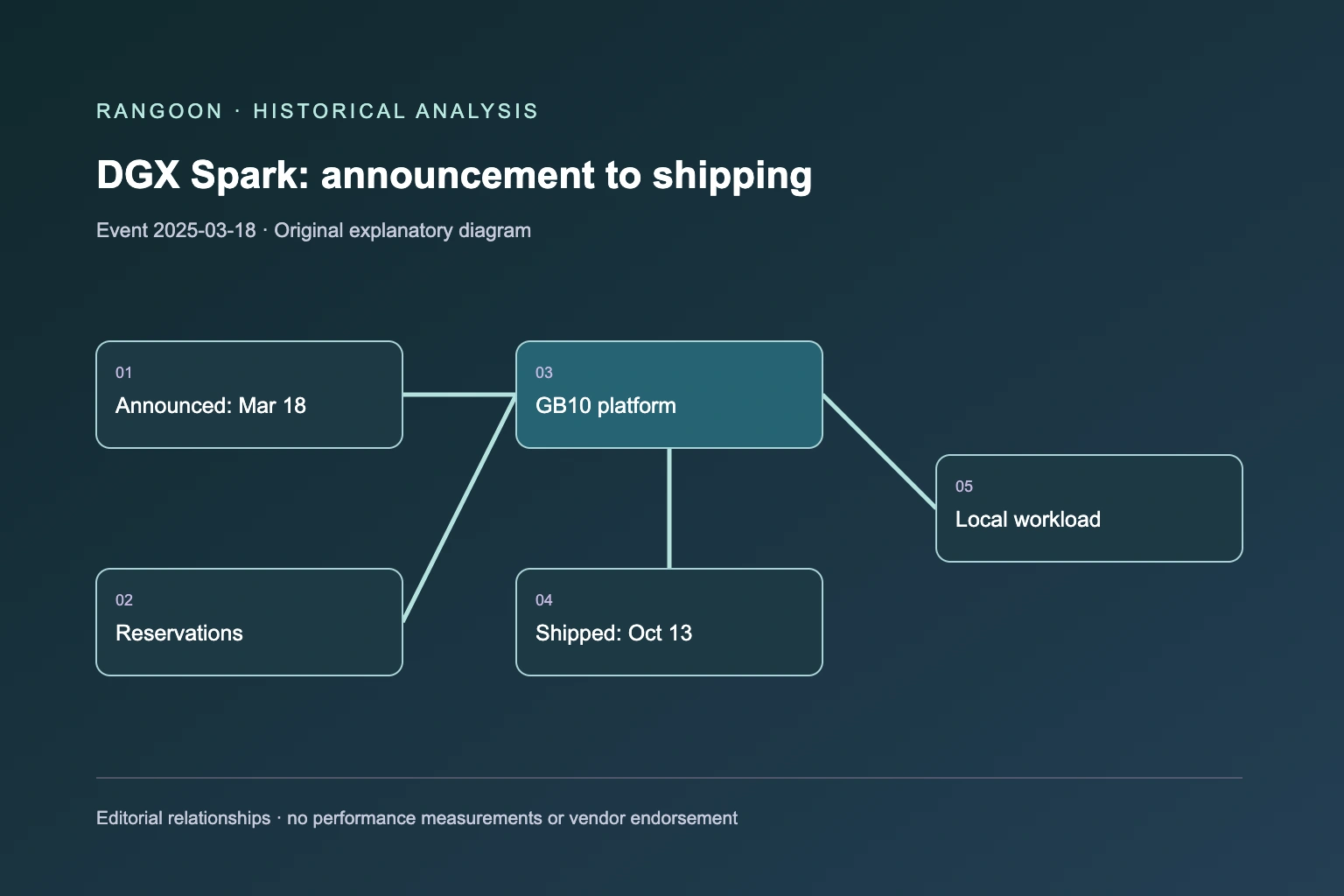
Historical reporting: NVIDIA announced DGX Spark on March 18, 2025 and opened reservations. NVIDIA separately announced shipping on October 13, with ordering from October 15. Announcement claims and later shipping evidence are intentionally kept distinct.
Key takeaways
- DGX Spark was announced as a GB10 Grace Blackwell desktop system, while DGX Station was a separate higher-memory product.
- Reservations and expected availability did not establish shipping; NVIDIA reported shipment months later.
- Local development changes data placement and iteration paths, but it does not remove model evaluation, access-control or recovery work.
The March event announced a personal AI-computer category[source 1]
NVIDIA announced DGX Spark and DGX Station on March 18, 2025. The press release described DGX Spark, formerly Project DIGITS, as a Grace Blackwell desktop system for developers, researchers, data scientists and students to prototype, fine-tune and run inference. It identified the GB10 Grace Blackwell Superchip, fifth-generation Tensor Cores, FP4 support and an NVLink-C2C CPU-GPU coherent-memory model.
The same release distinguished DGX Station, which NVIDIA described with a GB300 Grace Blackwell Ultra Desktop Superchip and 784GB of coherent memory. Conflating the two makes a desktop-capacity comparison misleading. At the March event, NVIDIA said reservations for DGX Spark opened that day; it did not say the product was then shipping.
Shipping was a later, separately dated event[source 1][source 2]
On October 13, 2025, NVIDIA announced that it and partners would start shipping DGX Spark and said ordering would begin October 15. That release listed 128GB of CPU-GPU coherent memory, a GB10 superchip and ConnectX-7 200Gb/s networking. It also stated model-size and performance capabilities. Those are NVIDIA statements about the shipping product and should not be read back into March as delivery proof.
The seven-month distinction is operationally useful. A team planning around a reservation needs evidence for delivery date, exact system revision, regional support, support terms and installed software. A launch announcement can establish intention and architecture; an availability notice establishes a different fact, still short of proving suitability for a specific workload.
Analysis: local inference changes the data path, not the acceptance bar[source 1][source 2]
A deskside system can keep exploratory prompts, source data and model artifacts closer to a developer than a remote service. That may reduce transfer steps, but it does not by itself establish privacy, policy compliance or access isolation. Document which data may reside locally, how it is encrypted, who administers the device, what leaves the device through tools or updates, and how a lost or failed system is recovered.
Test the full local workflow: model download, checksum verification, package updates, tool access, evaluation data, output retention and export to another environment. Treat a local result as reproducible only when another machine can recreate the same model, runtime and prompt conditions. This analysis is independent and does not claim NVIDIA’s hardware supplies those controls.
Analysis: compare iteration economics, not slogans[source 1][source 2]
The relevant local-versus-cloud comparison is the complete iteration loop: setup time, engineering attention, utilization, electricity, device support, shared access and the cost of sending a workload elsewhere when memory or throughput is insufficient. A compact system can be valuable for experimentation even when a larger remote cluster remains the better path for a production service.
NVIDIA’s 2025 releases establish announcement and shipping chronology. They do not establish the total cost of ownership, a benchmark result for every model or that a local deployment can replace centralized operations. Use the actual models, context lengths and concurrency targets to choose the boundary, then retain evidence for the decision.
Sources
Continue reading
Related reading
 News analysisDGX Station separated a high-memory desk-side system from DGX Spark’s developer role3 min read
 News analysisRTX 5090’s launch made local AI capacity a memory-and-workload fit question3 min read
 News analysisNVIDIA’s memory codesign post highlights a practical boundary between capacity and usable agent throughput3 min read