

DGX Station separated a high-memory desk-side system from DGX Spark’s developer role
NVIDIA announced DGX Station on March 18, 2025 as a GB300 Grace Blackwell Ultra personal AI computer, then named system builders for the platform in May.
Historical reporting: NVIDIA announced DGX Station on March 18, 2025 and separately named system-builder plans on May 18. NVIDIA-stated memory, compute, networking and partitioning specifications are product context, not independent local-model or multi-user performance evidence.
Key takeaways
- DGX Station was announced around the GB300 Grace Blackwell Ultra Desktop Superchip and 784GB of unified system memory.
- Its high-memory, multi-user framing makes isolation, scheduling and network design central to evaluation.
- DGX Station and DGX Spark were distinct products, so Spark shipment claims do not establish Station availability.
DGX Station was a different March product from DGX Spark[source 1][source 2]
NVIDIA announced DGX Station alongside DGX Spark on March 18, 2025, but described the two as different personal AI computers. The announcement identified DGX Station with a GB300 Grace Blackwell Ultra Desktop Superchip and 784GB of coherent memory, while DGX Spark used the GB10 platform. In May, NVIDIA said ASUS, Dell, GIGABYTE, HP and MSI were expected to build DGX Station systems, and described up to 20 petaflops of AI performance, a ConnectX-8 SuperNIC and up to 800Gb/s networking. This article concerns Station’s high-memory desk-side system concept, not Spark’s later shipping timeline, and keeps their announcement, configuration and delivery records distinct.
Unified memory changes sizing questions, not the need to size them[source 1][source 2]
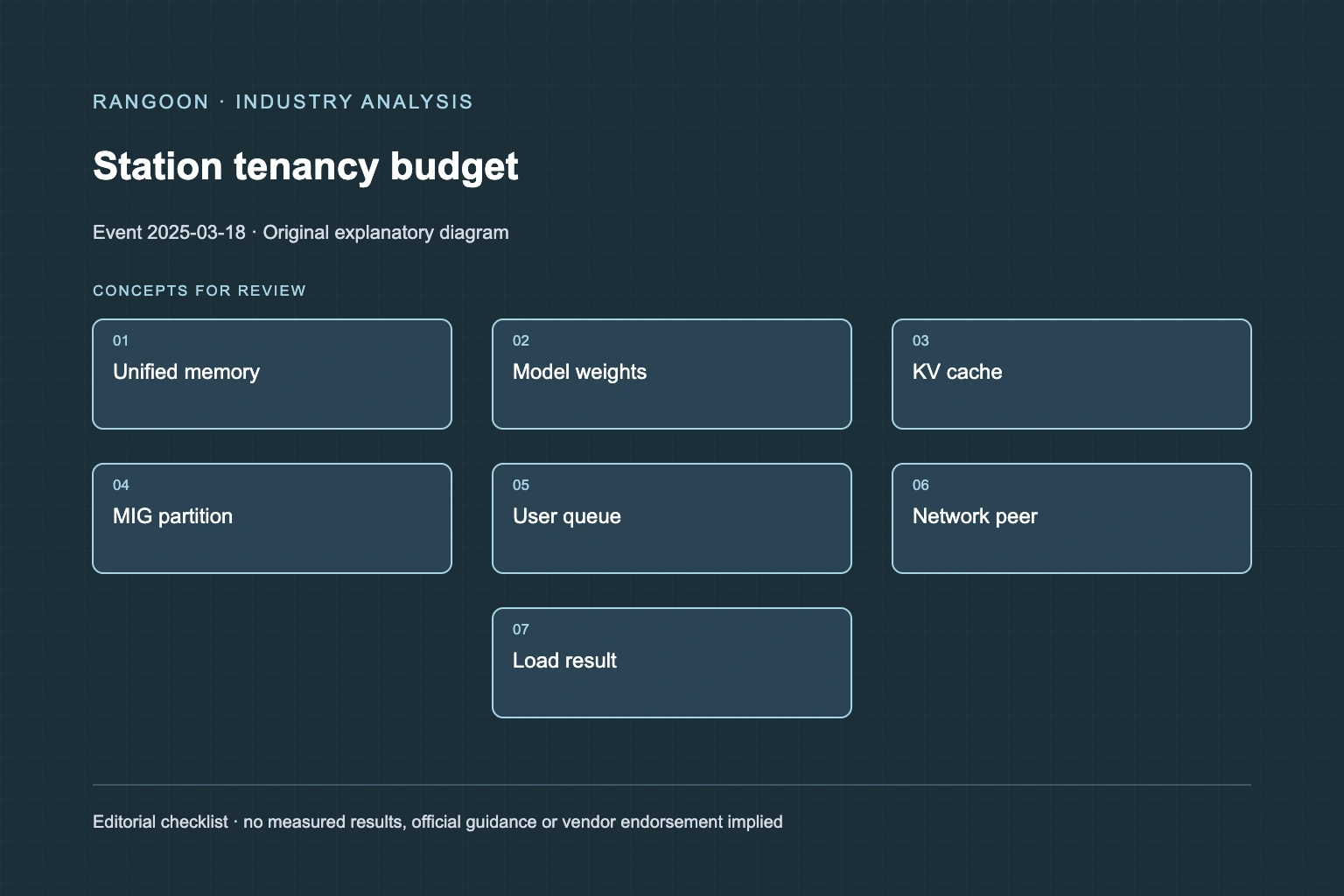
A 784GB unified-memory specification changes the class of workloads that can be placed on one system, but it does not guarantee that a chosen model is usable at a required response time. Weight format, context cache, batch policy, KV-cache growth, host memory pressure, storage throughput and network traffic all determine the result. NVIDIA also said Station could use Multi-Instance GPU technology for as many as seven instances. That makes tenancy a first-class test condition: partition count, per-instance memory budget, request mix and noisy-neighbor behavior should be measured rather than inferred from total memory, especially when interactive and batch work share a host.
A personal AI computer can still be shared infrastructure[source 1][source 2]
NVIDIA presented DGX Station both as an individual desktop and as a centralized node for multiple users. Those two roles require different operating evidence. A single-user evaluation should track interactive model and data-science tasks, display workload, local storage and power draw; a shared-node evaluation should add admission control, identity boundaries, utilization, queue time, observability and failure recovery. Network capacity also needs a traceable endpoint: a fast interface does not prove useful transfer time if storage, remote peers or application protocol supplies the bottleneck, or if a model server serializes requests before data moves.
Announcement, system-builder intent and delivery are separate records[source 1][source 2]
The March announcement documents NVIDIA’s product framing, and the May release documents system-builder plans. Neither alone is evidence that a particular Station configuration had shipped, was installed, or met a local workload target on those dates. Keeping those records separate avoids importing DGX Spark’s later delivery milestones into a different product. The sound integration question is concrete: which system-builder configuration, software stack, model mix and user policy has been tested, and what did it do under the intended load, including peak concurrency, an observed failure path, recovery time, operator intervention needs, sustained mixed-user traffic, changing context lengths and retained run receipts for all repetitions?
Sources
Continue reading
Related reading
 News analysisDGX Spark’s 2025 story separated a desktop announcement from shipment3 min read
 News analysisRTX 5090’s launch made local AI capacity a memory-and-workload fit question3 min read
 News analysisNVIDIA’s memory codesign post highlights a practical boundary between capacity and usable agent throughput3 min read