

Jetson Thor made edge-robotics compute a systems-integration question
NVIDIA made Jetson AGX Thor developer kits and production modules generally available on August 25, 2025, pairing a Blackwell-based robotics computer with JetPack 7 software.
Historical reporting: NVIDIA announced general availability of Jetson AGX Thor developer kits and production modules on August 25, 2025. Vendor-stated compute, memory, power and comparison figures describe the announced platform; they are not an independent robotics-performance result.
Key takeaways
- Jetson Thor combined a production-module launch with an operating-system and accelerator-stack transition.
- On-robot model choice must be evaluated with sensor, memory, thermal and scheduling conditions together.
- A module specification does not demonstrate task success for a robot or its full control system.
General availability joined a module to a software baseline[source 1][source 2]
NVIDIA announced general availability of the Jetson AGX Thor developer kit and Jetson T5000 production modules on August 25, 2025. Its launch release described a Blackwell-based robotics computer with 128GB of memory, up to 2,070 FP4 teraflops of AI compute, and a 130-watt power envelope. A same-day JetPack 7.0 announcement supplied a separate but important record: Jetson Linux 38.2, an Ubuntu 24.04 root filesystem, Linux kernel 6.8, CUDA 13, cuDNN 9.12 and TensorRT 10.13. The event therefore was more than a new module; it established a hardware-and-software combination that integrators could target while changing board generation and operating-system baseline together.
The useful unit is a robot runtime, not a peak figure[source 1][source 2]
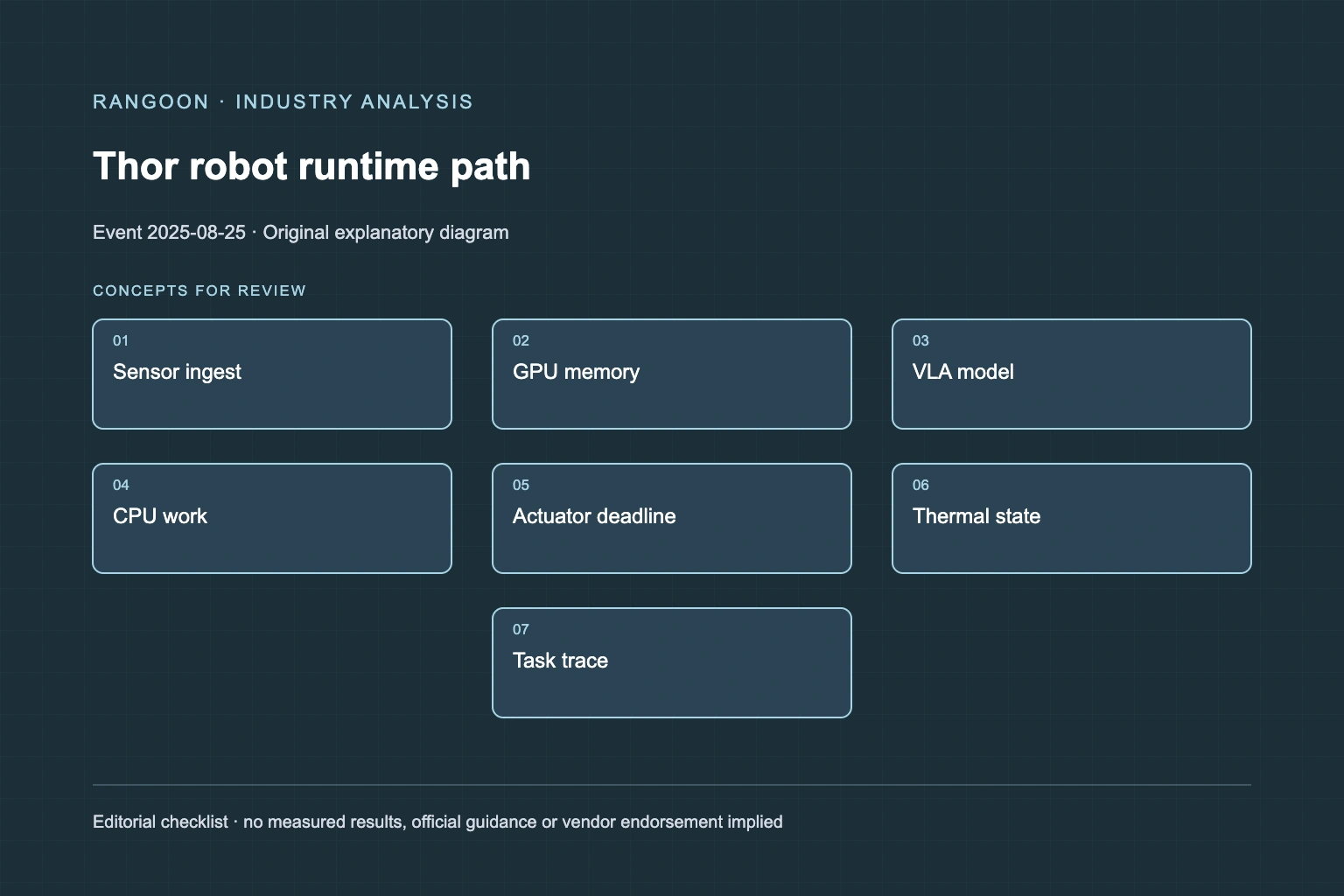
NVIDIA presented Thor for concurrent generative and sensor-processing workflows, including vision-language-action models. That framing makes memory residency, camera ingest, preprocessing, inference batching, actuator-loop deadlines and cooling part of the relevant system contract. The stated FP4 figure is a precision-specific vendor specification, not a prediction of end-to-end task latency or control quality. A robot can have enough accelerator capacity for a model and still miss a deadline because input synchronization, decoding, CPU work, storage, network activity or thermal throttling occupies the critical path, even when a bare model benchmark looks comfortably within target.
Edge reasoning changes data movement before it changes behavior[source 1][source 2]
The architectural implication is to measure where data crosses device boundaries. A practical Thor evaluation should record sensor formats and rates, host-to-device copies, model precision, GPU memory use, cold-start behavior, sustained power, temperature and the deadline that matters to the application. Run a representative multi-sensor trace rather than a single isolated model benchmark, then compare observed latency percentiles with the existing platform under the same workload. That approach can reveal whether a larger local model improves a decision enough to justify its memory and scheduling cost, without treating an announced platform maximum as proof of a deployed result or obscuring later software changes.
Compute availability leaves the robot-specific evidence open[source 1][source 2]
Thor also illustrates why physical-AI reporting needs separate evidence layers. A module release can establish available hardware and supported software, while a useful robot claim needs the embodiment, sensors, model revision, task definition, environment, failure cases and observed outcomes. The August records do not show that every compatible model runs within a particular robot latency budget, nor that a demonstration transfers across payloads, lighting or network conditions. Treat the platform as an integration target, preserve the actual runtime bill of materials, and publish task-level measurements only after the complete system has been exercised, so a later migration remains auditable rather than anecdotal across hardware and software baselines.
Sources
- NVIDIA Newsroom: NVIDIA Blackwell-Powered Jetson Thor Now Available (August 25, 2025)
- NVIDIA Developer Forums: JetPack 7.0 and Jetson Linux 38.2 for Jetson Thor (August 25, 2025)
Continue reading
Related reading
 News analysisJetson Orin Nano Super turned a developer-kit refresh into a software-configuration story3 min read
 News analysisIsaac GR00T N1.5 made synthetic-trajectory provenance part of robot learning3 min read
 News analysisIsaac GR00T N1 made humanoid action generation a deployment-boundary question3 min read