OLMo 2 made training artifacts part of a model claim
Ai2 released OLMo 2 on November 26, 2024 as a fully open language-model family. Reproducibility needs data, code, checkpoints, and evaluation artifacts kept linked.
Historical reporting: Ai2’s November 26, 2024 OLMo 2 post announced the family; the OLMo 2 7B Instruct model card is a separate primary record. The analysis below is original editorial analysis; it does not claim present availability, performance, or support.
Key takeaways
- On November 26, 2024, Ai2 announced OLMo 2 and described it as a fully open language-model family.
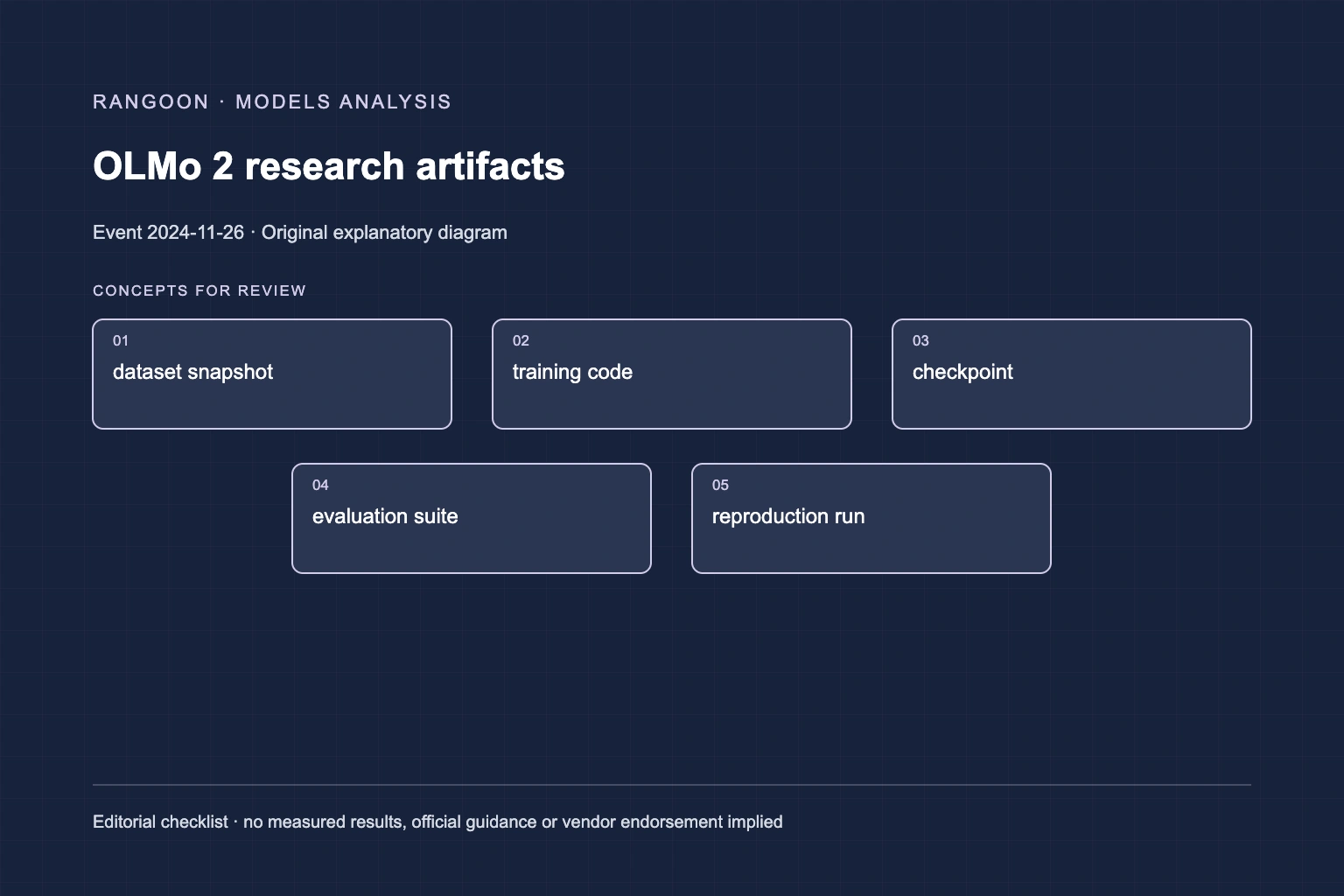
- For an open-model evaluation, retain the checkpoint hash, tokenizer, prompt template, dataset revision, preprocessing, runtime, hardware, precision, decoding, and scorer.
- Ai2’s November 2024 sources document OLMo 2 and its stated openness. They do not independently reproduce performance claims or guarantee a derivative model’s behavior.
What Ai2 released[source 1][source 2]
On November 26, 2024, Ai2 announced OLMo 2 and described it as a fully open language-model family. The post connected released models with training data, code, and evaluation artifacts. That is a stronger provenance claim than weights alone, because it offers several pieces that a researcher can inspect or adapt.
Ai2’s OLMo 2 7B Instruct model card is a separate primary record for an artifact in the release family. Availability of artifacts does not by itself reproduce a result: versions, compute, data preparation, training schedule, and evaluation environment still determine what can be replicated.
Editorial analysis: trace a result through its inputs
For an open-model evaluation, retain the checkpoint hash, tokenizer, prompt template, dataset revision, preprocessing, runtime, hardware, precision, decoding, and scorer. Each item can alter an observed result. A missing item should be marked unknown instead of filled by inference.
If a team fine-tunes a checkpoint, treat the resulting model as a new evaluated artifact. Record the base, train and validation data, method, hyperparameters, and behavioral deltas. Openness of the base model does not automatically establish provenance for a derivative.
Editorial analysis: separate reproducibility from preference
A reproducible score asks whether another party can run a specified procedure and inspect the result. A product preference asks whether the output meets a particular user need. Run both tests, because a transparent model may be a poor fit for one workload and a closed model may be hard to audit.
Use release-provided benchmarks as documented references, then add fixtures for the actual task. Keep their scores separate so historical research claims are not rewritten as local acceptance evidence.
Editorial analysis: link artifacts instead of summarizing them away
Create a release ledger containing source URLs, hashes, licenses, datasets, code commits, evaluation reports, and local test notes. This makes it possible to revisit a conclusion when one artifact changes or a discrepancy emerges.
The OLMo 2 release demonstrates a particular open-science publication approach in late 2024. It does not prove the correctness of every downstream training run or present-day artifact state.
Editorial analysis: retain the release boundary
Ai2’s November 2024 sources document OLMo 2 and its stated openness. They do not independently reproduce performance claims or guarantee a derivative model’s behavior.
An open release enables a different kind of debugging exercise. A hypothetical evaluator finds that a model’s answer changes after a fine-tuning run. It can compare the base checkpoint, preference data, training command, intermediate checkpoints, and scorer, then ask which intervention changed the behavior. That investigation still requires discipline: data licensing, privacy review, held-out test integrity, and reproducible environment files must be preserved. Openness creates inspectable inputs; it does not eliminate confounders or make every causal conclusion valid. This is original analysis of an open-artifact workflow, not a claim that all OLMo 2 materials reproduce a particular downstream result.
Independent evaluators should also protect held-out tasks from tuning. Re-running a public benchmark after repeated adaptation may measure familiarity with the evaluation rather than a general capability change.
Sources
- Ai2: OLMo 2 (November 26, 2024)
- Ai2: OLMo 2 7B Instruct model card
Continue reading