

OMB M-25-21 made federal AI governance a delivery-and-trust record
OMB Memorandum M-25-21, dated April 3, 2025, gave executive-branch agencies guidance on accelerating AI use through innovation, governance and public trust.
Historical reporting: OMB Memorandum M-25-21 is dated April 3, 2025 and addresses federal agency AI use. This article distinguishes the memorandum’s guidance from an agency’s later implementation or a determination about a particular system.
Key takeaways
- M-25-21 addressed agency use and governance; acquisition details belong to a separate M-25-22 record.
- A governance body needs workload facts, not only a vendor description.
- High-impact review evidence should include both a decision and the test conditions behind it.
M-25-21 addressed use, innovation, governance and public trust[source 1][source 2]
OMB Memorandum M-25-21 is dated April 3, 2025 and titled “Accelerating Federal Use of AI through Innovation, Governance, and Public Trust.” The memorandum says it provides guidance to executive-branch agencies on promoting use of AI while maintaining safeguards for civil rights, civil liberties and privacy. It rescinded and replaced OMB Memorandum M-24-10, according to its overview.
The document is a governance and use-policy event. It should not be collapsed into the acquisition guidance issued the same day as M-25-22. An agency can have an approved governance path but no vendor selection, or a procurement vehicle but no approved use case. Keeping those records separate helps reviewers locate the actual decision.
Governance needs the proposed use in inspectable form[source 1][source 2]
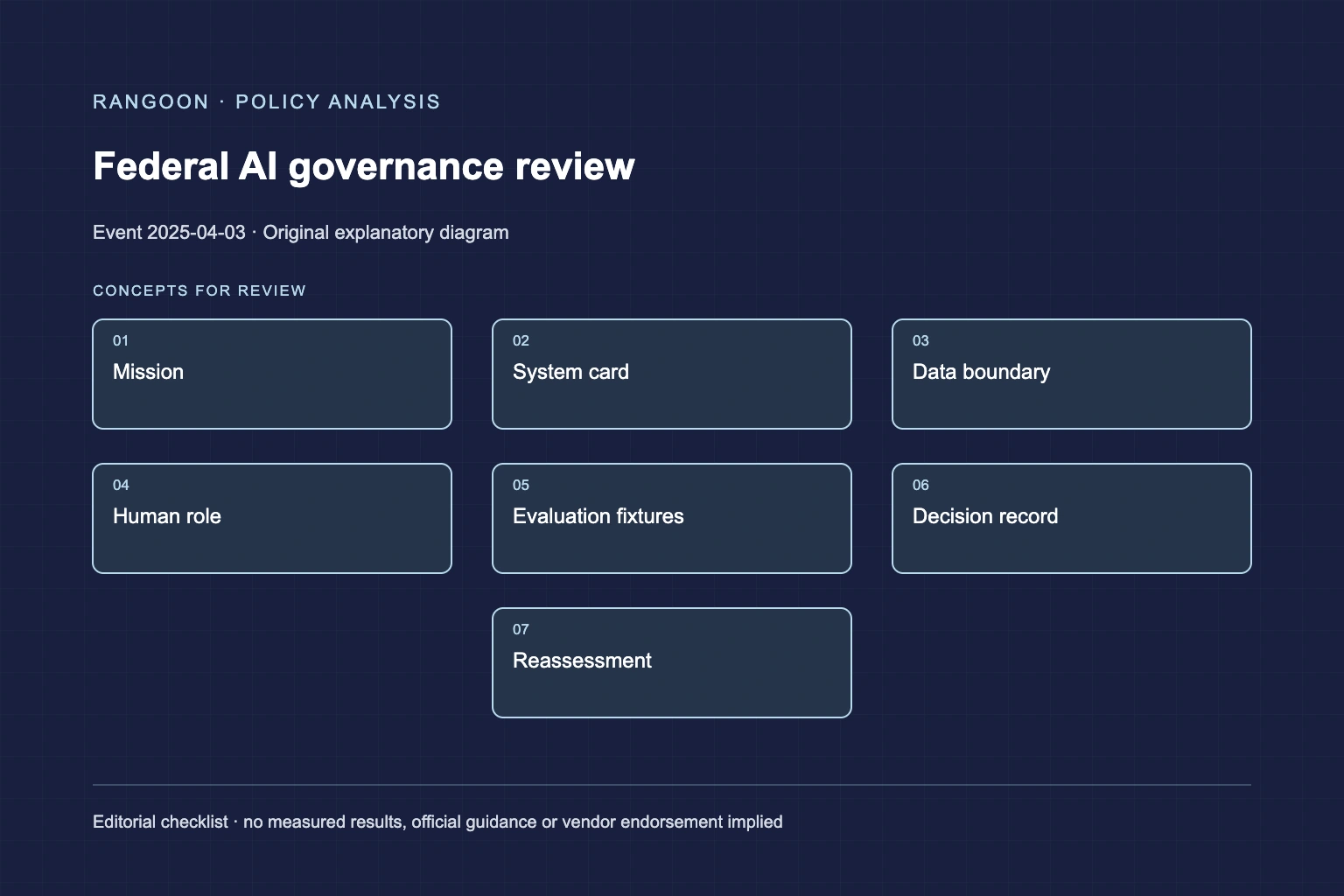
A governance review has little value if it only sees a product name. Give it a system card describing mission, affected people, data sources, outputs, human role, external connections, security boundary, error impact and operator. Attach model and configuration versions, evaluation fixtures, known limitations and a named accountable owner. That lets a board examine the use rather than an abstract technology category.
The record should also say what the system may not do. Examples include no final eligibility determination, no unreviewed external action, no training on specified non-public data or no use beyond a stated programme. A clearly stated negative boundary makes later changes visible. It is not a substitute for the agency’s own legal, privacy, security or records review.
Analysis: public trust depends on decision evidence[source 1][source 2]
Trust is not created by a one-time approval. It needs a traceable record of why a use was allowed, what was tested, who can intervene and how problems are reported. Evaluate representative and adverse cases, including missing data, ambiguous instructions, harmful outputs, disparate impacts where relevant and an operator who rejects the recommendation. Store results with the exact configuration that produced them.
When a use changes, reopen the review. A new model version, data source, target population, automation level or deployment channel can change the material facts. The outcome can be approve with controls, revise, pause or decline; a programme should make those states visible instead of treating silence as approval. This is editorial governance analysis, not a claim about an agency’s compliance.
Analysis: memo guidance is not a live implementation receipt[source 1][source 2]
M-25-21 establishes a dated memorandum and stated federal guidance. It does not prove that every agency completed its required steps, that a particular AI use is authorised, or that a vendor meets federal requirements. Agency-specific documents, contracts, impact assessments and operational evidence are needed for those claims.
For historical coverage, keep the memo date, title and replacement relationship precise. For current operational decisions, verify later OMB guidance and the responsible agency’s records. That preserves the line between reporting on federal policy and giving advice about a live federal deployment.
Sources
Continue reading
Related reading
 News analysisOMB M-25-22 treated AI procurement as an acquisition evidence problem3 min read
 News analysisUK’s third-party AI assurance roadmap mapped professionalization, information access and a planned innovation fund3 min read
 News analysisUK’s AI Playbook expanded government guidance to ten principles across selection, deployment and assurance3 min read