

OpenAI, Nscale and Aker announced Stargate Norway as a planned Narvik facility, not live European compute
OpenAI, Nscale and Aker announced Stargate Norway on July 31, 2025, with planned Narvik capacity and GPU targets that remained construction and expansion intentions.
Historical reporting: OpenAI and Nscale announced Stargate Norway on July 31, 2025 as an AI data-center initiative in Narvik. Nscale’s same-day release names Aker and describes a project targeting 100,000 NVIDIA GPUs by the end of 2026. OpenAI described 230MW planned capacity with an ambition for another 290MW, and said it welcomed an opportunity to be an initial offtaker. Aker Horizons’ market disclosure says the proposed 50/50 joint venture was subject to agreed closing conditions. Capacity, GPU, renewable-power, cooling and local-access descriptions are project statements or targets, not evidence of energized halls, commissioned systems, delivered GPUs, customer service, or a completed joint venture.
Key takeaways
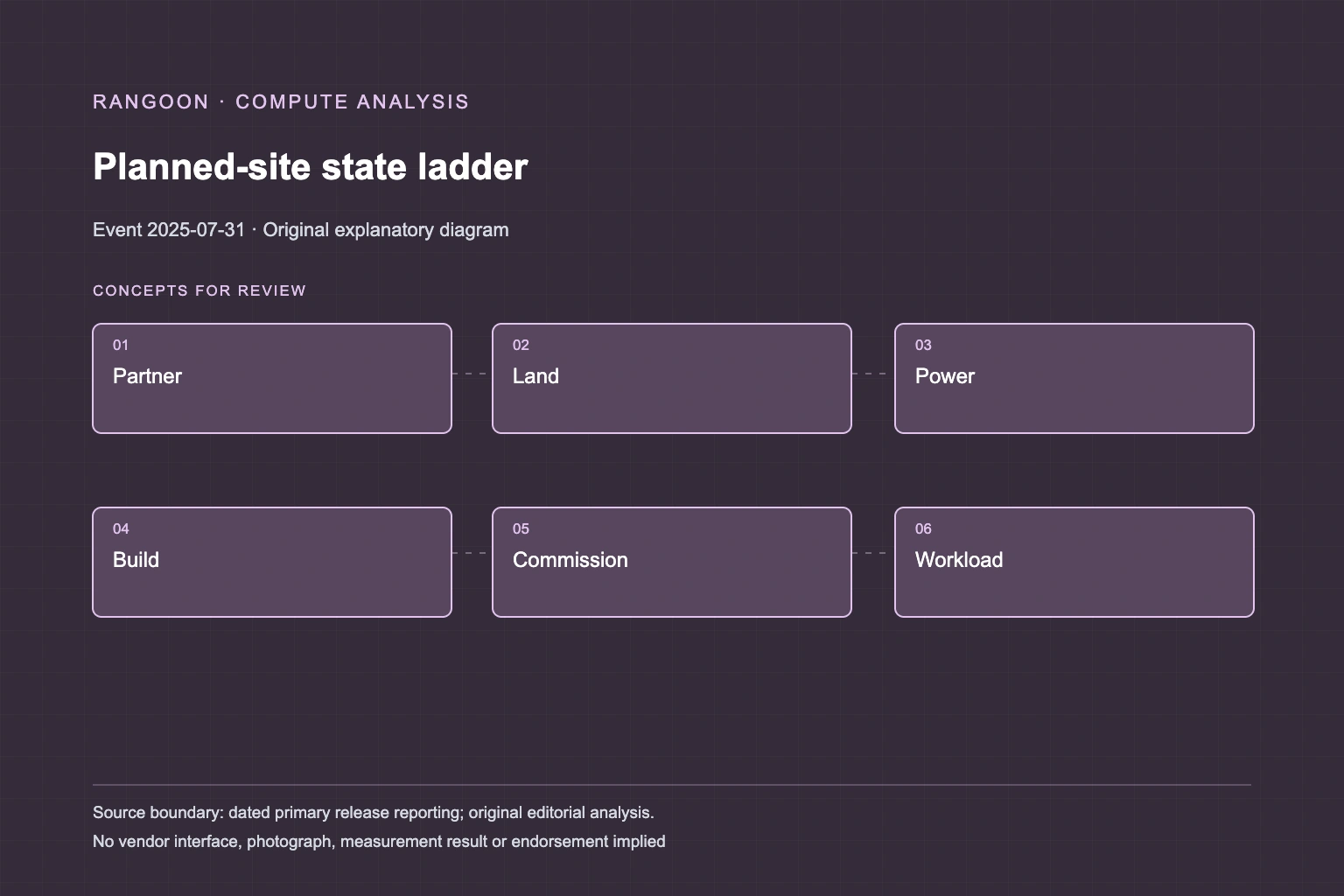
- July 31 records a launched project and partner arrangement; it does not record a live Narvik compute service.
- The announced 230MW and 100,000-GPU figures were planned targets, while further capacity was explicitly an ambition.
- A planned renewable-powered site still needs dated evidence for financing, construction, grid connection, equipment and commissioning.
The July releases announced a project and a partner structure, rather than operating infrastructure[source 1][source 2][source 3]
On July 31, 2025, OpenAI introduced Stargate Norway as its first European AI data-center initiative under OpenAI for Countries. Its announcement names Nscale as the intended designer and builder and describes Aker as an industrial and energy partner. Nscale’s same-day release likewise calls the effort an advanced AI infrastructure project in Narvik. Those records establish a public project announcement with named parties and a planned location. They do not say that a data hall was energized, that a cluster had been installed, or that a developer could use the facility. The Aker Horizons disclosure adds a legal boundary: ownership was expected through a 50/50 joint venture, but completion of that joint venture was subject to agreed closing conditions. A launch announcement therefore should not be shortened to a claim of operating European capacity.
The published power and GPU figures were targets and ambitions with separate timing[source 1][source 2]
OpenAI said Stargate Norway was planned to deliver 230MW, with an ambition to add 290MW, and that the facility would target 100,000 NVIDIA GPUs by the end of 2026. Nscale described the same 100,000-GPU target and stated that the project was to be powered entirely by renewable energy. These are material planning facts, but their verbs set the boundary. Planned capacity is not energized capacity, a target GPU count is not a delivered inventory, and an ambition for expansion is not an approved later phase. The sources do not state the number of installed servers, the accelerator model actually delivered, the usable network topology, the commissioned cooling system or a customer workload. The July event supports reporting the announced project scale and intended timing; it does not support saying that those resources were available in July 2025.
Hydropower and liquid-cooling descriptions were design claims that required later operating receipts[source 1][source 2]
OpenAI identified Narvik’s hydropower, climate and industrial base as reasons for the planned facility and said the project would run entirely on renewable power. It also described an expected closed-loop direct-to-chip liquid-cooling design. Those statements explain the partners’ intended energy and cooling approach. They do not demonstrate a power contract in service, an interconnection energized for the site, measured water use, a completed cooling loop, or emissions performance during a workload. Nscale’s release reinforces the renewable-powered intention but does not transform it into an operating measurement. Data-center environmental claims need a specific operating period, meter boundary and method: construction energy, grid supply, backup generation, chip utilization and water consumption are distinct records. The announcement supplies a design and siting rationale, not a verified lifecycle result.
An initial-offtaker statement did not establish public, sovereign or customer allocation[source 1][source 2][source 3]
OpenAI said it welcomed the opportunity to be an initial offtaker with an option to scale, while the Nscale release discussed infrastructure intended for sovereign AI workloads across Europe. Neither statement publishes an allocation agreement, a customer entitlement, regional quota, pricing, availability target or operational security boundary. An initial offtaker is a planned demand role, not proof that all capacity has been purchased or that local researchers can schedule a system. Likewise, a claim that a site could support sovereign workloads does not identify data-residency controls, identity management, audit requirements, model access rules or government approval. The historical record is valuable because it names the intended participants, geography and project targets. It remains a proposal-stage infrastructure milestone until later dated sources establish construction, power, hardware, commissioning and actual workload states.
Sources
- OpenAI: Introducing Stargate Norway (July 31, 2025)
- Nscale: Nscale, Aker and OpenAI establish Stargate Norway (July 31, 2025)
- Aker Horizons: Nscale, Aker ASA and OpenAI establish Stargate Norway (July 31, 2025)
Continue reading
Related reading
 News analysisStargate’s January announcement made financing intent different from built infrastructure3 min read
 News analysisMicrosoft announced a planned Pecos campus and dedicated power path, keeping its two-gigawatt figure separate from operation3 min read
 News analysisPredicted Outputs made regeneration latency depend on a declared reference string3 min read