

Stargate’s January announcement made financing intent different from built infrastructure
OpenAI announced the Stargate Project on January 21, 2025, describing a new company intending to invest up to $500 billion in US AI infrastructure over four years.
Historical reporting: primary documents record this event on 2025-01-21. Vendor statements, planned schedules and comparative figures remain attributed. This retrospective does not infer current availability, price, capacity, performance or support.
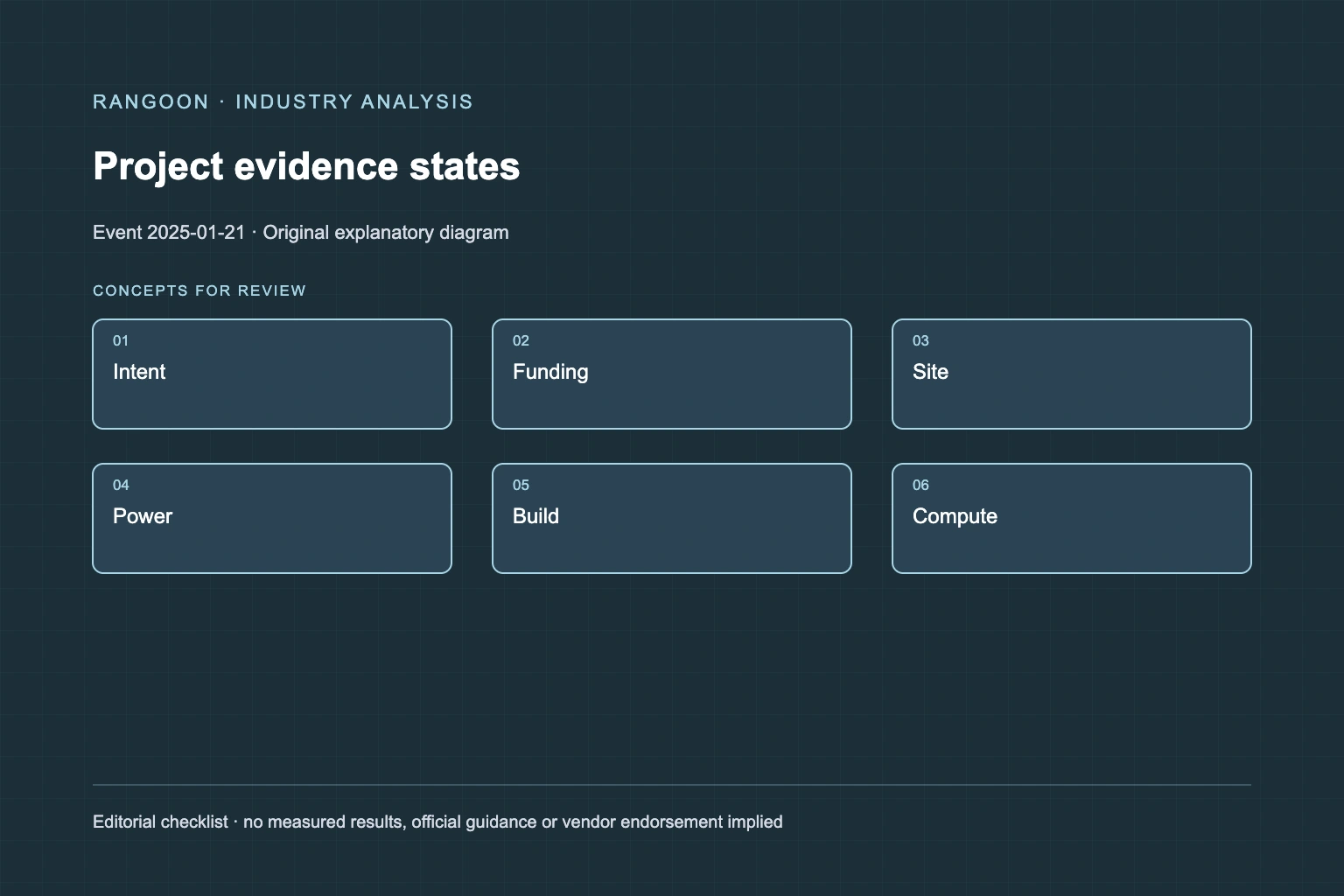
Key takeaways
- OpenAI announced Stargate as a new company intending to invest $500 billion over four years in AI infrastructure for OpenAI in the United States.
- A vendor announcement, a plan, an installed system and a completed workload are different evidence states.
- Original analysis: retain configuration and outcome evidence before treating an infrastructure claim as an operating result.
The dated event has a bounded claim[source 1][source 2]
On 2025-01-21, the first primary document recorded this event. OpenAI announced Stargate as a new company intending to invest $500 billion over four years in AI infrastructure for OpenAI in the United States. The announcement named SoftBank, OpenAI, Oracle and MGX as initial equity funders and later linked a land-and-power request for proposals.
Stargate’s January statement combined a four-year investment intention, an initial $100 billion deployment statement, named equity funders and initial technology partners. These are program-design facts. They do not turn a national buildout into a single completed data center or a fixed quantity of immediately usable accelerators.
Engineering facts need a workload boundary[source 1][source 2]
An announced investment intent has a different evidentiary status from financed construction, energised capacity, accepted servers or productive compute. Site selection, transmission, permitting, capital structure and equipment delivery are separate milestones.
The follow-up land-and-power RFP and architecture-engineering RFQ show that site development was a material technical path. Power interconnection, civil construction, cooling, equipment procurement and network integration have different lead times. A project can make progress on one while another remains its limiting constraint.
Plans, delivery and use are separate states[source 1][source 2]
The announcement said buildout was underway in Texas and sites were being evaluated across the country. Treat those as site-development states. A rigorous update would name which site has a signed power arrangement, active construction, delivered racks, commissioned systems and an accepted workload rather than collapsing all states into “Stargate capacity.”
An intended $500 billion investment is not a current spend, cash balance, enterprise value or return forecast. It also does not specify the eventual mix of equipment, power, land, debt and operating expense. Readers should resist deriving investment advice or a company valuation from the headline alone.
Original analysis: make the operating evidence inspectable[source 1][source 2]
When reading mega-project claims, map every number to its noun: intended investment, equity, debt, site count, power contract, installed equipment or usable compute. This avoids turning an infrastructure roadmap into a current capacity or performance statement.
Stargate is best read as an infrastructure roadmap with explicit partners and future targets. The January event provides a baseline for later site receipts; it does not prove that a target has been met or that an AI product has a specified level of compute on any given day.
For each later Stargate claim, require a receipt that identifies the site, date, source, equipment state and workload state. A land announcement, utility agreement, construction photograph and active cluster are different records. Where a claim lacks one of these fields, report the missing element instead of estimating it from the project total. This makes a large national program readable as a sequence of verifiable infrastructure changes.
Stargate’s scale makes it especially important to resist a single progress number. An increase in planned sites, a new funding commitment and an energized hall are all meaningful, yet they answer different questions about the program’s actual infrastructure state.
Sources
- OpenAI: Announcing the Stargate Project (January 21, 2025)
- Microsoft: Microsoft and OpenAI evolve partnership (January 21, 2025)
Continue reading
Related reading
 News analysisOpenAI, Nscale and Aker announced Stargate Norway as a planned Narvik facility, not live European compute3 min read
 News analysisOracle’s Stargate partnership tied a 4.5GW plan to named buildout milestones3 min read
 News analysisMicrosoft announced a planned Pecos campus and dedicated power path, keeping its two-gigawatt figure separate from operation3 min read