

Pydantic AI 1.0 made typed contracts part of the agent-framework pitch
Pydantic released Pydantic AI V1 on September 4, 2025, committing to API stability after nine months of iteration and emphasizing engineering practices for GenAI applications.
Historical reporting: Pydantic announced Pydantic AI V1 on September 4, 2025. This retrospective does not make a claim about later major versions or current package support.
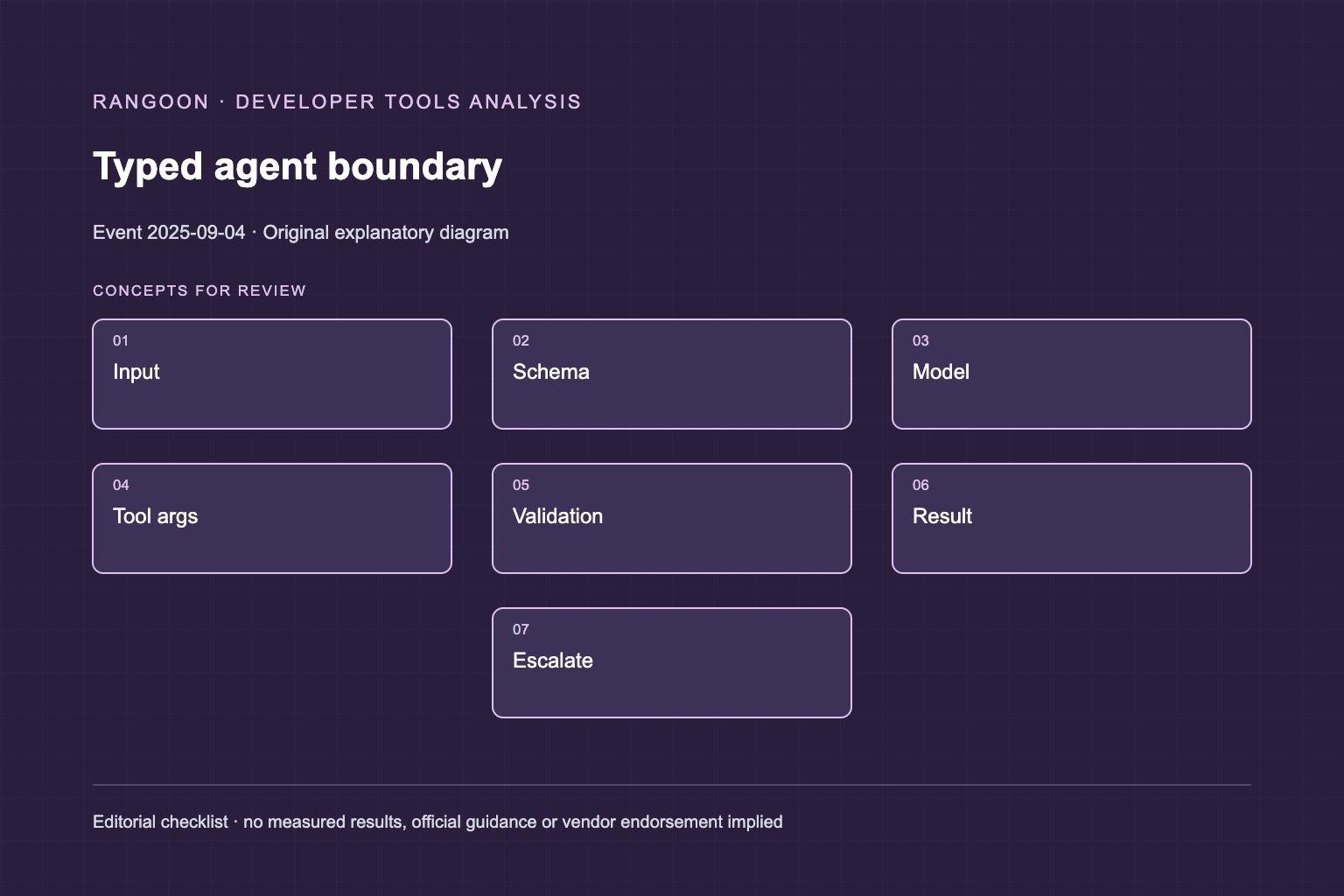
Key takeaways
- V1 framed stable APIs as a response to framework churn.
- Typed inputs and outputs improve validation but cannot prove semantic correctness.
- Structured-agent tests need invalid and adversarial payloads, not only valid schemas.
Pydantic presented V1 as a stability commitment after iteration[source 1][source 2]
Pydantic published its Pydantic AI V1 announcement on September 4, 2025. The post said the project had nine months of feedback, iteration and real-world usage and that the team was ready to commit to API stability. It also argued that GenAI applications remain engineering. That is a dated project statement. The same post now carries a later-version update, which reinforces why this article treats the V1 event as historical rather than using it to describe current package status.
The later update attached to the launch post is itself a useful archival signal: release pages age while readers continue to arrive through old links. A historical story should retain the V1 date and claim, then avoid silently importing later product status into 2025 reporting. That is why this article dates its scope tightly.
Typed contracts make boundary failures visible earlier[source 1][source 2]
An agent can cross several untyped boundaries: user input, retrieval results, model output, tool arguments, tool results and application state. Typed schemas help name what each boundary expects and reject malformed shapes before a downstream operation treats them as facts. They do not prove that a field is truthful, that a model selected the correct action, or that a tool result is authorised. Schema validation is a control with a defined scope, not a verdict on whole-workflow correctness.
Structured output contracts also need a compatibility policy. If a producer introduces a new enum value or an optional nested object, an older consumer may reject valid new work or, worse, ignore it. Version schemas, document defaults, and use explicit adapters at boundaries instead of allowing a model response to drift through permissive parsing unnoticed.
Validation must cover malformed shape and wrong meaning[source 1][source 2]
Write tests for missing fields, extra fields, wrong types, truncated structured output, semantically impossible values and adversarial strings in otherwise valid fields. If an agent proposes an action, validate both the schema and the business preconditions outside the model. Keep generated object, validation error, retry decision and final human escalation in a trace. This lets an operator see whether a failure came from parsing, retrieval, model planning or the connected service.
For a customer-facing flow, present validation failures as actionable recovery states rather than exposing raw parser detail. The model can retry with a repaired structure only within a bounded attempt count. After that, preserve the original output and escalate, so repeated self-repair does not turn an ambiguous request into an unreviewed business action.
Analysis: version models and schemas together[source 1][source 2]
A schema adjustment can change behavior as materially as a model change: a required field can force abstention, a default can trigger a wrong action, and a permissive type can hide a drift. Release them together with sample fixtures and explicit compatibility notes. The original V1 announcement supports the stability context; the release process described here is original analysis for teams operating typed agent boundaries.
A useful review asks two separate questions: can this value be decoded, and should the application act on it? Typed frameworks help with the first question. Domain validation, authorization and human accountability answer the second. Keeping those questions separate prevents a clean JSON object from acquiring unjustified operational authority.
Sources
- Pydantic: Pydantic AI V1 (September 4, 2025)
- Pydantic AI GitHub releases (September 4, 2025)
Continue reading
Related reading
 News analysisAnthropic donated Agent Skills to AAIF: treat open governance as a new supply-chain input3 min read
 News analysisZoom released AI Companion 2.0 as a cross-Workplace context and action surface3 min read
 News analysisZendesk’s 2025 Resolution Platform joined service agents, knowledge, actions and QA3 min read