PyTorch 2.6 joined compiler changes with a Linux packaging transition
PyTorch 2.6 arrived on January 29, 2025 with Python 3.13 compiler support, AOTInductor work and a consequential shift in official package distribution.
Historical reporting: PyTorch's dated January 29, 2025 release post and matching repository release describe PyTorch 2.6. Feature, binary and compatibility statements are project claims for that version, not a finding about another workload or extension build.
Key takeaways
- PyTorch 2.6 made compiler and binary-distribution changes part of one release decision.
- Python 3.13 support in torch.compile and AOTInductor improvements did not remove the need to test a specific model and extension stack.
- The end of official Conda publication and Linux ABI changes created an explicit upgrade boundary for deployment teams.
The January release named compiler work and distribution policy together[source 1][source 2]
On January 29, 2025, the PyTorch project announced version 2.6. The dated release post identifies Python 3.13 support for torch.compile, a new torch.compiler.set_stance control, AOTInductor changes and FP16 support on x86 CPUs among its highlights. The corresponding repository release records the same version and its release notes. This was a framework release with several paths through it: eager execution, compilation, generated code and packaged binaries. It was not a general claim that every PyTorch program would become faster or compatible merely by changing a version pin. A model, custom operator, extension compiler and accelerator driver still determine whether an upgrade is usable.
Compiler controls gave developers more choices, not a universal performance result[source 1][source 2]
The project described torch.compiler.set_stance as a performance-related control and listed AOTInductor improvements. Those facts make the release relevant to teams that compile a model ahead of time or rely on compiled regions at runtime. They do not make a supplier benchmark portable. Graph breaks, dynamic shapes, dtype choices, operator coverage, warmup behavior and input distribution can change a compiled run materially. The release record is useful for establishing that the controls and improvements shipped in 2.6. An operator considering them still needs a pinned model, representative requests, cold and warm measurements, error capture and a rollback path before treating a compiler result as production evidence.
The binary change exposed an integration contract beyond Python code[source 1][source 2]
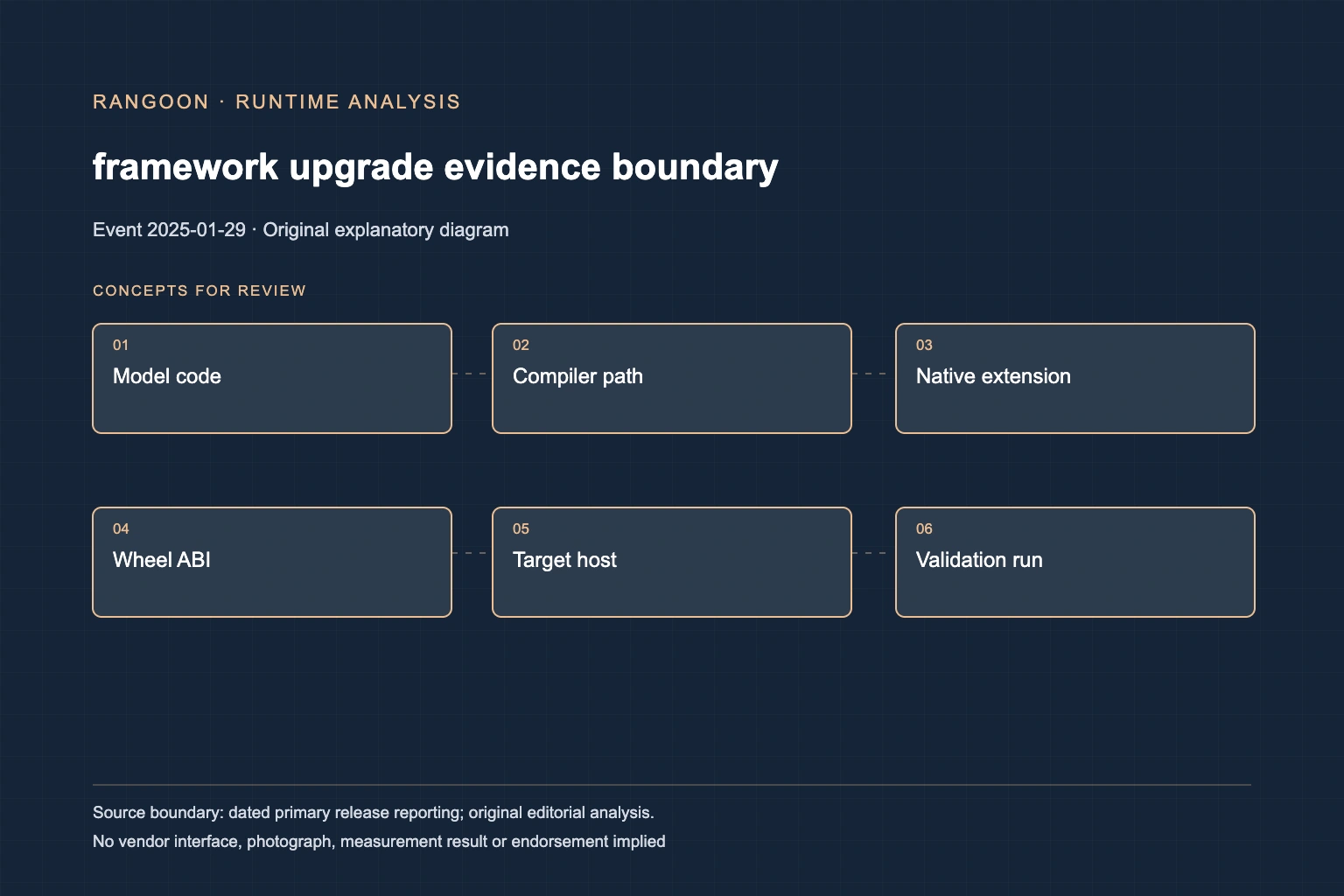
PyTorch said it would stop publishing on its official Anaconda channel starting with 2.6. It also said experimental Linux binaries used CUDA 12.6.3, ROCm 6.2.4 or XPU lanes as applicable, CXX11_ABI=1 and the Manylinux 2.28 platform, while asking custom C++ or CUDA extension builders to update their builds. That is a concrete packaging event, not a small installation footnote. Python source that imports cleanly can still fail at the native boundary if an extension, wheel resolver or base image assumes a different ABI. Package provenance, compatible indexes and container image pins therefore belong in an upgrade record alongside model tests.
A release note can identify a migration target without proving a completed migration[source 1][source 2]
The 2.6 materials establish what the project released and what it flagged as backward-sensitive. They do not certify an enterprise's dependency graph, serving latency, numerical tolerances or security posture. A careful migration can separate framework installation, extension rebuild, model export, compile enablement and traffic rollout so an observed change has a clear cause. It can also retain the prior resolved environment until target hardware and representative requests have passed. That distinction matters because framework releases carry both developer-facing features and lower-level toolchain assumptions. The January announcement is evidence of availability and stated support, while local validation remains evidence of behavior in a particular deployment.
Sources
- PyTorch: PyTorch 2.6 Release Blog (January 29, 2025)
- PyTorch GitHub: PyTorch 2.6.0 Release
Continue reading