Triton 3.2.0 reached PyPI with five Linux compiler wheels
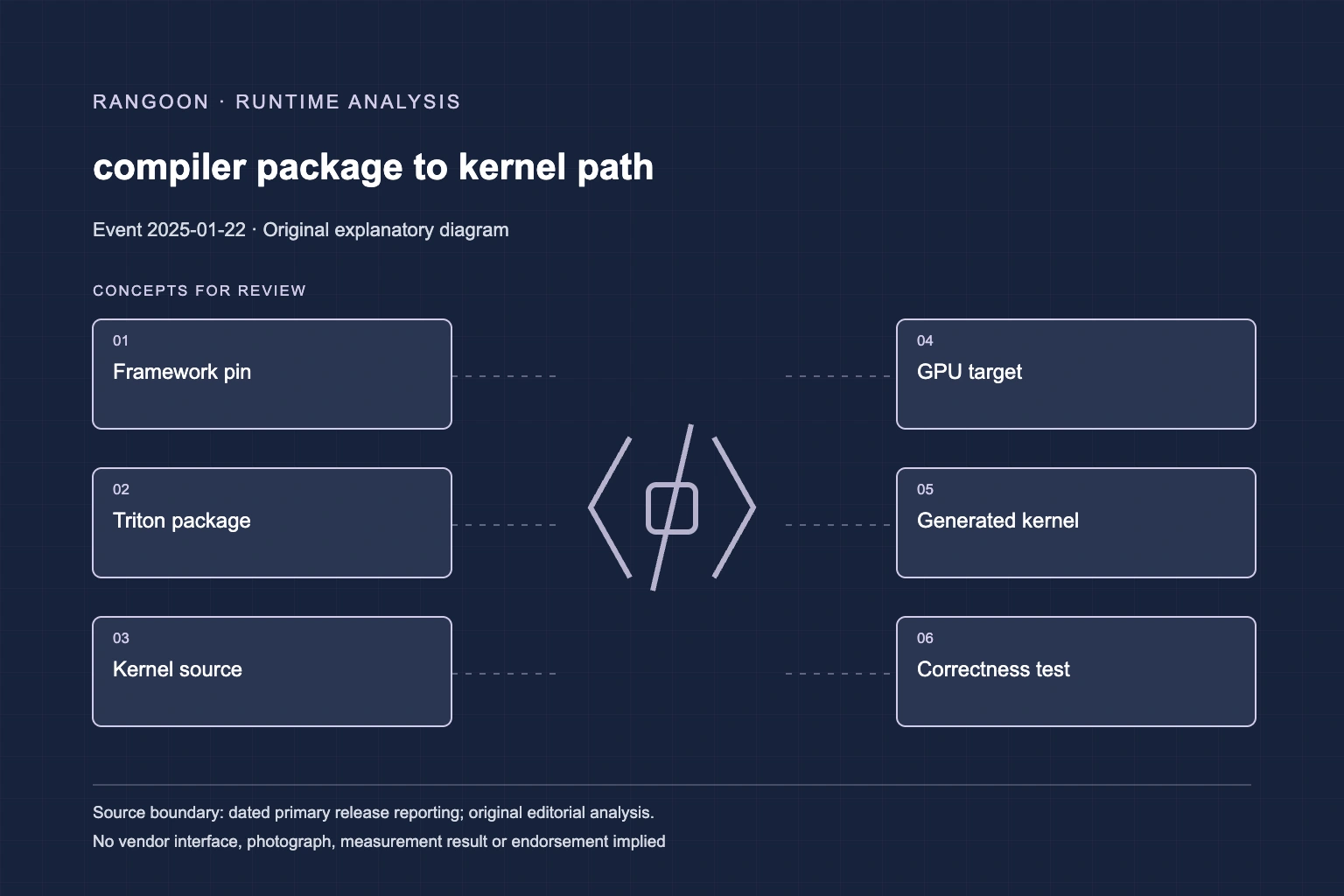
Triton 3.2.0 appeared on PyPI on January 22, 2025, with five Linux x86-64 wheels for CPython 3.9 through 3.13 and a matching promotion tag.
Historical reporting: the version-specific PyPI record gives January 22, 2025 as the release date and dates the five wheel uploads to that day. The Triton repository tag separately records readiness for PyPI promotion. A source tag and an uploaded distribution are different records. No October branch-cut history is asserted, and current package metadata is not treated as a complete January release announcement.
Key takeaways
- The dated PyPI record establishes January 22 package publication, while the GitHub tag records readiness to promote the 3.2.x release.
- The version-specific file list contains five Linux x86-64 wheels covering CPython 3.9 through 3.13; that is a packaging scope, not a universal device-support claim.
- The public records identify a concrete compiler dependency but contain no application benchmark that establishes an inference-speed gain.
The package registry supplies the publication date[source 1][source 2]
Triton 3.2.0 was published on PyPI on January 22, 2025. The version-specific registry record gives that release date and lists five wheel files uploaded on the same day. Separately, the project repository has a v3.2.0 tag whose message says the 3.2.x release was ready for promotion to PyPI. Reading both records resolves a small but important historical distinction: a maintainer can mark source as ready before a distribution exists for a package installer. Here, the registry supplies evidence of actual uploaded files. The tag supplies the project-side promotion context. Neither record is a model announcement or an application-performance result.
Five wheels defined a concrete Python and operating-system surface[source 1]
The 3.2.0 file list contains Linux x86-64 wheels for CPython 3.9, 3.10, 3.11, 3.12 and 3.13. Each filename identifies its interpreter and platform tags, so the publication is more precise than a general claim that a new compiler version was available. The visible records establish those specific distribution artifacts; they do not establish a matching Windows, macOS, ARM or arbitrary Python build. This distinction matters when a higher-level framework resolves a compiler dependency automatically. An environment can request the same version number yet have a different compatible-file selection, or no matching file, because its interpreter or platform differs from the published wheel tags.
The tag and registry answered different dependency questions[source 1][source 2]
The repository tag names version 3.2.0 and describes enabling promotion for the 3.2.x line. The package record identifies the corresponding version in the distribution registry and exposes file-specific hashes. Together they give an engineer two useful references: a project-side source revision and the concrete wheel an installer can retrieve. They are not interchangeable identifiers. A source checkout may be built with a different toolchain or local changes, while a wheel is a particular binary artifact. Keeping the tag, selected filename and its digest together makes the dependency record more informative than writing only Triton 3.2 in a build note.
This was a package-publication milestone, with a narrow evidence boundary[source 1][source 2]
The dated uploads make this a verifiable release event even though the tag message contains little feature detail. The article therefore reports package availability and the visible distribution scope rather than inventing a kernel-feature list or a planned branch-cut chronology. The registry and tag do not publish an end-to-end inference benchmark for this release. They also do not show which Triton version a downstream framework actually selected, which GPU kernels ran or how a model behaved. Those are different observations. The January record remains useful for reconstructing an environment: it names the version, the publication day and the specific binary files that could have been selected, without converting those facts into a claim about every workload.
Sources
- PyPI: Triton 3.2.0 release files and upload dates (January 22, 2025)
- Triton GitHub: v3.2.0 PyPI-promotion tag (January 22, 2025)
Continue reading