

Salesforce introduced Agentforce 3 with Command Center, trace data and MCP direction
Salesforce announced Agentforce 3 on June 23, 2025, adding Command Center observability, OpenTelemetry-linked session traces and a roadmap for MCP interoperability.
Historical reporting: Salesforce announced Agentforce 3 on June 23, 2025. The announcement defines Command Center, Session Tracing, MCP direction, Testing Center and staged availability. Salesforce Help’s Session Tracing record is a later technical reference for the announced trace model, not June availability proof. Product and customer results are vendor claims.
Key takeaways
- Agentforce 3’s June post placed Command Center in Agentforce Studio and described live analytics for latency, escalations and error rates.
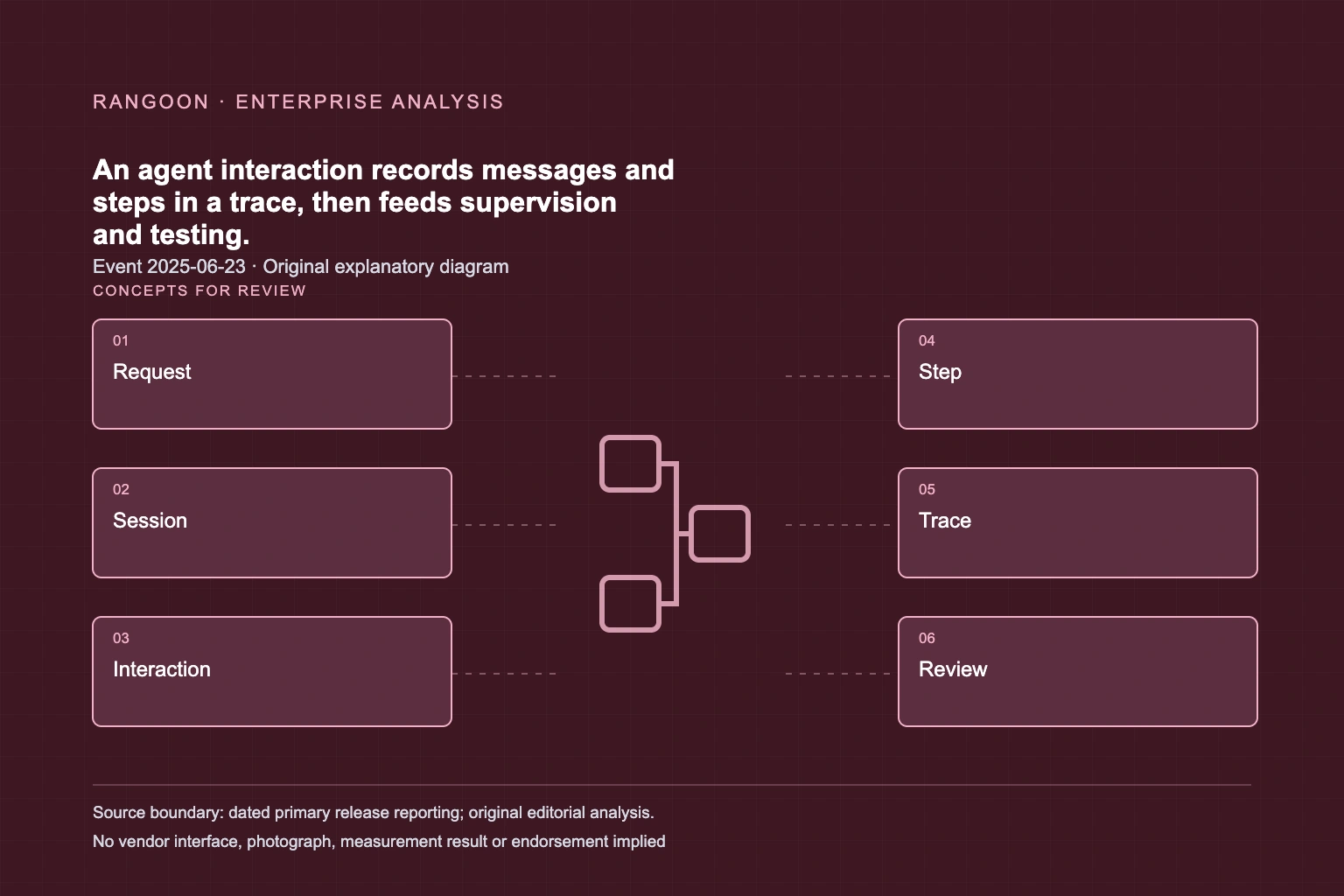
- Salesforce said session traces would use a native Data Cloud model built on OpenTelemetry; the later record defines sessions, interactions, messages and steps.
- MCP support was staged: native MCP support was listed for July, while Command Center and the Studio app were listed for August.
The June 23 announcement gave Agentforce 3 a staged feature map[source 1]
Salesforce announced Agentforce 3 on June 23, 2025 as an upgrade aimed at visibility and control for AI agents. The post named Agentforce Command Center, built-in support for Model Context Protocol, an expanded AgentExchange and more than 100 pre-built industry actions. It also gave a staged availability list rather than claiming every feature was live that day. Native MCP support was listed for July; Command Center and the Agentforce Studio app were listed for August; Session Tracing Data Model and agent-health monitoring were also listed for August. Anthropic models hosted in the Salesforce trust boundary, MuleSoft MCP and A2A support, and Heroku AppLink were marked generally available in July. The announcement is evidence of that roadmap as published, not proof that a feature had reached a particular org, edition or region.
Command Center joined live health signals to interaction-level investigation[source 1]
Salesforce described Command Center as an observability layer inside Agentforce Studio. The June post says teams could analyze interactions, drill into specific moments, inspect usage trends and view recommendations for tagged conversation types. It names live analytics for latency, escalation frequency and error rates, with alerts for unexpected events, plus dashboards for adoption, feedback, success rates, cost and topic performance. The post also says Service Cloud would be the first place where agent activity appeared in real-time wallboards for contact-center supervisors. This is release-specific information about the intended management surface. It is not a claim that a dashboard decides whether a response was correct, nor evidence that an organization collected every signal. The practical importance lies in which event types Salesforce chose to make observable.
Salesforce tied the release to a structured trace model in Data Cloud[source 1][source 2]
The announcement says agent activity would be captured in a native, extensible Session Tracing Data Model in Data Cloud and that signals were built on OpenTelemetry for integration with Datadog, Splunk and Wayfound. A Salesforce Help record supplies the feature-level structure: an AI agent session is the top-level container, interactions represent request-and-response segments, messages identify communications, and interaction steps record discrete operations. It also describes references to reasoning-engine LLM calls and fields that can link an interaction to a distributed telemetry trace and span. That later document is useful technical context, but it should not rewrite the June schedule: its release-note version says Session Tracing became available starting in August 2025.
The June post connected interoperability to Testing Center and explicit release timing[source 1]
Salesforce presented MCP as a path to plug-and-play interoperability and said Agentforce 3 would use an expanded partner catalog. The announcement also said Testing Center could simulate behavior at scale with state injection and AI-driven evaluations, while Agentforce Studio could use natural language to generate topics, instructions and test cases. These details distinguish a protocol connection, an authoring environment and a testing environment. The public roadmap placed native MCP support in July, not on the June 23 event date. The source does not specify which third-party connections a customer has completed, which tools an agent may invoke, or what authentication configuration an outside organization uses. The historical event is the product direction and timetable Salesforce stated, not proof of a completed third-party connection.
Sources
Continue reading
Related reading
 News analysisSalesforce signed for Informatica at an $8 billion stated equity value, then closed the data-management acquisition3 min read
 News analysisZoom released AI Companion 2.0 as a cross-Workplace context and action surface3 min read
 News analysisZendesk’s 2025 Resolution Platform joined service agents, knowledge, actions and QA3 min read