

Salesforce signed for Informatica at an $8 billion stated equity value, then closed the data-management acquisition
Salesforce signed a definitive agreement to acquire Informatica on May 27, 2025 for approximately $8 billion in stated equity value and completed the deal on November 18.
Historical reporting: Salesforce announced a definitive agreement to acquire Informatica on May 27, 2025, stating approximately $8 billion in equity value net of Salesforce’s current investment and $25 cash per share. Salesforce announced completion on November 18, 2025. The announcement’s descriptions of catalog, integration, quality, privacy, metadata and master-data capabilities are the companies’ stated transaction rationale. Plans to integrate those capabilities into Agentforce and Data Cloud were forward-looking at announcement; closing does not prove a completed product integration, data quality result, regulatory outcome or an investment conclusion.
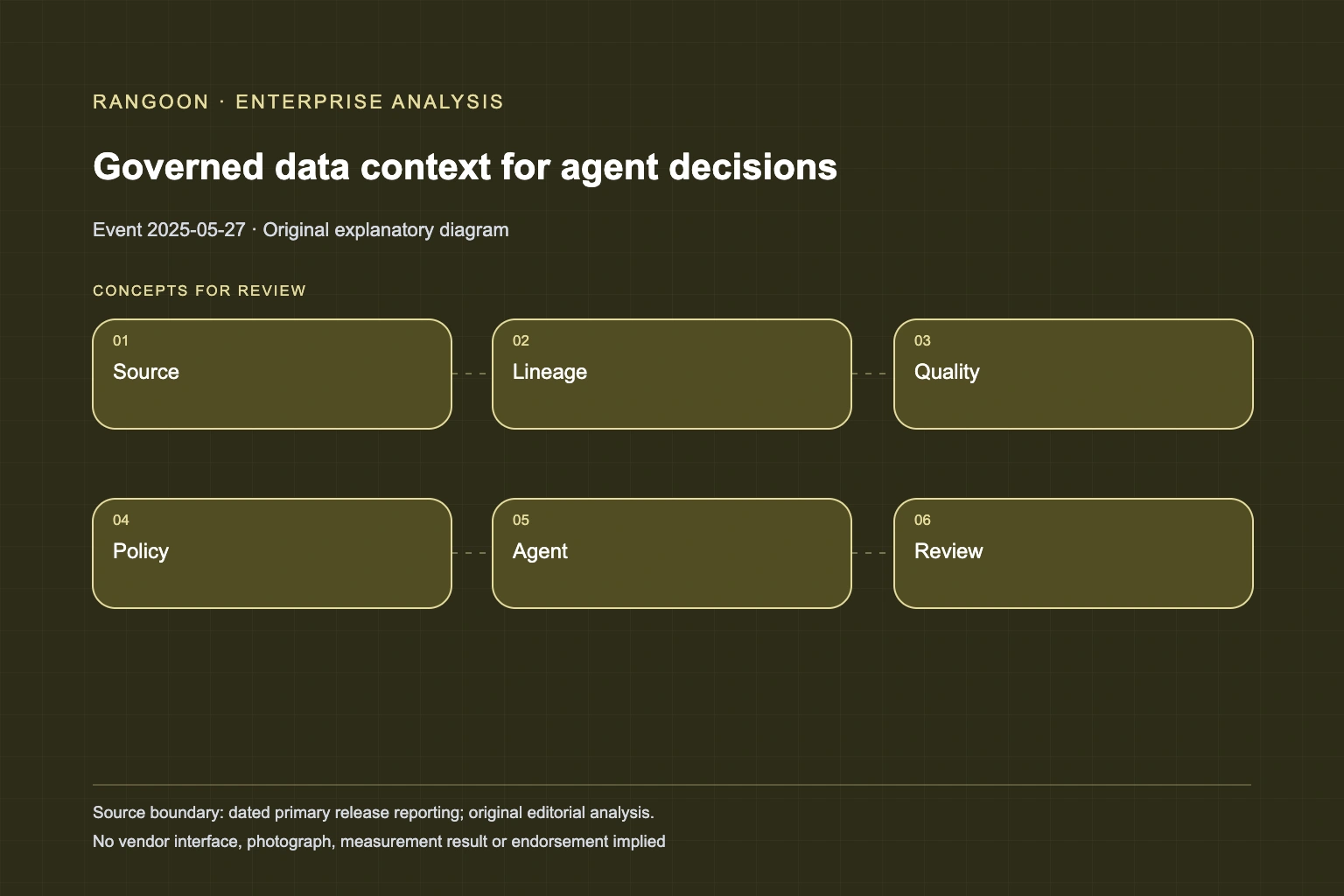
Key takeaways
- The May 27 event was a signed definitive agreement with stated transaction terms, while the November 18 release records completion.
- Salesforce positioned governance, metadata, quality and master data as foundations for its agent-oriented data stack.
- A catalog or governance product can improve evidence and control, but it does not by itself make an agent’s decision correct or permitted.
The May announcement states an agreement and its reported consideration[source 1]
On May 27, 2025, Salesforce and Informatica announced that they had entered into an agreement for Salesforce to acquire Informatica. Salesforce stated an approximate $8 billion equity value net of its existing Informatica investment and said holders of the relevant common stock would receive $25 cash per share. Those are company-reported transaction terms, not a valuation recommendation or a projection of either company’s future performance. The release says the boards approved the deal and lists customary closing conditions and regulatory clearances. That makes the event a signed-acquisition record with disclosed terms, rather than evidence that the transaction had already closed. A reader should keep the agreement date, reported consideration and subsequent completion status distinct from business forecasts made around the deal.
The release placed data management underneath the proposed agent platform[source 1]
Salesforce described Informatica’s catalog, integration, governance, quality, privacy, metadata-management and master-data-management services as inputs to a more complete data foundation for agentic AI. It also connected those capabilities to Data Cloud, MuleSoft, Tableau and Agentforce. This is a concrete product thesis: agents need context about data origin, transformation, quality and policy as well as access to values. It is not a demonstration that a particular record is accurate or that a model will use metadata correctly. Data lineage can identify a source path without answering whether the source is current, authorized for a user, relevant to a request or internally consistent. The announcement supplies the companies’ stated architecture direction, while an actual deployment must separately show its data contracts, user permissions, refresh behavior and response review.
The November release changes the transaction state from planned to completed[source 1][source 2]
Salesforce announced on November 18, 2025 that it had completed the acquisition of Informatica. The completion release again named Informatica’s catalog, integration, governance, quality, privacy, metadata and master-data services and said Salesforce would rapidly integrate its technology stack. This source is important because it turns the earlier proposed transaction into a completed one. Its integration statements still use future-oriented language. Corporate completion does not prove that a single data pipeline, unified metadata path or Agentforce feature was already operating for each customer. Migration, product packaging, connector behavior and customer authorization remain separate implementation facts. The historical account can therefore report both the agreement and close accurately without treating a stated integration plan as a release note.
Trusted-data language still leaves application-specific decision controls to the user[source 1][source 2]
The transaction was notable because Salesforce explicitly connected data-management functions to the reliability claims made for enterprise agents. That linkage is useful but bounded. A master-data record can reduce duplication, a quality rule can flag an issue, and a lineage record can document provenance. None automatically determines whether an agent should answer a question, expose a field, call an API or alter a business record. Those actions depend on the caller’s identity, policy, evidence threshold and approval design. The May and November releases do not publish a universal access-control model or test evidence for customer workflows. They support a focused historical conclusion: Salesforce signed for Informatica with the stated terms and data-management rationale, then closed the deal. They do not support investment advice, a blanket compliance claim or an assertion that all future agent outputs are governed.
Sources
Continue reading
Related reading
 News analysisSalesforce introduced Agentforce 3 with Command Center, trace data and MCP direction3 min read
 News analysisNIST, NSA and CISA publish voluntary SI incident-readiness practices3 min read
 News analysisAnthropic expanded AI for Science credits: preserve research evidence beyond access3 min read