

Skild presented vision-based locomotion as a specific result within its broader omni-bodied robot-model program
Skild AI published its vision-based locomotion result on August 6, 2025, describing end-to-end control from visual input while framing it within its Skild Brain research program.
Historical reporting: Skild AI published “One Model, Any Scenario: End-to-end Locomotion from Vision” on August 6, 2025. Its July 29 technical account describes Skild Brain as a hierarchical, omni-bodied robotics foundation-model program and discusses simulation, video and targeted real-world post-training. The sources are company technical reports of a research result and architecture direction. They do not provide independent replication, a public model release, a general safety guarantee, a product deployment receipt, or evidence that one policy covers every robot and terrain.
Key takeaways
- Skild’s August post presented a visual-input locomotion result, not a general certification for robots in arbitrary environments.
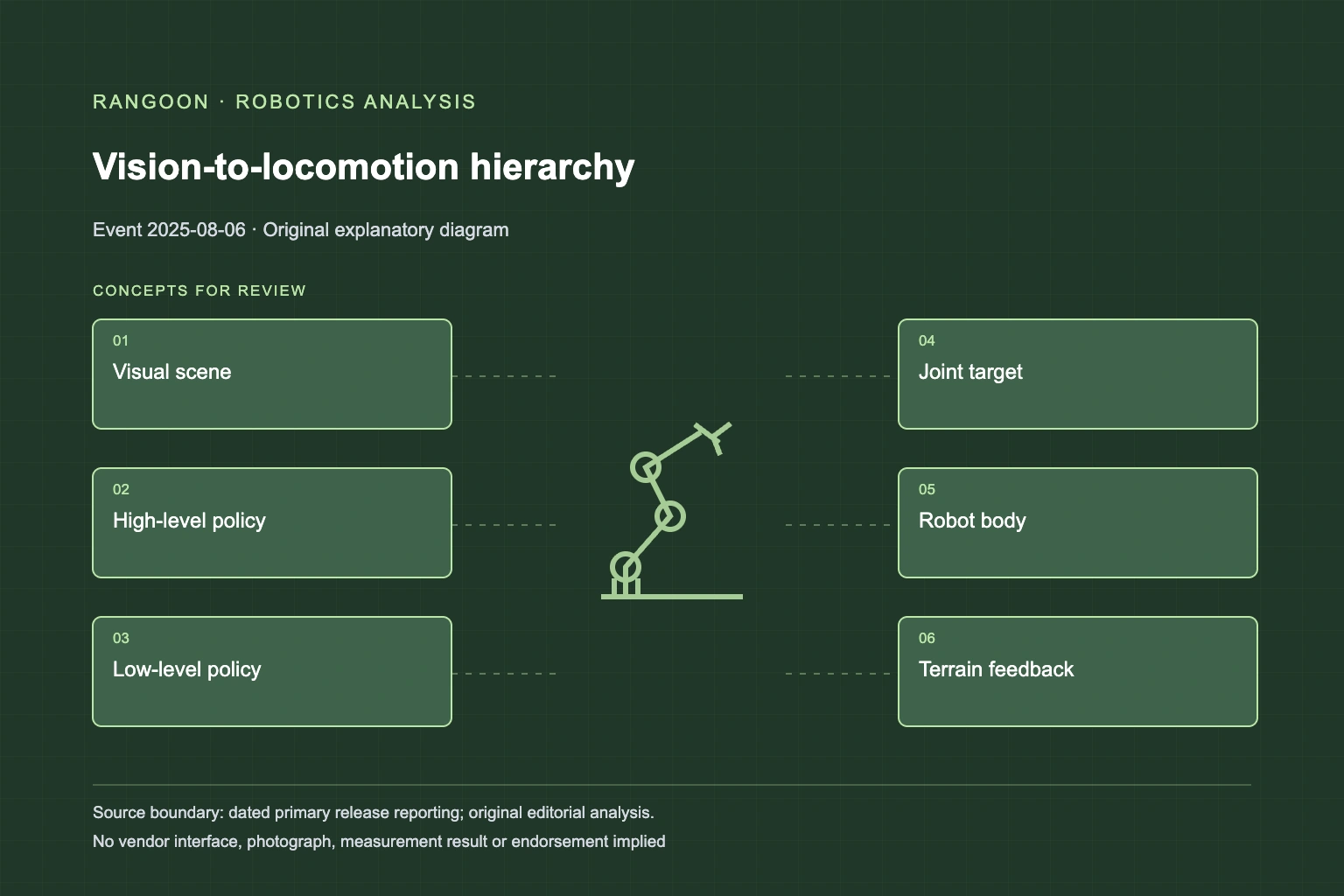
- The company separately described a high-level and low-level policy hierarchy for Skild Brain.
- The public accounts state research methods and goals but do not supply independent benchmarks, weights or customer deployment outcomes.
Skild framed the August result around vision-dependent locomotion in variable terrain[source 1]
Skild AI published its end-to-end locomotion-from-vision account on August 6, 2025. The post contrasts visually guided terrain negotiation with acrobatic movements that can be performed using internal sensing in controlled settings. Its examples focus on stair climbing and obstacles whose geometry can vary, framing vision as a necessary input for that problem. This is a research communication about a defined locomotion challenge. It is not a statement that a robot can safely navigate every staircase, building, outdoor surface, or worksite. The post does not publish an independent field study, a full test protocol, or a certified operating envelope. A careful reading keeps the event tied to the company’s demonstration and technical explanation of visual locomotion, instead of translating a named result into a broad public claim about autonomous mobility.
The earlier Skild Brain account described a hierarchy rather than a single undifferentiated control claim[source 2]
Skild’s July account describes Skild Brain as a robotics foundation-model program intended to generalize across several robot morphologies. It says the system uses a low-frequency high-level manipulation and navigation action policy and a high-frequency low-level action policy that translates commands into joint angles and motor torques. That is the company’s stated architectural framing. It helps distinguish task direction from low-level physical action, but it is not enough to reconstruct the full controller. The public material does not provide weights, source code, a reproducible training recipe, interface specifications, or a safety supervisor. It also does not prove that the same system performs equally well on every listed morphology. The archive reports the disclosed hierarchy as context for the August locomotion story, while leaving unreported implementation and performance details outside its conclusions.
The sources describe mixed data sources and targeted post-training without a public dataset receipt[source 1][source 2]
Skild says its approach uses large-scale simulation and internet video for pre-training, followed by targeted real-world data for post-training aimed at delivering working solutions. That description is important because it makes the company’s data strategy more specific than a claim that the system simply learned from a robot demonstration. It still does not disclose a public dataset inventory, consent and provenance treatment for every video source, filtering method, real-world data volume, or a benchmark split. The August locomotion post should therefore not be read as proof that a model has seen every real environment it might encounter. The sources supply the company’s stated research path and examples of why visual conditions vary. They do not establish universal generalization, independent reproducibility, or a particular deployment reliability level.
A research result and a product-deployment claim require different evidence[source 1][source 2]
Skild presents a broad ambition for an omni-bodied robot brain, while the August post gives a concrete visual-locomotion example. Both can be true without proving that one model is ready for unlimited deployment. The public materials do not name a customer, a factory installation, a robot fleet, an operating duration, or a task-level service guarantee. They also do not provide a safety certification or an independently audited comparison with specialist locomotion systems. This boundary protects the usefulness of the announcement: it records a company’s dated technical result and stated architecture direction. It does not treat marketing scope, research aspiration, or a visual demonstration as a verified claim about every robot, task, or human environment. Claims about commercial delivery or measured real-world outcomes need a separate partner or operating record.
Sources
- Skild AI: One Model, Any Scenario: End-to-end Locomotion from Vision (August 6, 2025)
- Skild AI: Building the general-purpose robotic brain (July 29, 2025)
Continue reading
Related reading
 News analysisAmazon introduced DeepFleet to coordinate mobile robots, then documented four model design paths3 min read
 News analysisMercado Libre and Agility announced a Digit agreement beginning with a Texas fulfillment facility3 min read
 News analysisHyundai Mobis publicly detailed an Atlas actuator-supply framework after CES3 min read