

SynthID Text made provenance detection a generation-time design choice
Google opened SynthID Text on October 23, 2024, making text-watermark detection a generation-time design and evaluation problem.
Historical reporting: Google’s October 23, 2024 announcement made SynthID Text available through Hugging Face and its Responsible GenAI Toolkit, alongside a Nature paper. A positive detector result is probabilistic evidence about a compatible watermark, not proof of human or AI authorship, intent, or factual reliability.
Key takeaways
- SynthID Text moved text watermarking into a generation utility and detector workflow that developers could inspect and adapt.
- The mark is a statistical pattern in token selection, so detector calibration, model configuration and transformation resistance are part of the system boundary.
- A detector result should support a review path, not decide authorship, truthfulness or punitive action by itself.
The October release linked an implementation to a research record[source 1][source 2]
Google announced SynthID Text on October 23, 2024 as part of an expansion of its Responsible GenAI Toolkit. The announcement said text watermarking and detection were available to developers through Hugging Face and the toolkit, while a Nature paper described the underlying scheme. That pairing matters because the historical event was both an access change and a method disclosure. It did not create a universal detector for all machine-written text, nor did it make a watermark result a provenance record for every document.
The watermark biases token choice instead of adding a visible marker[source 2][source 3]
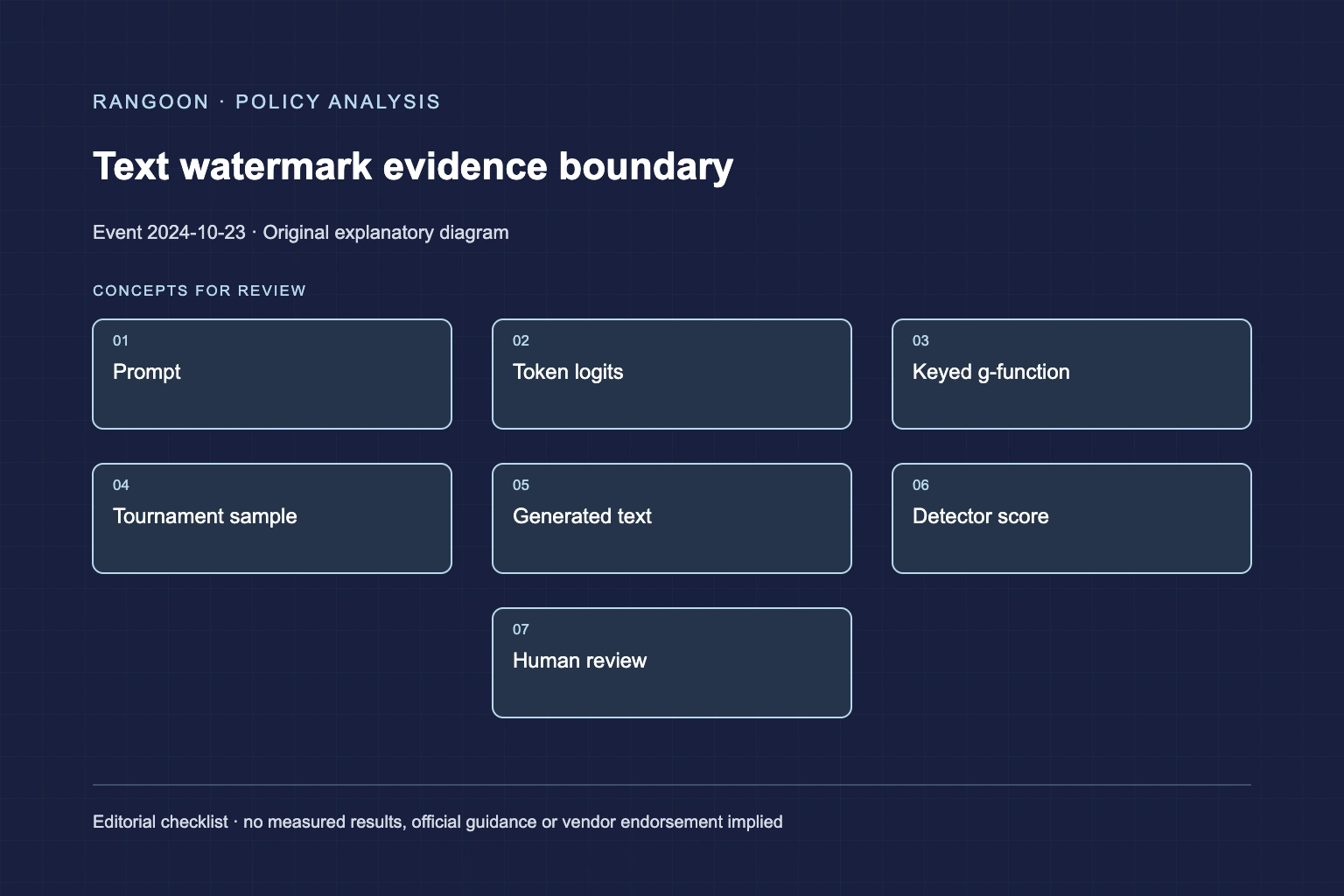
SynthID-Text operates while a language model generates tokens. The paper describes a keyed pseudo-random g-function that assigns values to candidate tokens from recent context, then a tournament sampling procedure that favors choices carrying the desired statistical pattern; a detector tests whether the final sequence contains more of that keyed pattern than chance predicts. Later maintained Google toolkit documentation describes a logits processor with key and n-gram configuration; these implementation details provide subsequent context for the 2024 method. Watermark strength, text quality and robustness depend on sampling, tokenizer compatibility, secret configuration and the detector trained for that configuration; because each choice also changes later context, the practical test unit is a complete generated sequence under declared decoding settings, including temperature and candidate-filter policy, not an isolated word or character pattern.
Detection produces a calibrated signal, not authorship proof[source 2][source 3]
A watermark detector answers a narrower question than an AI-authorship classifier: whether text is statistically consistent with a particular applied watermark and detection setup. Its threshold creates false-positive and false-negative tradeoffs, so a result should retain detector version, configuration lineage, model revision, text length, threshold and uncertainty policy; short excerpts can contain too little statistical evidence for a decisive score. A positive score cannot establish who prompted, edited or published the text, and a negative score cannot show that a person wrote it or that no model touched it. In the later toolkit guidance, a reused configuration is meaningful only if the detector was trained for the model and tokenizer that produced the text, so a probability should trigger contextual inspection rather than serve as a standalone verdict.
Paraphrasing and task type set practical limits on a watermark[source 3]
Later maintained Google toolkit documentation says SynthID Text can tolerate cropping, a few word changes and mild paraphrasing, but notes reduced confidence after thorough rewriting or translation; it also notes that factual responses leave less room to alter token probabilities without hurting accuracy. Those are engineering constraints, not edge cases. A deployment should test representative response lengths, languages, retrieval-heavy answers, edits and transformations before treating a detector score as actionable, and its evaluation set should include human-edited marked material plus unmarked text from the same domain. It should measure its own error rates on held-out marked and unmarked material; no vendor evaluation in the announcement or paper is an independent measurement of another model, workflow or user population.
Sources
- Google Developers Blog: Evolving the Responsible Generative AI Toolkit with new tools for every LLM (October 23, 2024)
- Nature: Scalable watermarking for identifying large language model outputs (October 23, 2024)
- Google AI for Developers: SynthID tools for watermarking and detecting LLM-generated text
Continue reading
Related reading
 News analysisGoogle’s Big Sleep reported a previously unknown SQLite flaw before release, with human disclosure still central3 min read
 News analysisFACTS Grounding’s January paper defined a two-stage test for document-faithful answers3 min read
 News analysisGoogle DeepMind and NVIDIA announced MuJoCo Warp as an early alpha3 min read