

Google DeepMind and NVIDIA announced MuJoCo Warp as an early alpha
Google DeepMind and NVIDIA announced the early-alpha MuJoCo Warp on March 18, 2025, bringing a GPU-oriented MuJoCo implementation to high-throughput robotics simulation.
Historical reporting: Source 0 is the dated Google DeepMind MuJoCo project announcement. Source 1 is the current official MJWarp repository, used only for implementation scope, requirements and exceptions; it is not used as March 2025 launch-date proof.
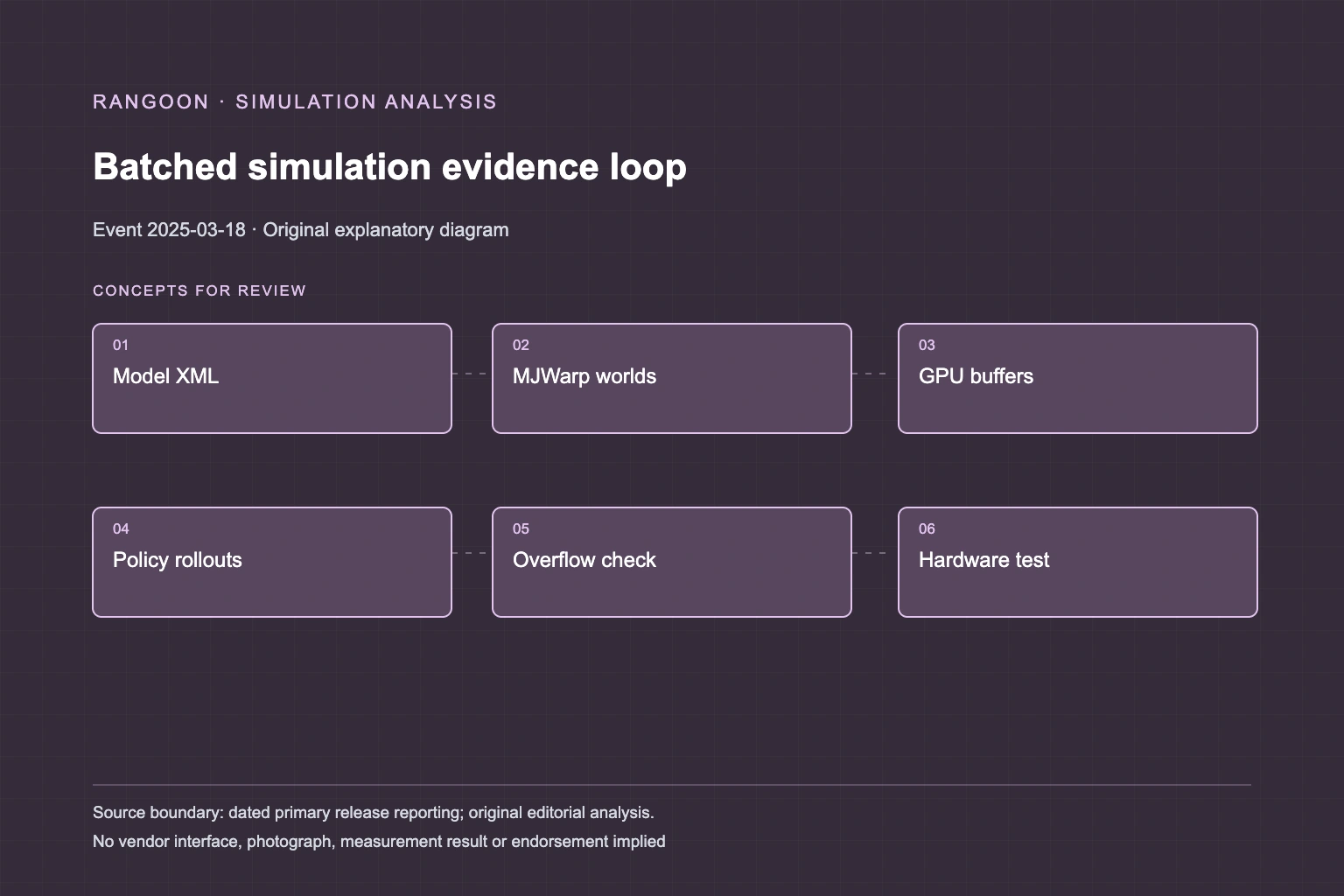
Key takeaways
- Google DeepMind and NVIDIA announced MuJoCo Warp on March 18, 2025 as early-alpha, open-source GPU-oriented work for NVIDIA hardware.
- The launch compared high-throughput complex-scene simulation with MJX, while the current project describes both GPU acceleration and CPU development or debugging support.
- Alpha status, unsupported API features and fixed GPU buffer limits mean throughput claims cannot substitute for correctness checks or workload-specific benchmarks.
The March event was an early-alpha availability claim[source 1]
Google DeepMind announced MuJoCo Warp, or MJWarp, on March 18, 2025 in the official MuJoCo project. The announcement described a new open-source implementation of MuJoCo optimized for NVIDIA hardware and built with NVIDIA Warp. It also called the code early Alpha and said many features were still missing. That release status is part of the technical record, not an incidental caveat. An alpha can expose a useful direction, API and benchmark path while retaining gaps that affect compatibility and repeatability. The announcement reported more than 100 times faster simulation than MJX for some complex scenes such as manipulation tasks, but that is a supplier comparison under then-current workloads. It does not establish the same result for every model, contact configuration, GPU, batch size or robotics training stack.
GPU throughput targeted many worlds, not every local task[source 1][source 2]
MJWarp’s current repository describes it as a GPU-accelerated version of MuJoCo for robotics research and says an NVIDIA GPU is required for fast simulation, although CPU execution remains available for development and debugging. That distinction matters when reading its high-throughput objective. GPU simulation has setup, transfer and launch costs; a workload that runs thousands of environments can behave differently from a single interactive scene. The repository also lists examples spanning rigid contacts, soft bodies, cloth and signed-distance fields, which shows breadth without establishing equal maturity or performance for each. A simulator user needs to fix the model, numerical settings, world count, device and measurement method before comparing results. “Faster” is not a property of a simulator in the abstract; it is a claim about a defined workload and resource envelope.
Compatibility gaps remained part of the operating surface[source 2]
The project’s current compatibility section documents exceptions to standard MuJoCo behavior, including no support for the IMPLICITFAST midpoint integrator, no PGS solver and missing plugin actuator and sensor types. It also marks flex support experimental and says Warp-based differentiability is not yet available. These entries should not be projected backward as a complete March 2025 feature table, but they do show why a drop-in framing needs verification. A policy or model that depends on a particular solver, actuator plugin, sensor path or differentiation route may need an adaptation rather than a package swap. The engineering question is not only whether an XML model loads. It is whether the contact sequence, controls, observation pipeline and optimization path relevant to a target training run behave as required.
High throughput required explicit overflow and fidelity checks[source 1][source 2]
MJWarp documentation describes fixed-size allocations for contacts, constraints and related GPU buffers, and warns that an overflow can lead to undefined behavior when a simulation demand exceeds those limits. That is a concrete operational reason to monitor status rather than accepting a fast run as valid. The March announcement established an early-alpha, open-source path and a stated performance goal; it did not certify a manipulation policy, contact model or sim-to-real outcome. Benchmark values should remain attributed to Google DeepMind and NVIDIA and be rerun on the intended scene. A sound evaluation records overflow checks, solver settings, time step, random seeds, GPU, task success criteria and representative hardware tests. The archive supports the dated announcement and its declared scope, while leaving later package maturity and any real-world transfer claim outside the evidence.
Sources
Continue reading
Related reading
 News analysisNVIDIA’s memory codesign post highlights a practical boundary between capacity and usable agent throughput3 min read
 News analysisNVIDIA supply-chain capacity plans make packaging, test and optics explicit infrastructure constraints3 min read
 News analysisTensorRT-LLM 0.17 added Blackwell and an experimental PyTorch workflow3 min read