TensorRT-LLM 0.17 added Blackwell and an experimental PyTorch workflow
NVIDIA released TensorRT-LLM 0.17 on February 7, 2025 with scoped Blackwell support, NVFP4 work and an experimental PyTorch workflow.
Historical reporting: NVIDIA's dated GitHub 0.17.0 release establishes the event and its stated scope. Current TensorRT-LLM release notes were freshly read for product context only, not as launch-day proof. Hardware and performance statements remain NVIDIA release claims.
Key takeaways
- TensorRT-LLM 0.17 brought Blackwell-era support with explicit installation and coverage limits.
- The PyTorch workflow was marked experimental and listed a bounded model, hardware and feature set.
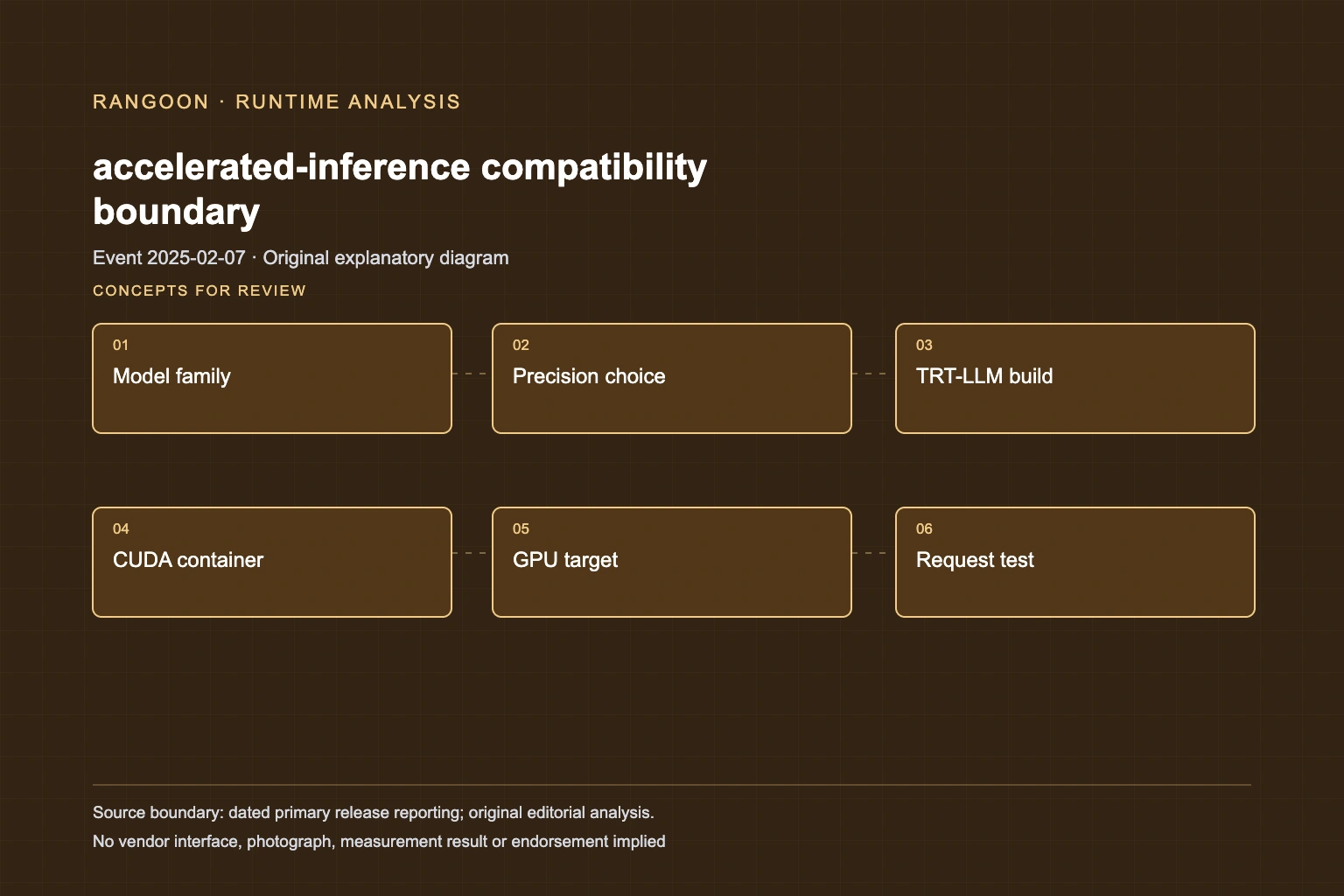
- A GPU architecture label cannot replace compatibility testing across model, precision, driver, CUDA container and runtime API.
NVIDIA recorded the 0.17 release on February 7[source 1][source 2]
NVIDIA's TensorRT-LLM repository shows version 0.17.0 released on February 7, 2025. The release calls out Blackwell support, B200 support, limited-model GeForce RTX 50-series support through Windows Subsystem for Linux, and NVFP4 GEMM support for Llama and Mixtral. It also says GB200 NVL was not fully supported. Those qualifiers are part of the event. They prevent a broad reading of Blackwell support as a promise that every Blackwell deployment, operating system, model or multi-node configuration was ready. The dated release is evidence of what NVIDIA announced for that version, not measured compatibility in a different environment.
One release note made packaging limits operationally important[source 1][source 2]
For Blackwell platforms, the 0.17 release says pip installation was not supported and recommends building from source with an NVIDIA NGC 25.01 PyTorch container. That changes the upgrade work from a package substitution to a controlled build and image decision. An operator needs to record the container, CUDA and driver relationship, compiler inputs and resulting artifacts before comparing an inference result. It is also prudent to make image provenance and rollback explicit, because a source build can differ from a prebuilt package in dependencies and enabled features. The announcement states a recommended path; it does not attest that a resulting build is reproducible or secure for every deployment.
The PyTorch path was explicitly experimental[source 1][source 2]
TensorRT-LLM 0.17 describes its tensorrt_llm._torch workflow as experimental. The release lists H100, H200 and B200 support; Llama, Mixtral, QWen and Vila model support; specified FP16, BF16, FP8 and NVFP4 GEMM and fused MoE paths; and additional capabilities including custom PyTorch ops, chunked context disabled by default, decode-only CUDA Graphs and an overlap scheduler. A detailed list is valuable because it defines what was claimed. It also exposes what must be tested: a model outside that list, a different precision or a context policy may not share the same behavior.
Inference releases need separate hardware, software and policy evidence[source 1][source 2]
The current TensorRT-LLM documentation shows a broad project surface, including installation, supported hardware, model recipes and serving APIs. That context does not rewrite the February 2025 release boundary. A deployment decision should separate hardware enablement from model correctness, numerical tolerance, capacity and request policy. For example, a quantization format can fit a GPU but still change a task score; a cache or scheduler option can improve a measured trace while changing latency under another mix. The 0.17 record's warning that GB200 NVL was not fully supported makes an explicit topology check especially important for multi-node plans. The 0.17 release supports a historical account of these stated features and limits. It does not prove any particular system's throughput, output quality or service availability.
Sources
Continue reading