

Tenstorrent put Blackhole’s developer hardware on an orderable, open-stack path
Tenstorrent launched Blackhole developer products on April 3, 2025, pairing PCIe cards and a four-processor workstation with its open-source software stacks.
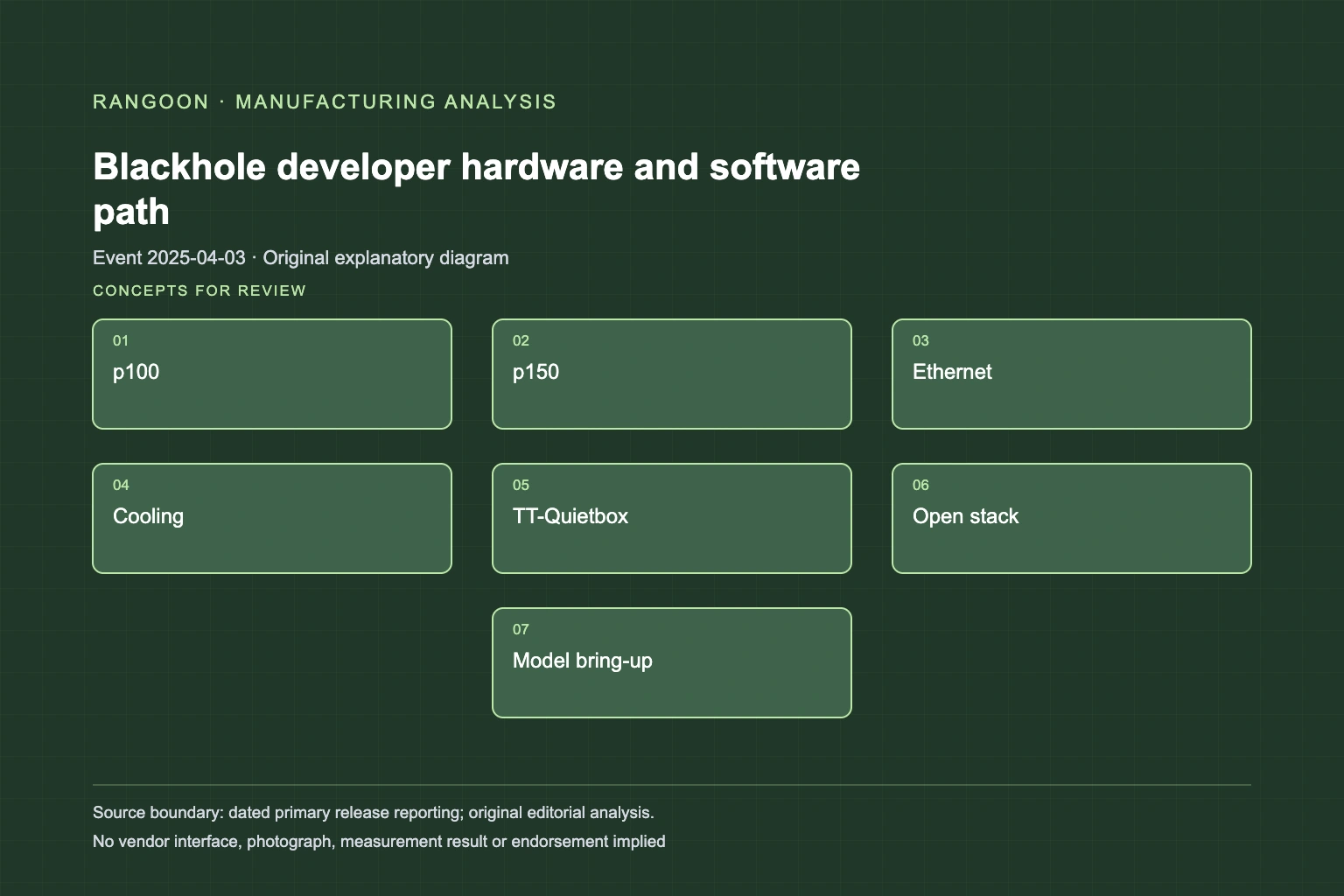
Historical reporting: Tenstorrent announced Blackhole developer products on April 3, 2025 and said listed cards and the TT-Quietbox were available for order. The announcement identifies form factors, cooling choices, Ethernet distinction, updated silicon and named open-source stacks. Current hardware documentation is later context and is not used as proof of April inventory, shipping time, benchmark performance or subsequent specifications.
Key takeaways
- Tenstorrent’s April event paired Blackhole silicon with orderable PCIe and workstation form factors.
- The p100 and p150 distinguished Ethernet and cooling options, while the TT-Quietbox combined four processors in a desktop system.
- Open-source stack support describes software availability, not automatic model compatibility or a measured workload result.
Blackhole arrived as developer products rather than only a chip announcement[source 1]
On April 3, 2025, Tenstorrent announced its Blackhole developer products at DevDay. The company said the p100, p150 and TT-Quietbox were available for order, turning a processor-family announcement into several ways to obtain and host the hardware. The p100 used one processor without Ethernet and active cooling; the p150 used one processor with Ethernet and offered passive, active and liquid-cooled forms. The TT-Quietbox placed four Blackhole processors in a liquid-cooled desktop workstation.
The product list made interconnect and thermal design part of the developer choice[source 1]
The p100 and p150 naming was not merely a price tier. Ethernet support affects how a card can participate in a connected system, while passive, active and liquid cooling change the enclosure and thermal assumptions around the same class of accelerator. A four-processor workstation changes the local integration question again by combining several devices into one system. Tenstorrent also described updated 6nm manufacturing, faster network-on-chip operation, higher memory density and additional integrated RISC-V cores, tying the product forms to a changed processor architecture. These are hardware-topology decisions that shape what a developer can test, even before a model compiler or runtime is involved. The April announcement provided those product boundaries without proving a particular multi-card model would scale as expected.
The open software stack was the bridge between cards and model work[source 1][source 2]
Tenstorrent said the Blackhole cards and TT-Quietbox were supported by its open-source TT-Forge, TT-NN, TT-Metalium and TT-LLK stacks, and launched a Developer Hub with model support and learning resources. That made software access part of the release mechanism rather than a separate afterthought. A developer could inspect and work through named layers from model support toward lower-level software, but the availability of those layers does not erase operator coverage or compiler bring-up work. The tradeoff is that an open stack can expose low-level control and community inspection while still requiring a model to be compiled, brought up and validated for a specific device path. The event supports the availability of named stacks, not a claim that all framework graphs or operators already ran on Blackhole.
Available for order did not settle delivery or workload readiness[source 1][source 2]
Tenstorrent’s wording established that the listed products could be ordered on the launch date. It did not establish inventory in every market, a delivery date for a particular buyer, or a finished serving system for every model. Later hardware pages can describe current card generations and systems, but those maintained pages cannot silently add features to the April event. The historical significance is a developer-access route for Blackhole hardware joined to named open-source software, with physical deployment and model compatibility remaining separate questions.
Sources
Continue reading
Related reading
 News analysisTensorRT-LLM 0.17 added Blackwell and an experimental PyTorch workflow3 min read
 News analysisOpenVINO 2025.1 put GenAI memory and NPU work into its runtime release3 min read
 News analysisIntel’s Crescent Island announcement made a future inference GPU a roadmap record, not available capacity3 min read