Texas set a January 2026 start for its Responsible AI Governance Act
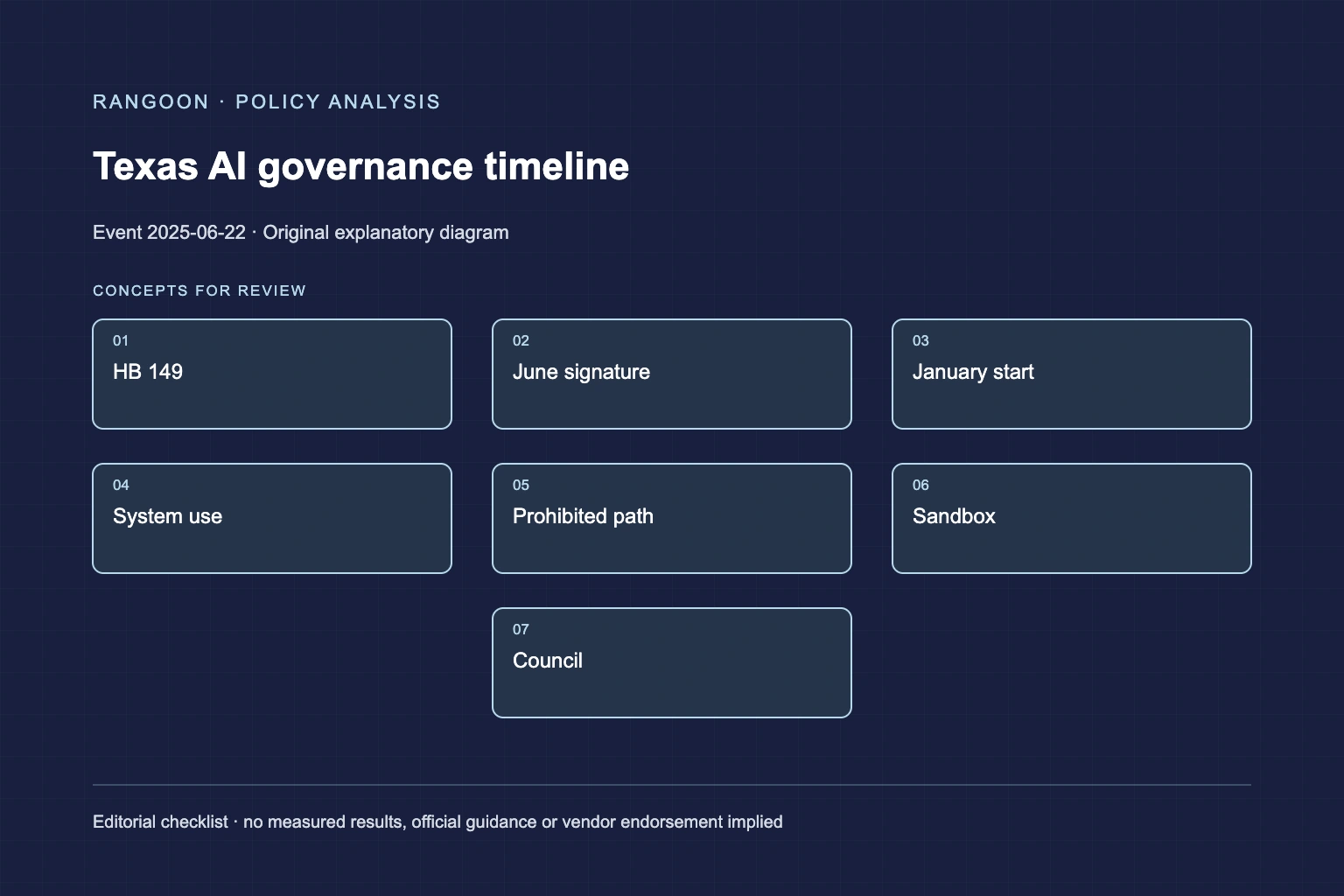
Texas Governor Greg Abbott signed HB 149 on June 22, 2025, setting January 1, 2026 as the effective date for the Texas Responsible AI Governance Act.
Historical reporting: Texas legislative records show that Governor Abbott signed HB 149 on June 22, 2025. The enrolled Act sets January 1, 2026 as its effective date; this analysis describes the enacted text and does not offer legal advice.
Key takeaways
- HB 149 was signed on June 22, 2025 and took effect on January 1, 2026; those are different events.
- The Act combines prohibitions, selected disclosures, a state sandbox, and public-sector governance rather than one general model-audit rule.
- A product classification should distinguish a system’s function, actor, deployment setting, and prohibited use before treating the statute as applicable.
The June signature and January commencement were separate milestones[source 1][source 2]
Texas legislative history records Governor Abbott’s signature on HB 149 on June 22, 2025. The enrolled text names the Texas Responsible Artificial Intelligence Governance Act and says it takes effect January 1, 2026. That sequence matters: passage by each chamber, gubernatorial signature, and legal commencement are not interchangeable dates. The official bill summary identifies amendments to the Business and Commerce Code and Government Code, placing the story in a state statutory framework rather than a voluntary vendor pledge.
The Act addressed defined uses and state institutions[source 1][source 2]
The enrolled summary lists selected disclosure requirements for certain AI users, including governmental agencies and health-care service providers, and prohibits specified development or deployment uses. Those listed prohibitions include systems intended to impair constitutional rights or unlawfully discriminate against a protected class, social scoring, certain biometric-data conduct, and specified sexually explicit content. The Act also creates a regulatory sandbox and the Texas Artificial Intelligence Council. Those provisions do not make every software feature, every output error, or every model-training choice the same legal question.
Product boundaries become an engineering input[source 1][source 2]
For technical teams, the useful unit of analysis is a concrete system path: who configures it, what it infers, whether it is deployed, what data it receives, and what external action follows. A generic chatbot and a workflow that ranks people, processes biometric inputs, or supports a health-care interaction can expose different facts. Teams can make those distinctions testable by mapping request types to model routes, tool permissions, output transforms, and user-facing notices. That mapping is implementation evidence; it is not a determination that a particular system complies with the Act.
An engineering inventory can also expose when a feature changes character after release, such as when an assistant gains identity matching, a ranking endpoint, or an action-taking integration. Each change should be attached to its code or configuration revision so a review can reproduce the observed path. This is narrower and more useful than treating a model family as a single unchanging system.
The historical record leaves operational questions open[source 1][source 2]
The Act’s effective date was January 1, 2026, while one enrolled provision directs the attorney general to post specified information and an online mechanism by September 1, 2026. Those dates show that the statute’s own implementation timeline has more than one stage. This article does not infer an enforcement outcome, a sandbox admission, agency funding decision, or a court interpretation from the text. Later guidance, rules, appropriations, and cases require separate source checks instead of being projected backward onto the June 2025 signing event.
A release calendar can preserve those distinctions without turning a date field into a compliance verdict. It can name the Act version, the system release, the feature flag, and the verified government source used for a timeline entry. That structure makes a later revision visible and prevents a project from silently carrying forward a statement written before an implementation date or rulemaking change.
Sources
- Texas Legislature Online: HB 149 history and governor action (June 22, 2025)
- Texas Legislature Online: HB 149 enrolled Act (June 22, 2025)
Continue reading