

Executive Order 14179 reset an AI policy direction and ordered an action plan
Executive Order 14179, issued January 23, 2025, revoked specified prior AI policy actions and directed development of an AI Action Plan within 180 days.
Historical reporting: the White House issued Executive Order 14179 on January 23, 2025. The order directed review and planning; this article does not infer current agency policy, contract terms, legal effect on any party or the status of later implementation.
Key takeaways
- An executive order can set direction and assign work without proving programme completion.
- The order’s revocation and review language requires version-aware policy inventories.
- Agency implementation claims need their own dated evidence after the order.
The order set a policy direction and assigned follow-on work[source 1][source 2]
The White House published Executive Order 14179, “Removing Barriers to American Leadership in Artificial Intelligence,” on January 23, 2025. The order stated a policy of sustaining and enhancing U.S. global AI dominance and said it revoked certain existing AI policies and directives that it characterized as barriers. It also directed specified White House officials, in coordination with agency heads as appropriate, to develop and submit an AI Action Plan within 180 days.
The Federal Register later published the order on January 31. The two dates describe different parts of the public record: January 23 is the order date used for this article’s event, while the Federal Register publication is an official publication record. Neither date alone proves how a particular agency changed a manual, system or acquisition.
A policy reset needs a versioned inventory[source 1][source 2]
When an order revokes prior actions and calls for review, teams should not rely on a document title or a copied policy table. Inventory the source, issuing authority, effective date, scope, replacement relationship and operational owner. Link each system control or procurement clause to the source version that justified it. That creates a path to find controls that became stale, changed or need confirmation.
A useful inventory also preserves uncertainty. “Referenced by a prior procedure” is not the same as “currently required,” and “under review” is not the same as “rescinded.” Ask the agency responsible for a control to confirm its standing before removing a safeguard or claiming a new requirement. This is operational discipline, not legal advice on the order’s reach.
Analysis: trace policy direction to a concrete authority[source 1][source 2]
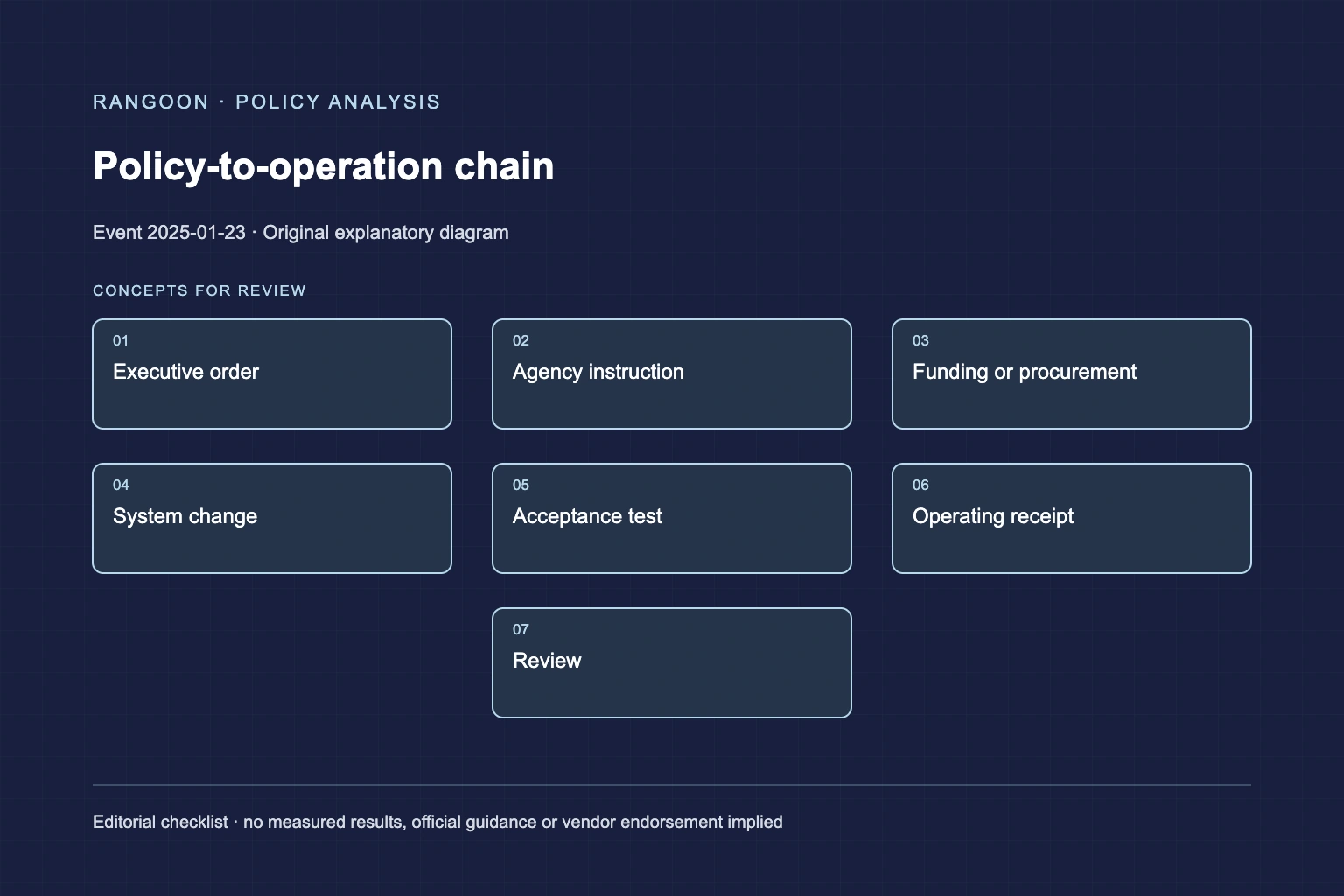
A policy statement becomes operational only through a chain: delegated authority, funding or procurement path, implementing instruction, system change and evidence of operation. The January order supplied direction and a planning instruction. Later actions require their own sources. A dashboard that jumps directly from executive order to “deployed” cannot show where the authority, money, acceptance test or accountable owner came from.
For an AI programme, keep that chain beside the workload record. Record the mission, model and data boundary, decision rights, evaluation results, security review and rollback owner. This gives an auditor a factual path without assuming that a general federal policy direction authorizes a particular use.
Analysis: distinguish the 2025 event from live policy[source 1][source 2]
This historical account records issuance on January 23, 2025 and Federal Register publication on January 31. It does not establish the current status of every executive-branch policy, regulation or agency implementation. Later executive actions, memoranda, court decisions, appropriations and agency records may matter to a live question.
Use the order as a dated primary source, then verify the present authority from current official sources before changing controls or making a compliance statement. That is a safer use of historical reporting than treating an executive order as a permanent, self-executing description of every federal AI programme.
Sources
Continue reading
Related reading
 News analysisFDA’s January AI-device lifecycle draft asked sponsors for an evidence trail, while remaining nonbinding and open for comment3 min read
 News analysisTexas set a January 2026 start for its Responsible AI Governance Act3 min read
 News analysisNew York’s RAISE Act tied frontier-model duties to a December 2025 signing3 min read