

UiPath launched an agentic-automation platform spanning agents, robots and people
UiPath launched its next-generation agentic-automation platform on April 30, 2025, positioning agent, robot and human orchestration as one enterprise workflow surface.
Historical reporting: UiPath announced its next-generation platform for agentic automation on April 30, 2025, describing orchestration across AI agents, robots and people. A UiPath community post records Agent Builder’s earlier private-preview background. UiPath statements about accuracy, security and business impact are supplier claims; they do not establish an organization’s process reliability, human-review design or realized return.
Key takeaways
- UiPath framed agentic automation as coordination among agents, robots and people.
- The April platform launch followed an earlier Agent Builder private-preview record.
- A unified orchestration claim still depends on each workflow’s data, tools and escalation path.
UiPath launched its agentic-automation platform on April 30, 2025[source 1]
UiPath’s April 30 release announced a next-generation platform for agentic automation. The company said it would unify AI agents, robots and people on one system and combine low-code and pro-code paths for enterprise agents. This is a platform announcement about how different automation actors could be orchestrated together. It is not proof that an agent, an RPA robot and a human reviewer completed a specific business process successfully. The event supports reporting UiPath’s stated product scope, while workflow performance remains tied to the systems, exceptions, permissions and review rules configured by an adopter.
The release treated agents, robots and people as distinct workflow actors[source 1][source 2]
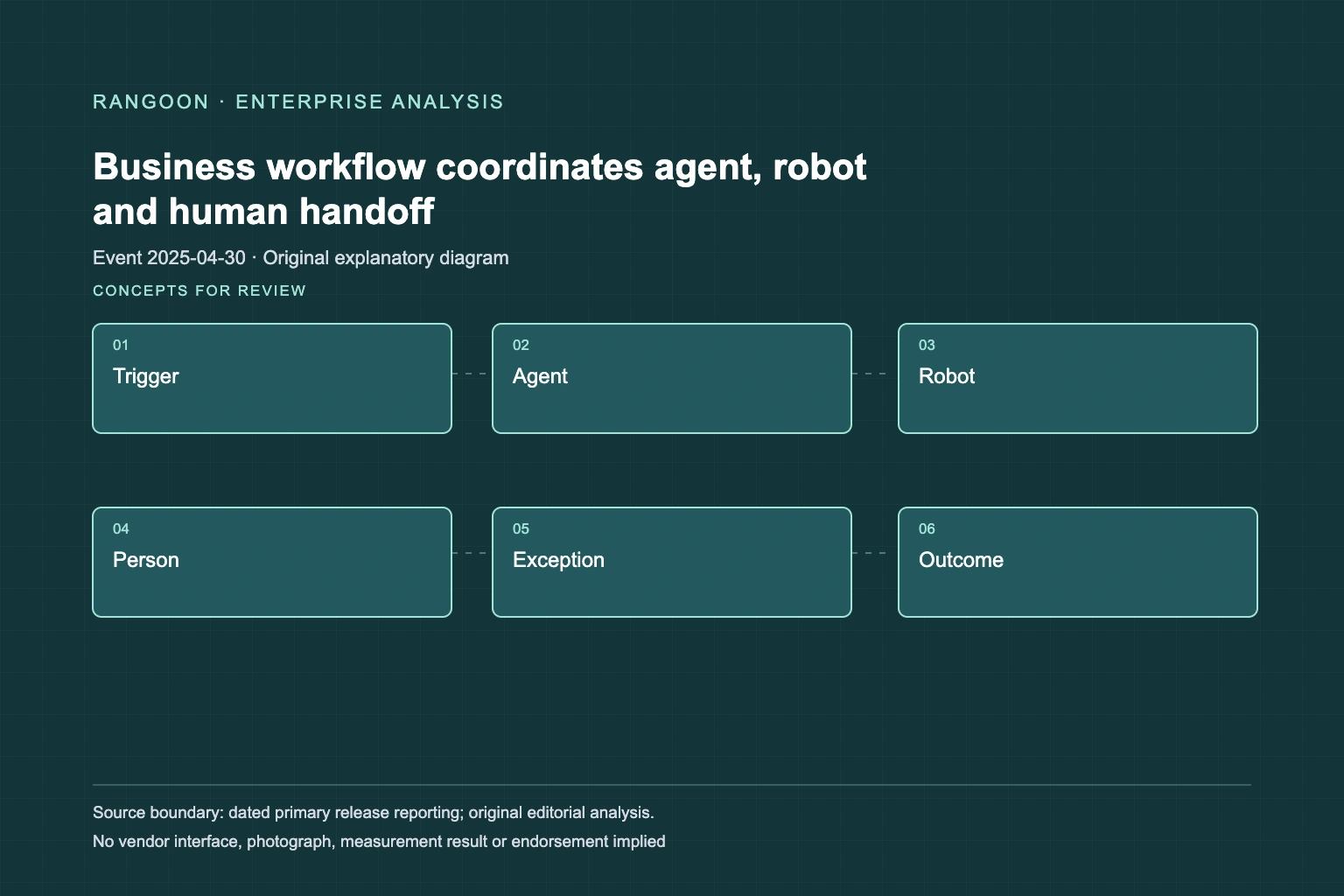
UiPath’s framing is specific: it did not describe only an LLM assistant, but a system intended to coordinate AI agents, software robots and people. These actors have different strengths and failure modes. A robot can execute a deterministic interface sequence; an agent may choose tools or interpret a request; a person can approve, correct or resolve an exception. Combining them can expand a process, but it also creates handoff boundaries that need visible ownership. The announcement identifies UiPath’s orchestration model. It does not show the escalation design, service accounts or audit records for a customer process.
Agent Builder had an earlier private-preview history before the platform launch[source 1][source 2]
UiPath’s community material says Agent Builder entered private preview in December 2024 and describes a low-code environment for creating, deploying and managing enterprise agents. That record is distinct from the April 30 platform launch. It shows the agent-building component had an earlier access state, while the April announcement presented a broader platform and orchestration claim. Keeping the milestones separate prevents a private preview from becoming a retrospective GA assertion. It also avoids assuming that an agent builder’s availability proves that every related automation, robot integration or governance capability was active for all customers at the same time.
Agentic automation requires evidence for the full process rather than a product label[source 1][source 2]
UiPath said its platform would improve accuracy, reliability, security and compliance while helping enterprises move beyond stalled pilots. These are supplier outcomes, not an independent study of each customer workflow. A useful assessment needs the business trigger, agent instruction, robot implementation, human handoff, system permissions, exception rate and final-state verification. That is especially important when a workflow moves from explanation into record updates or external communication. The April event establishes a new product positioning and UiPath’s proposed architecture. It does not establish that a chosen workflow reached production, met a policy requirement or produced a measured result in a customer environment. A process receipt should show the handoff that happened and any human correction before final completion.
Sources
- UiPath: agentic automation platform launch (April 30, 2025)
- UiPath: Agent Builder private-preview background (February 13, 2025)
Continue reading
Related reading
 News analysisServiceNow’s Yokohama release put preconfigured AI-agent teams into business workflows3 min read
 News analysisOracle introduced AI Agent Studio for building and managing Fusion application agents3 min read
 News analysisSalesforce announced Agentforce 2.0 with a staged availability plan for skills, Slack and reasoning3 min read