

The UK opened an AI-and-copyright consultation, not a new copyright rule
The UK opened its Copyright and AI consultation on December 17, 2024, seeking views on training-data access, rights reservation, licensing and transparency.
Historical reporting: on December 17, 2024, the UK government opened a 10-week Copyright and Artificial Intelligence consultation. It sought views on four policy options, including a text-and-data-mining exception with rights reservation and accompanying transparency measures. A consultation is a request for evidence and views, not binding law or a final statement of copyright rights. A March 2026 government report is identified as later context and is not used to turn the 2024 proposal into a rule at launch.
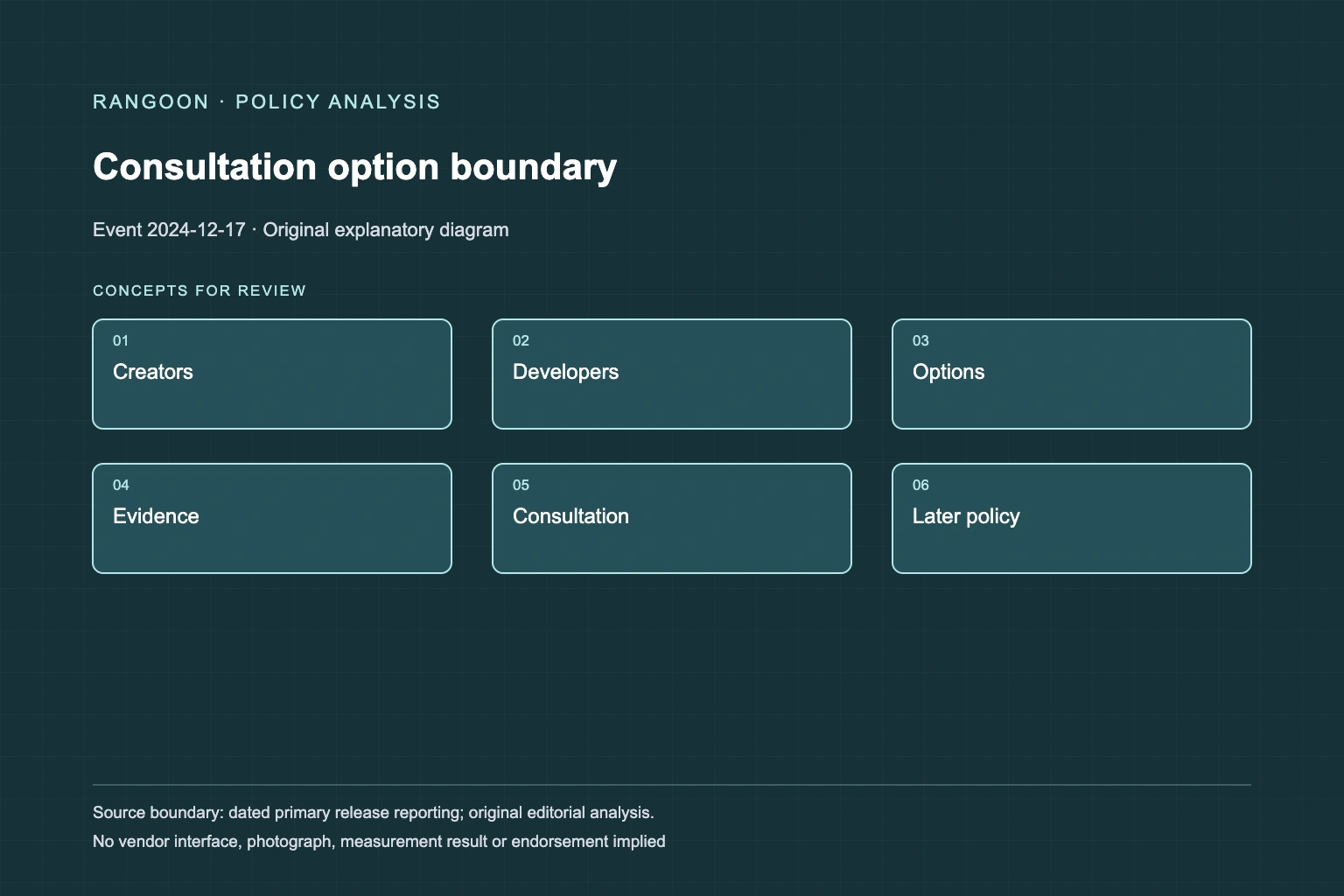
Key takeaways
- The December 2024 event opened a consultation; it did not enact a new training-data exception or settle current disputes.
- The government sought to balance creator control, lawful access for developers and greater transparency about training material.
- Later response analysis belongs to a separate date and cannot be projected backward into the consultation’s launch terms.
The December event asked questions about policy instead of changing the law[source 1][source 2]
On December 17, 2024, the UK government opened its Copyright and Artificial Intelligence consultation. The Intellectual Property Office, Department for Culture, Media and Sport and Department for Science, Innovation and Technology described a 10-week process ending on February 25, 2025. The event was a formal invitation for evidence and views from creators, rights holders, AI developers and others. It did not itself create a new copyright exception, grant permission to train on a class of works or decide the outcome of an individual dispute.
The consultation began from a stated policy problem: rights holders said they struggled to control and be paid for use of their works in AI training, while developers said unclear access rules created risk and constrained domestic development. Reporting this carefully matters because the document recorded competing concerns and possible reforms. It did not resolve whether a particular dataset, model or output complied with existing law. Those questions depend on facts, applicable law and, where needed, the institutions that decide disputes.
The paper paired access options with rights reservation and transparency questions[source 1][source 2]
The consultation put forward four policy options: maintain the position, strengthen copyright protection, create a broad text-and-data-mining exception, or create such an exception with a rights-reservation mechanism. The government described the last approach as its preferred option for consultation, alongside proposals for greater transparency. That wording is important. A preferred consultation option is a proposal that may change after evidence and political decisions; it is not a legal rule an organisation could treat as already in force.
The paper also asked how developers should disclose training-material sources, how web crawlers might be addressed and how technical standards could support rights holders. These questions point to an implementation challenge rather than a simple toggle. Disclosure can vary in granularity, rights reservation needs interoperable tools and licensing depends on the underlying rights and agreements. The December record supports discussion of the government’s proposed direction, not an assurance that a technical signal would necessarily control every model-training workflow.
The consultation framed creator control, developer access and transparency as connected objectives[source 1][source 2]
The government set out three broad objectives: give rights holders more control and a route to remuneration, support lawful access to high-quality material for AI development, and increase transparency. Those goals can pull in different directions. Stronger restrictions may reduce the material available to developers, while broad access without usable rights signals may weaken creators’ ability to license or challenge use. The consultation’s value was to expose those trade-offs for public evidence rather than declare them solved by a single technical mechanism.
The announcement also covered issues beyond model training, including computer-generated works, output labelling and digital replicas. That breadth is a reason to resist a headline that treats the process as only a web-crawling policy. Each area can involve different people, rights and evidence. The consultation did not provide legal advice to creators or developers, and it did not tell a reader whether a specific input, output or contract was permitted. It created a public policy record for a later government response.
The later government report is context, not a rewrite of the launch event[source 1][source 2][source 3]
A government report published in March 2026 later reviewed the consultation, its four options and responses received. That later document is useful for locating the December event in a timeline, but its date must stay visible. It cannot change the status of the December 2024 consultation into a completed legislative measure. The launch article therefore treats the consultation as an opening move: a defined set of questions, a closing date and stated objectives, with outcomes dependent on subsequent analysis and policy choices.
This article gives no legal conclusion about training data, text and data mining, licensing, output ownership or enforcement. It also does not suggest that a proposed rights-reservation system existed at launch. The primary records support a simpler historical point: the UK opened a public process to test options for copyright and AI, putting transparency and creator control alongside AI development needs without announcing a final rule.
Sources
- GOV.UK: UK consults on proposals to give creative industries and AI developers clarity over copyright laws (December 17, 2024)
- GOV.UK: Copyright and Artificial Intelligence consultation (December 17, 2024)
- GOV.UK: Report on Copyright and Artificial Intelligence (March 18, 2026)
Continue reading
Related reading
 News analysisBritain’s AI Opportunities Action Plan paired 50 recommendations with a government response4 min read
 News analysisThe Copyright Office put human authorship at the center of AI-output analysis3 min read
 News analysisUK’s third-party AI assurance roadmap mapped professionalization, information access and a planned innovation fund3 min read