

Britain’s AI Opportunities Action Plan paired 50 recommendations with a government response
The UK published the AI Opportunities Action Plan on January 13, 2025, alongside a government response that set priorities for compute, adoption and frontier capability.
Historical reporting: the Department for Science, Innovation and Technology published Matt Clifford’s AI Opportunities Action Plan on January 13, 2025, with 50 recommendations. The government published its response the same day. The response stated commitments and delivery intentions, including an aim to expand sovereign compute capacity and a plan to begin delivery work on an additional facility; it was not proof that every recommendation, site, supplier or capacity target had already been delivered.
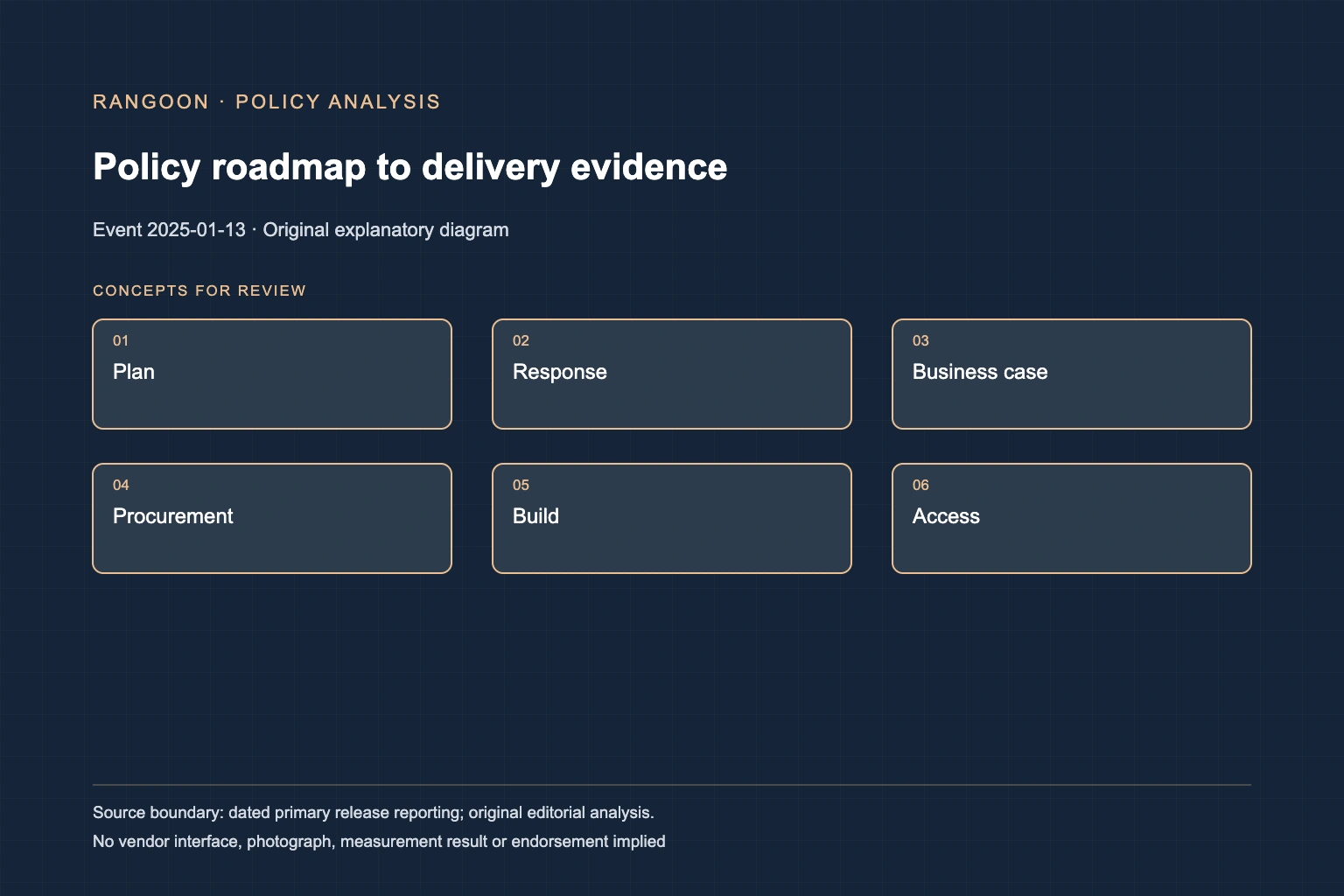
Key takeaways
- The January event published a 50-recommendation plan and a same-day government response, rather than a completed delivery program.
- Compute, data, talent, adoption and public-sector capability were connected policy tracks with different owners and timelines.
- A stated commitment or delivery timeline should be read separately from funded, procured and operating infrastructure.
The January release joined an independent plan to a public government response[source 1][source 2]
On January 13, 2025, the UK Department for Science, Innovation and Technology published the AI Opportunities Action Plan, led by technology entrepreneur Matt Clifford. The report set out 50 recommendations aimed at expanding the domestic AI sector, increasing adoption across the economy and improving products and services. It was presented as a roadmap for government action. Its same-day publication matters because the document described proposed directions and dependencies, not a retrospective catalogue of outcomes already achieved.
The government also issued a response on January 13. That pairing gave readers two records to keep separate: the plan’s recommendations and the government’s stated approach to them. The response set out actions it said it would take forward, while retaining delivery dates and further work for many items. Historical reporting should not turn agreement with a recommendation into a completed program, or mistake the plan’s requested institutional design for an institution that was necessarily operating on publication day.
Compute was framed as a national capacity issue with a delivery sequence[source 1][source 2]
The response said the government would pursue an expansion of sovereign compute capacity and described a new state-of-the-art supercomputing facility intended to at least double the national AI Research Resource. It also said departments would start the business-case process and seek to lock in a site and suppliers during 2025. Those are meaningful policy signals, but they are milestones in a sequence that includes planning, procurement, construction, commissioning, access rules and operation. Announcing the sequence did not itself add a usable machine to a researcher’s account.
The documents also linked national capacity to practical access for researchers and smaller businesses. That connection is easy to overstate. A published capacity aspiration does not answer who can apply, what work receives priority, how security or data restrictions are handled, or when a specific allocation is available. The useful news point was the government’s decision to make compute a central part of its AI growth agenda; the operational question remained whether later programs converted that intention into accessible capacity.
The plan treated adoption as a broader problem than model development[source 1][source 2]
Beyond infrastructure, the Action Plan called for wider AI adoption in the public and private sectors. Its recommendations covered foundations such as compute, data, talent and regulation alongside industry and public-service use. That framing matters because national AI policy is not only a competition to host model training. An organisation that adopts a tool still needs suitable data, trained people, accountable decision owners, procurement routes and a way to evaluate whether a use case improved the service it was meant to improve.
The government response proposed an AI Opportunities Unit within DSIT to track delivery and pointed to future work through the Industrial Strategy and Spending Review. These statements established coordination and future-policy intent, not a universal deployment standard for agencies or businesses. The January record can support analysis of the policy architecture: central teams, infrastructure plans and sector adoption were meant to reinforce each other. It cannot prove that a local authority, hospital, school or small business had adopted a particular system responsibly.
A roadmap gave a public direction, while delivery still needed separate evidence[source 1][source 2]
The significance of the Action Plan was political and operational at once. It supplied a common list of priorities while the response attached them to government ownership and prospective timing. That can affect research agendas, business planning and public debate before a project is built. But a roadmap is not a contract with a single implementation date. Its 50 recommendations were diverse enough that progress could differ across compute, data access, skills, regulatory work and departmental adoption.
This article stays with the January 13 publication. It does not backfill later funding decisions, procurement outcomes, facility launches or changes in government policy into the announcement. Nor does it present the plan as binding law or business advice. The dated evidence supports a narrower conclusion: the UK published an AI growth roadmap and a response that made government delivery intentions visible, placing subsequent progress under a more specific public record.
Sources
- GOV.UK: AI Opportunities Action Plan (January 13, 2025)
- GOV.UK: AI Opportunities Action Plan government response (January 13, 2025)
Continue reading
Related reading
 News analysisUK’s AI Playbook expanded government guidance to ten principles across selection, deployment and assurance3 min read
 News analysisThe UK opened an AI-and-copyright consultation, not a new copyright rule4 min read
 News analysisIsambard-AI came online as the UK completed the first phase of its AI Research Resource4 min read