vLLM V1 alpha made the serving engine’s internal loop a migration surface
vLLM announced its V1 alpha on January 27, 2025 as a major core-architecture redesign, retaining an OpenAI-compatible API while changing execution internals.
Historical reporting: vLLM announced V1 alpha on January 27, 2025. Performance and compatibility statements are vLLM project claims, not workload-specific validation.
Key takeaways
- V1 was an alpha redesign under an unchanged high-level API goal.
- API compatibility does not prove identical scheduling or tail latency.
- Inference migration must benchmark request distributions and failure behavior.
The V1 alpha described a new core architecture beneath a familiar API[source 1][source 2]
The vLLM team announced V1 alpha on January 27, 2025 as a major upgrade to its core architecture. It said the project had consolidated features, simplified the codebase and retained a full continuous-batching engine and OpenAI-compatible API server, with V1 enabled through an environment variable during testing. A January release-planning issue independently records the V1 alpha timing. The announcement is an alpha-release event; it does not establish that a specific application sees unchanged latency, output or hardware support.
The opt-in environment switch is an archival detail with practical significance: it signals an evaluation period in which the project expected feedback before making V1 default. Teams should interpret that as a reason to compare engines under controlled traffic, not as proof that a visible API endpoint guarantees identical internal execution.
Continuous batching makes scheduler behavior part of application performance[source 1][source 2]
Serving throughput depends on how the engine groups prefill and decode work, tracks request states and manages memory between model forward passes. A stable HTTP shape can conceal a changed scheduler, compilation path, cache behavior or multimodal preprocessing route. Benchmarking only a single prompt misses the queueing interactions that dominate a multi-user service. Treat the engine version as a release dependency alongside model weights, tokenizer, GPU driver and request policy.
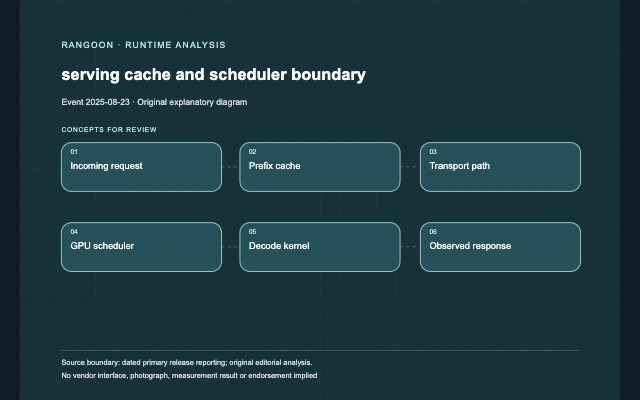
The continuous-batching loop also couples tenants through admission and scheduling. A long request can shift queue delay for short requests even when each endpoint reports valid output. Build a service-level view by request class, then decide whether isolation, priority queues or separate pools are needed for interactive and background work.
Canaries need both latency percentiles and semantic checks[source 1][source 2]
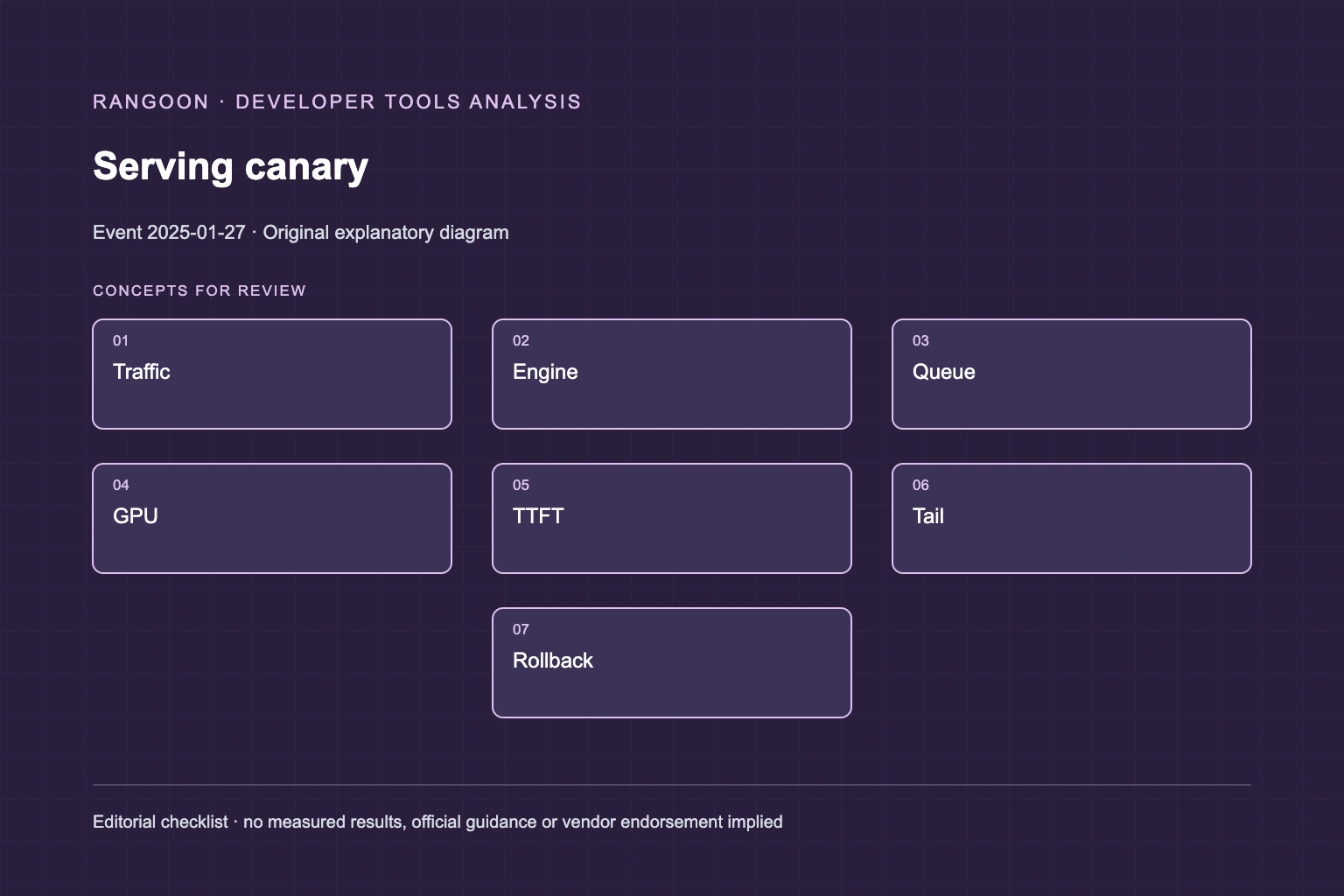
Replay privacy-safe traffic by request class: short chat, long context, streaming, structured output, tool-oriented prompts and multimodal inputs where applicable. Compare time to first token, inter-token latency, completion errors, GPU memory, queue delay and output conformance. Keep temperature and decoding controls fixed for semantic checks, then separately test load saturation. Roll back on explicit thresholds rather than on a vague impression that the new engine feels faster.
Run a tokenizer mismatch check before the load test. A changed tokenizer or chat template can alter context length, truncation and output semantics while performance metrics still look good. Include a small reference corpus with exact expected token counts and structured-output validity so the serving change is not judged by speed alone.
Analysis: alpha architecture changes deserve a two-track gate[source 1][source 2]
Use one gate for compatibility and another for capacity. Compatibility confirms clients, auth, streaming and output formats work; capacity measures throughput and tail behavior under representative load. A pass in one lane does not imply a pass in the other. The V1 announcement gives a dated reason to make that separation; it does not substitute for evidence on a team’s models or production topology.
The rollback plan should preserve a request-class comparison, not merely a global error-rate trigger. A change can improve aggregate tokens per second while making interactive completion unacceptable. Pin both engine images and model artifacts during the test window so a rollback returns to a known serving combination instead of another moving target.
Sources
- vLLM Blog: V1 alpha release (January 27, 2025)
- vLLM GitHub: v0.7.0 release planning (January 23, 2025)
Continue reading