

GLM-4.7 made preserved thinking a named control for multi-turn coding agents
Z.ai released GLM-4.7 on December 22, 2025, pairing open model weights with interleaved, preserved, and turn-level thinking controls for agent workflows.
Historical reporting: Z.ai published GLM-4.7 on December 22, 2025. Its official launch material describes agentic coding, tool use, open availability, and thinking controls; the maintained official Hugging Face card lists MIT and local-serving guidance. Vendor score tables are attributed to Z.ai and treated as configured benchmark evidence, not universal coding performance.
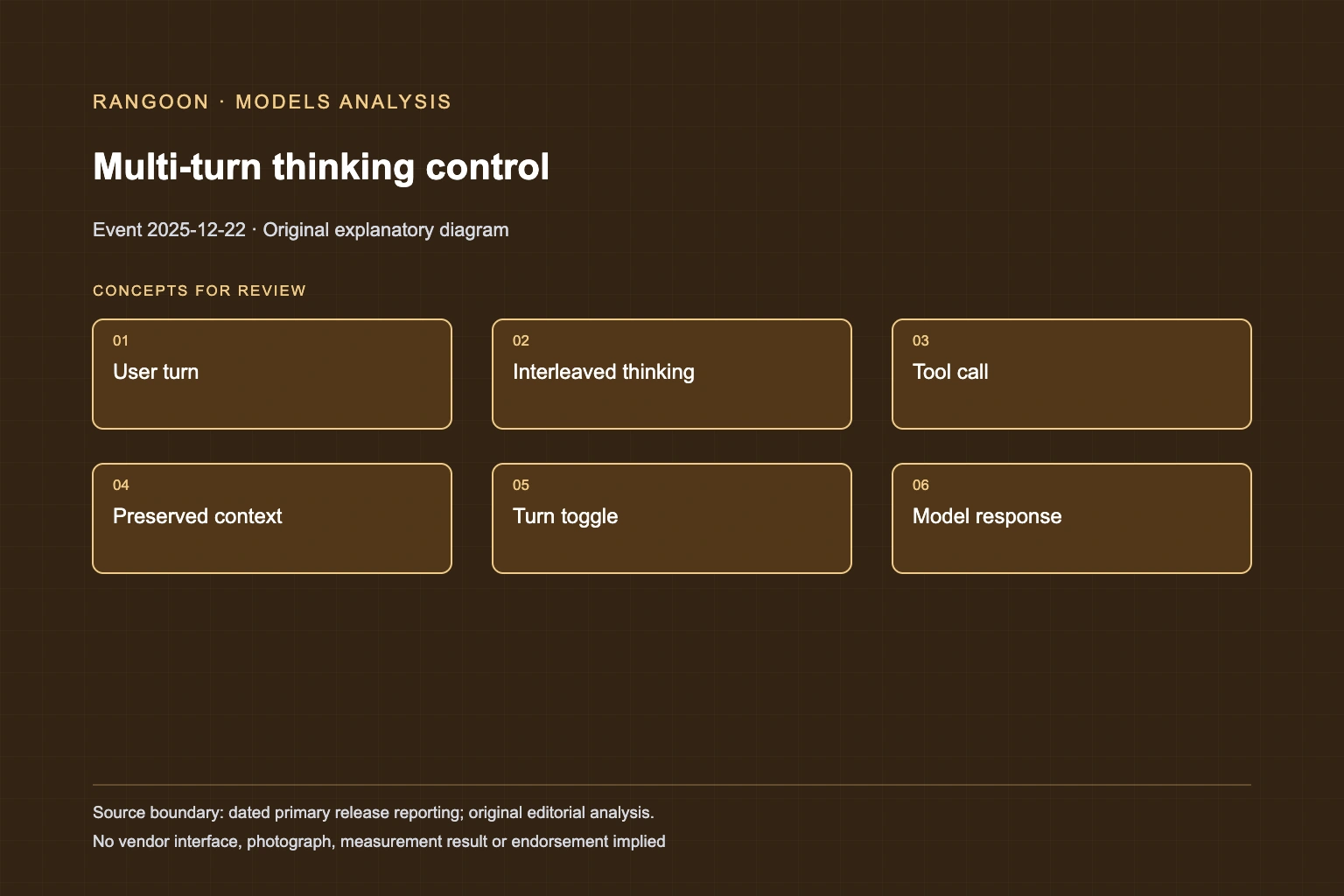
Key takeaways
- GLM-4.7 separated interleaved, preserved, and turn-level thinking controls, making a multi-turn reasoning setting part of the run configuration.
- Z.ai’s coding and tool-use scores are vendor comparisons with named benchmarks and settings, not measurements of a local agent stack.
- MIT-labeled weights and local-serving examples do not supply deployment governance, repository permission, or generated-code acceptance.
The December release centered coding and tool-use claims[source 1][source 2]
Z.ai published GLM-4.7 on December 22, 2025, presenting it as a coding-oriented model with tool-use and reasoning updates. Its official material linked a chat product, API access, a repository, weights, and a technical blog. Those artifacts serve different purposes. A hosted API, a chat experience, and a local checkpoint may use different defaults, system prompts, availability rules, and operational controls even when their public model name is the same.
Z.ai reported improvements over GLM-4.6 on coding, terminal, browsing, and reasoning benchmarks. The figures are supplier-reported under the company’s published evaluation conditions. A benchmark line is useful only with its task definition, scaffold, tool policy, prompt, token budget, and scoring procedure. It does not predict how a model will behave when a local agent has different tools, a private codebase, slower services, or a requirement to obtain human approval before an action.
Preserved thinking made multi-turn context handling a stated feature[source 1][source 2]
The model card describes interleaved thinking before responses and tool calls, preserved thinking for reusing prior thinking blocks in coding-agent conversations, and turn-level thinking controls. This made the reasoning mode part of an agent configuration rather than an invisible property of a model name. Preserving prior context can reduce re-derivation and inconsistency in a long interaction, but it can also preserve a mistaken assumption unless the caller exposes evidence, tests alternatives, and lets a user correct the plan.
Z.ai recommended preserved thinking for named multi-turn benchmark tasks and listed separate sampling settings for other evaluations. That is a reminder that an observed score is conditional. Changing temperature, top-p, maximum new tokens, hidden context treatment, or tool transcript changes the execution. A system should record those parameters when comparing runs instead of interpreting a product announcement as a model-invariant result.
Tool use turns a language result into a system behavior[source 1][source 2]
GLM-4.7’s tool-use claims covered benchmarks such as τ²-Bench and BrowseComp, while its coding claims included SWE-bench and Terminal Bench variants. These evaluations test defined tasks under supplied environments. They do not tell a developer whether a tool schema matches its service, whether an API call is authorized, or whether a generated patch respects an organization’s tests, dependencies, and review rules.
Agent frameworks add another layer. A caller decides which files, shells, browsers, databases, and credentials are exposed, how failures are retried, and which actions require confirmation. A model can produce a plausible tool call without a valid result. For that reason, vendor benchmark gains should be described as evidence about the vendor’s configured runs, while a deployment needs its own permission boundaries, logging, regression checks, and human decision points.
An MIT card describes one artifact, not every operating condition[source 1][source 2]
The official GLM-4.7 Hugging Face card currently labels the model MIT and provides local-serving examples for Transformers, vLLM, and SGLang. That gives developers a concrete published-weight artifact and a starting point for integration. It does not mean a user can skip dependency review, hardware sizing, license notices for bundled components, or validation of the exact server and tokenizer revision selected for a deployment.
Z.ai’s stated UI-generation and coding quality claims are also not a replacement for product acceptance. A generated page can look polished while missing interaction behavior, accessibility semantics, data handling, or a safe backend boundary. The December event is best understood as a release of model and agent-workflow capabilities with supplier evidence attached; it is not a blanket claim that an autonomous coding system is production-ready.
Sources
- Z.ai: GLM-4.7 launch announcement (December 22, 2025)
- Z.ai: GLM-4.7 model card
Continue reading
Related reading
 News analysisGLM-4.5 put hybrid reasoning modes and open weights in one release record3 min read
 News analysisOpenAI introduced SWE-Lancer to test coding agents against freelance software work3 min read
 News analysisAmazon introduced SWE-PolyBench to broaden coding-agent evaluation beyond Python repositories3 min read