

Applied, Apple and TI disclosed U.S. equipment and factory commitments without a finished-chip output claim
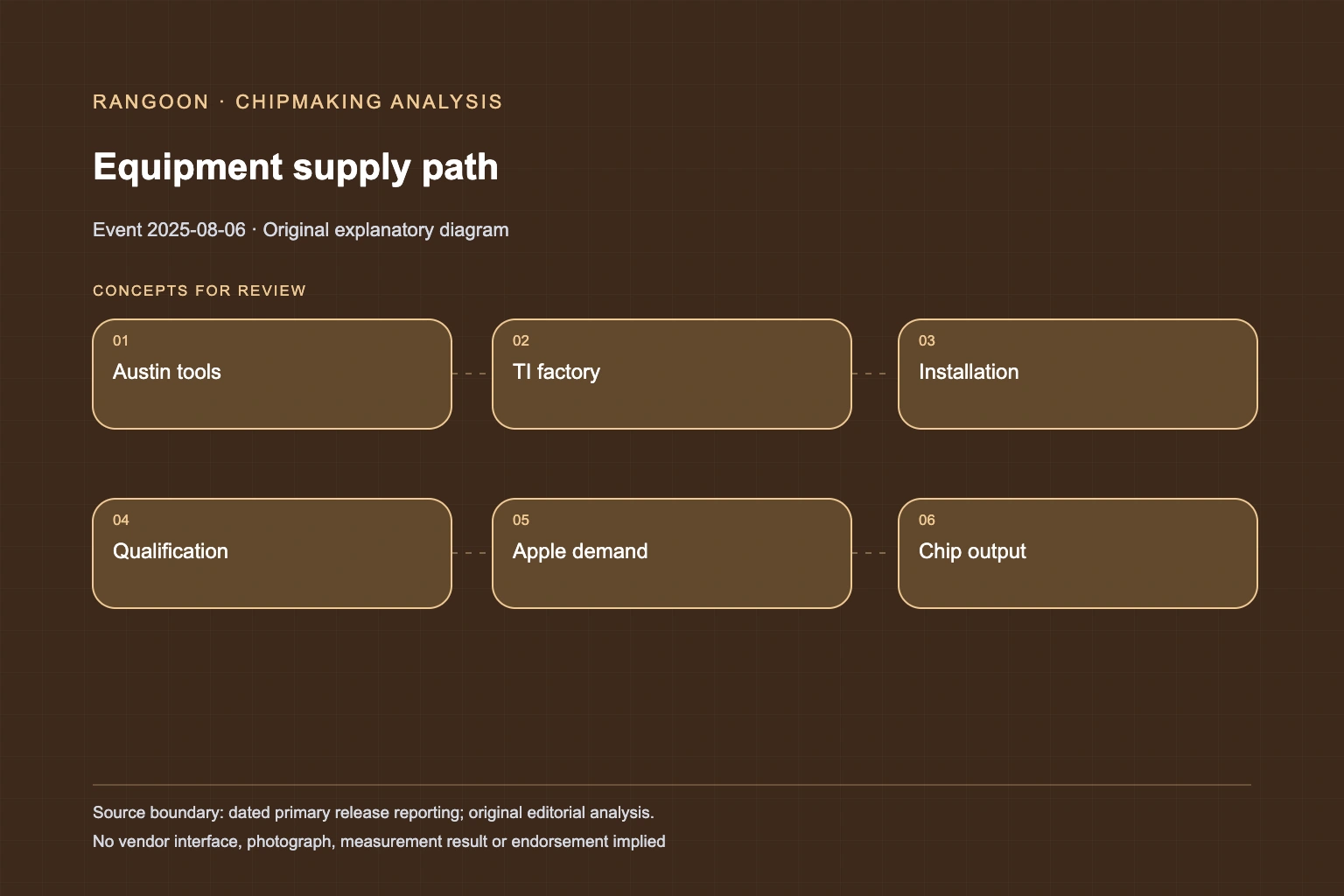
Applied Materials said on August 6, 2025 that it would supply Austin-made chipmaking equipment to Texas Instruments factories supporting Apple semiconductor production plans.
Historical reporting: Applied Materials and Apple each published August 6, 2025 records of the U.S. manufacturing programme involving Applied equipment and Texas Instruments factories. The sources establish disclosed equipment supply, future tool installation and manufacturing commitments; they do not establish completed factory output, a finished chip volume, a particular node, or a realised capacity increase on that date.
Key takeaways
- Applied said it would supply Austin-made equipment to TI’s U.S. factories.
- Apple described future TI tool installations in Utah and Texas within its programme.
- Commitments and tool supply do not prove completed chip output or capacity on the disclosure date.
The August disclosures linked equipment manufacturing to future TI factory work[source 1][source 2]
Applied Materials said on August 6, 2025 that it was supporting Apple’s partnership with Texas Instruments by supplying American-made chipmaking equipment from Austin to TI factories in the United States. Apple’s same-day programme announcement described additional tool installations at TI facilities in Lehi, Utah and Sherman, Texas. This is a manufacturing-supply-chain disclosure, not a report that a new chip line had already produced finished devices. The two primary records identify the participants and the intended flow from equipment supplier to chip factory. They do not name every tool, the timing of installation completion, the exact semiconductor technology or the volume of chips that would result. The archive treats the disclosure as a commitment and equipment-supply event.
Austin, Lehi and Sherman identify facilities without supplying production measures[source 1][source 2]
The sources provide a useful geographic distinction. Applied identifies its Austin facility as the equipment source, while Apple identifies TI facilities in Utah and Texas as sites for additional installations and future product collaboration. Naming sites does not establish that all tools had arrived, passed acceptance testing or were producing a particular Apple component on August 6. Factory capacity is built through construction, utility readiness, equipment installation, process qualification, material supply, workforce and customer demand. Neither release publishes a wafer-start figure, product yield, shipment count or production date for the stated work. The information is therefore sufficient to document who announced a supply relationship and where future activity was planned, but not to infer an immediate output increase from the day of publication.
Apple’s manufacturing programme is a stated investment framework, not a chip-production ledger[source 1][source 2]
Apple presented the arrangement within its American Manufacturing Program and described partnerships with several suppliers. Applied separately said it would invest in an Arizona facility for critical semiconductor-equipment components. These are business and capacity commitments. They should not be collapsed into an assertion that the entire programme had been completed or that every participating supplier made the same type of semiconductor product. The releases do not disclose contracts, purchase quantities, actual capital spend by each party or a final timetable for the tool installations. They also do not establish an independently audited domestic-content share. The historical event is the public disclosure of linked plans: Apple, TI and Applied described a route to expand U.S. semiconductor manufacturing support.
Equipment commitments and installed capacity need later proof from operating factories[source 1][source 2]
The two announcements create a clear documentary record of supply intentions and future installations. They do not show whether a factory met a ramp target, how tools performed, or whether Apple received a stated volume of semiconductors. No source provides a reliability qualification, a product test record, an output curve or a comparison with an earlier factory configuration. Such evidence is needed before concluding that a commitment changed capacity or supply resilience. The archive preserves the event precisely: on August 6 the parties disclosed an equipment and factory-support arrangement. A later earnings record, facility report or customer shipment disclosure would be required to establish completed production rather than the planned manufacturing path.
Sources
Continue reading
Related reading
 News analysisApplied unveiled the EPIC Center as a collaborative chipmaking R&D facility, with HVM still a future transfer step3 min read
 News analysisApplied Materials introduced Kinex, Xtera and PROVision 10 for logic, memory and packaging process work3 min read
 News analysisApplied disclosed Singapore equipment manufacturing already at volume production, while the public release date remained distinct3 min read