

Applied disclosed Singapore equipment manufacturing already at volume production, while the public release date remained distinct
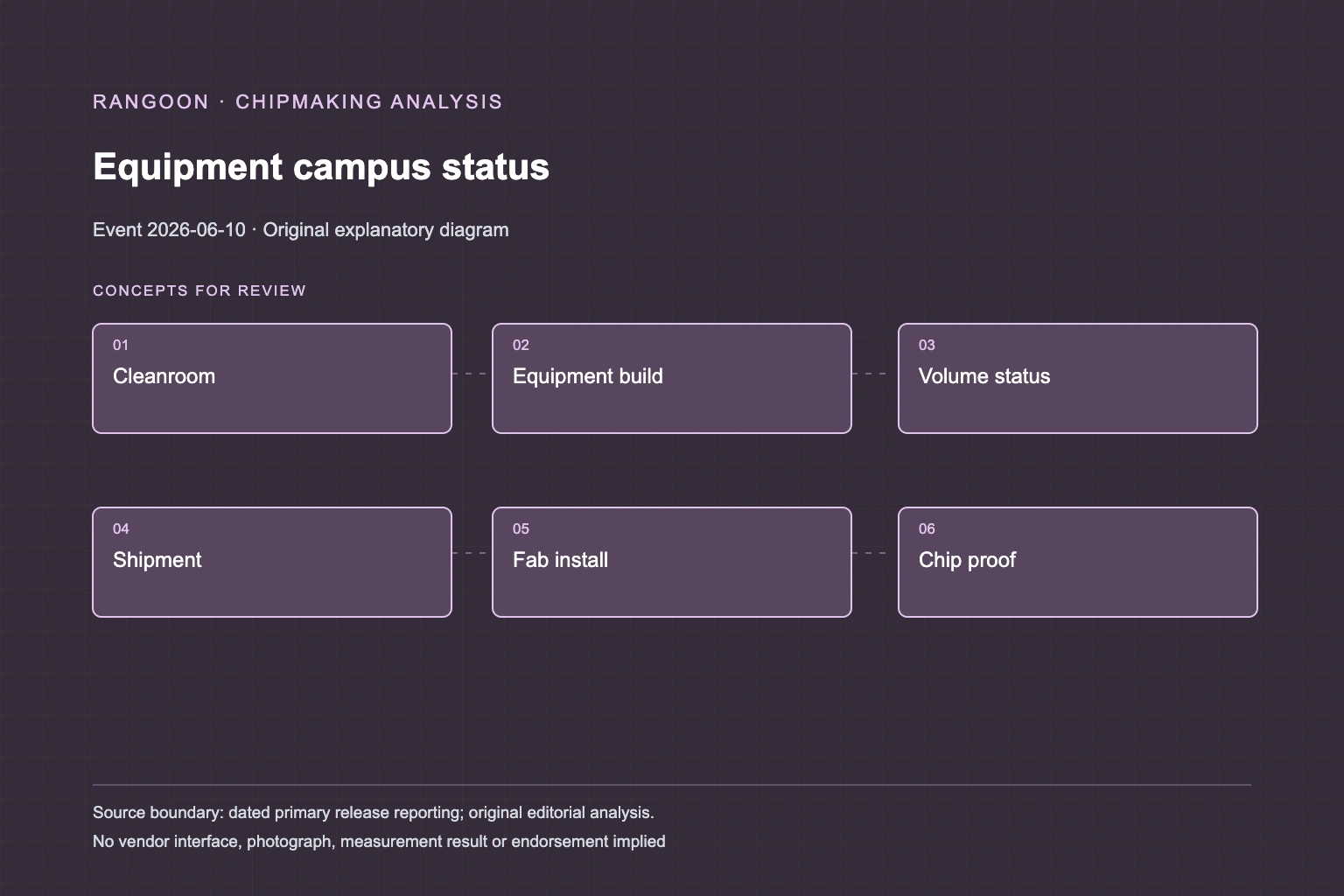
Applied Materials’ June 10, 2026 public release said its Singapore Tampines Campus was operating at volume production for AI-driven equipment demand.
Historical reporting: Applied’s public release is displayed June 10, 2026 and has a June 9 Singapore dateline; this article uses June 10 as the public-disclosure event date and states the distinction. The release says the Tampines Campus was already operating at volume production. Applied’s June 2026 master-class materials provide related manufacturing context. The sources establish a disclosed equipment-factory status, not chipmaker output, a customer-specific capacity figure, or a full production-performance audit.
Key takeaways
- The public release displayed June 10 while carrying a June 9 Singapore dateline.
- Applied said the Tampines Campus was already operating at volume production.
- Equipment-factory volume production does not measure customer chip output or a specific AI-chip supply result.
The public-disclosure date and the Singapore dateline are distinct facts[source 1]
Applied Materials’ release page displays June 10, 2026, while the release text carries a Singapore and Santa Clara dateline of June 9. This article uses June 10 as the dated public-disclosure event and preserves the local dateline rather than inventing a day for an unspecified ramp. The release says Applied expanded manufacturing and research operations in Singapore and that the Tampines Campus was already operating at volume production. The claim concerns production of semiconductor equipment, not a disclosure that a semiconductor fab began producing a particular AI chip. Maintaining this distinction matters because equipment supply is upstream of wafer fabrication and system delivery. The source does not provide a daily or quarterly output count for the new campus.
The campus announcement describes Applied’s equipment capacity, not a foundry’s finished-wafer capacity[source 1][source 2]
Applied said the new campus more than doubled its advanced-cleanroom capacity in Singapore and would support chipmakers expanding production for AI-driven demand. Those statements identify a physical manufacturing and research expansion at an equipment provider. They do not state how many wafer-fab systems had been built, shipped or accepted by named customers. They also do not translate cleanroom area into a universal equipment-output or chip-output number. Factory performance depends on production mix, supplier availability, qualification, workforce, logistics and customer schedules. The article therefore records the company’s own stated capacity expansion and volume-production status, while avoiding an inference that any chipmaker had achieved a matching increase in fab capacity on the release date.
Applied’s intelligent-production language is an equipment-factory claim with limited public metrics[source 1][source 2]
The release characterises the Tampines Campus as a sustainable and intelligent semiconductor-equipment manufacturing facility. This identifies the company’s operational framing, but it does not publish a full energy, scrap, quality or throughput data set. The sources also do not specify an autonomous control system or a verified AI deployment within the campus. Applied’s master-class materials provide context on the company’s broader materials and packaging focus, yet they do not convert an equipment-factory description into a scorecard for every product made in Singapore. Public evidence supports a careful conclusion: Applied disclosed a new campus already operating at volume production. It does not establish the measured efficiency of that operation or its effect on a customer’s final chip yield.
Equipment capacity and downstream AI-chip supply must be documented separately[source 1][source 2]
The June disclosure is relevant to AI hardware because equipment availability can shape a chipmaker’s ability to build and qualify capacity. It is not itself evidence of delivered AI accelerators, memory stacks or foundry revenue. Neither source identifies a specific customer ramp, a tool-installation acceptance date or a semiconductor product shipment. They also do not report a production incident history or an independent audit of the facility’s output. The archive preserves the exact public date, the local dateline and Applied’s stated volume-production status. Claims about downstream supply resilience or chip output require later factory, customer or shipment records that identify what was made and measured.
Sources
Continue reading
Related reading
 News analysisApplied unveiled the EPIC Center as a collaborative chipmaking R&D facility, with HVM still a future transfer step3 min read
 News analysisApplied Materials introduced Kinex, Xtera and PROVision 10 for logic, memory and packaging process work3 min read
 News analysisApplied and GlobalFoundries announced a Singapore waveguide fabrication collaboration for AI-era photonics3 min read