California announced companion-chatbot safeguards with SB 243 signing
Governor Gavin Newsom announced the October 13, 2025 signing of California SB 243, describing companion-chatbot safeguards aimed at protecting children online.
Historical reporting: Governor Newsom announced SB 243’s signing on October 13, 2025, and California Legislative Information records approval and chaptering that day. This retrospective reports safeguards attributed to the Governor’s announcement; it does not state statutory scope, effective dates, reporting rules, or legal conclusions.
Key takeaways
- California records show SB 243 was approved by the Governor and chaptered on October 13, 2025.
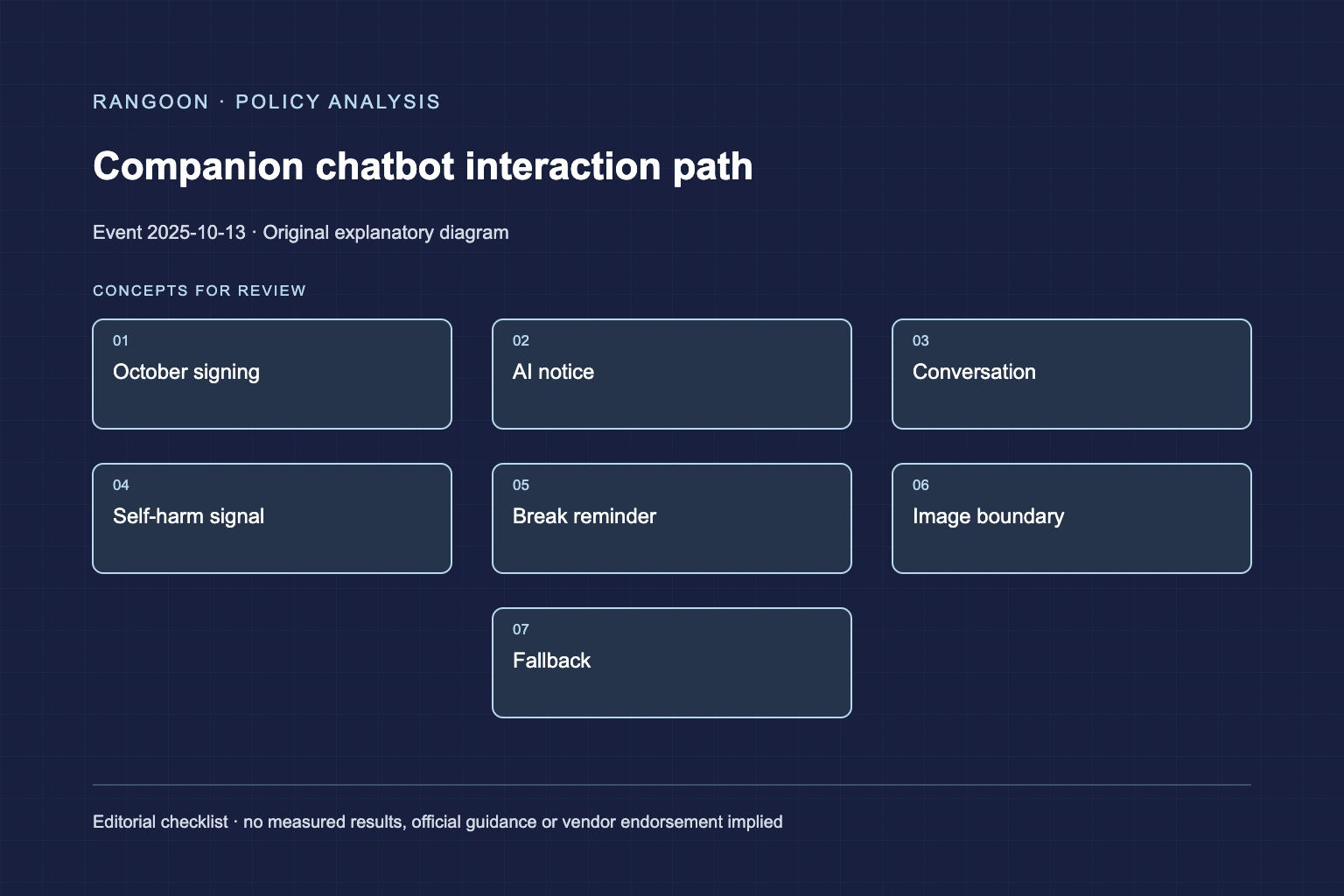
- The Governor reported self-harm protocols, AI-origin notices, break reminders for minors, and protections against sexually explicit images generated by chatbots.
- The announcement does not establish an individual product’s statutory coverage, implementation date, or legal outcome.
The dated event was the October 13 signing announcement[source 1][source 2]
Governor Newsom’s October 13, 2025 announcement listed SB 243 among legislation signed to protect children online and address emerging technology. The announcement named the bill as Senator Steve Padilla’s companion-chatbots measure. California Legislative Information separately records approval by the Governor and chaptering as Chapter 677 on the same day. Together, those two official records establish the signing and chaptering event; they do not settle a particular product’s legal status or technical implementation.
The Governor described several companion-chatbot safeguards[source 1][source 2]
The Governor’s announcement said companion-chatbot platforms would be required to create protocols addressing users’ expressions of suicidal ideation or self-harm. It also described disclosures that interactions are artificially generated. For minors, the announcement described break reminders and protections against sexually explicit images generated by a chatbot. These are the Governor’s public descriptions of the signed package, not a substitute for the enacted chapter text or a claim about how any named service behaves.
The announcement points to interaction design, not a single model setting[source 1][source 2]
A product team reading the announcement has to look beyond the text model to the interaction surrounding it. An AI-origin notice has a presentation path, a locale, an accessibility treatment, and a re-entry state; a notice that exists in a component library may never reach an actual conversation. Break reminders likewise depend on a coherent definition of an ongoing session across refreshes, app restarts, and multiple devices. Those are concrete HCI and delivery questions, not statements that a particular implementation satisfies a law.
The announced self-harm protocol theme also describes a system path rather than a one-word refusal. A safe synthetic test can examine signal detection, response selection, resource presentation, logging boundaries, and failure handling when a delivery service is unavailable. An image-generation boundary needs separate checks for prompt handling, tool routing, and media rendering, because a text guard alone cannot establish what a user sees. These checks can reveal product behavior without claiming a clinical result or statutory compliance.
Product teams can instrument the visible state of each intervention separately from the model response that initiated it. This distinguishes a generated answer, a queued notice, and a screen rendered to a user.
An interface event model can distinguish conversation start, generated response, notice exposure, reminder render, image request, and recovery after an interrupted session. That separation helps designers find a broken handoff without storing the full user conversation as a debugging surrogate.
The event record leaves statutory detail outside this article[source 1][source 2]
The official records used here establish the October 13 event and the safeguards the Governor publicly described. They do not, by themselves, prove the enacted chapter’s definitions, covered parties, effective date, reminder cadence, reporting terms, or a regulator’s future interpretation. This article therefore does not turn an announcement into a compliance checklist. It also keeps SB 243 separate from other bills listed in the same press release, including the distinct health-care-professions measure.
Sources
- Governor of California: signing announcement for SB 243 (October 13, 2025)
- California Legislative Information: SB 243 bill history (October 13, 2025)
Continue reading