

California’s SB 53 signing made frontier-AI transparency a state-law record
California signed SB 53 on September 29, 2025, establishing a frontier-AI transparency framework with reporting duties and whistleblower protections.
Historical reporting: California Governor Gavin Newsom’s office announced the signing of SB 53 on September 29, 2025 and published a signing message. This article reports that event; it does not determine whether a developer, model or incident is covered or give legal advice.
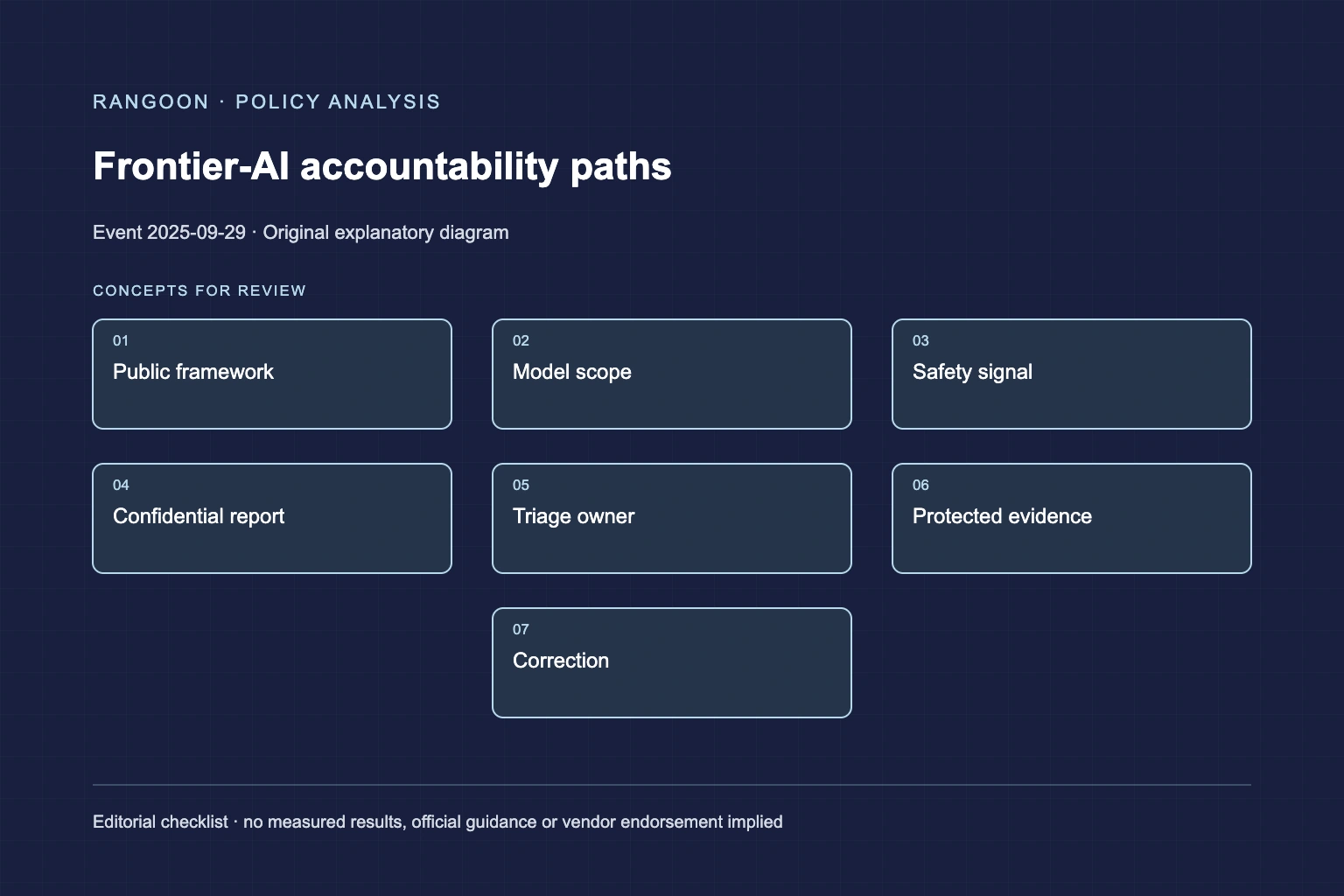
Key takeaways
- SB 53’s signing is a state-law event, not proof that every AI developer is in scope.
- Public framework statements, incident reporting and whistleblower processes need separate operating owners.
- A historical signing notice does not settle current effective dates, regulations or enforcement facts.
The September 29 record identifies SB 53 and its stated aims[source 1][source 2]
On September 29, 2025, the Governor of California announced that Governor Gavin Newsom had signed Senate Bill 53, the Transparency in Frontier Artificial Intelligence Act. The announcement described requirements for large frontier developers to publish a framework describing how standards and practices were incorporated, a mechanism for reporting potential critical safety incidents, whistleblower protections and a civil penalty for noncompliance. It also described CalCompute as a new consortium framework.
The Governor’s signing message dated the same day described the bill as establishing state-level oversight of use, assessment and governance of advanced AI systems. These official materials establish a signing event and state executive-branch descriptions of the law. They are not a substitute for the chaptered statutory text, regulations, facts about a particular model or a current enforcement determination.
Transparency, incident response and whistleblowing are different systems[source 1][source 2]
A public framework is a communication and governance artefact. An incident-reporting process is an operational path with intake criteria, escalation, evidence preservation and an accountable decision maker. A whistleblower process requires confidential intake, anti-retaliation protections, access control and a way to investigate claims without exposing sensitive material. Treating all three as one webpage leaves important controls unowned.
For each process, document the trigger, intake channel, role allowed to classify an event, records retained, notification deadline where applicable and a review route for a disputed decision. Use scenarios to test the process: a researcher finds an unexpected capability, an employee raises a safety concern, or an external report lacks enough detail. This is editorial systems analysis, not an interpretation of SB 53.
Analysis: publish a framework that points to evidence[source 1][source 2]
A framework is more useful when readers can trace its claims to governed evidence. Name the model family and scope, state the responsible organisation, date the document, identify the standards or practices considered, explain update triggers and link to a reporting path. Avoid claiming that a published framework proves a model is safe or that a checklist predicts every failure.
Internally, pair the public document with records that should not be public: evaluation versions, incident triage, access control, remediation decisions and change approvals. A safe publication process needs review for security-sensitive detail and clear ownership for corrections. The point is not more disclosure for its own sake; it is a trustworthy boundary between public accountability and protected operational evidence.
Analysis: a signing notice is not live scope advice[source 1][source 2]
This article records the September 29, 2025 signing event and the governor’s stated description. It does not settle present effective dates, implementing regulations, thresholds, model coverage, reporting duties, penalties or enforcement. Those questions require current statutory and regulatory sources, facts and qualified counsel.
Historical coverage should therefore preserve its date and limits. Organisations considering a live California obligation should use current official materials and their own factual record rather than treat this retrospective analysis as a compliance answer.
Sources
- Governor of California: Governor Newsom signs SB 53, advancing California’s world-leading artificial intelligence industry (September 29, 2025)
- Governor of California: SB 53 Signing Message (September 29, 2025)
Continue reading
Related reading
 News analysisCalifornia announced companion-chatbot safeguards with SB 243 signing3 min read
 News analysisUK’s third-party AI assurance roadmap mapped professionalization, information access and a planned innovation fund3 min read
 News analysisUK’s AI Playbook expanded government guidance to ten principles across selection, deployment and assurance3 min read