

Claude 4 made tool use an observability question
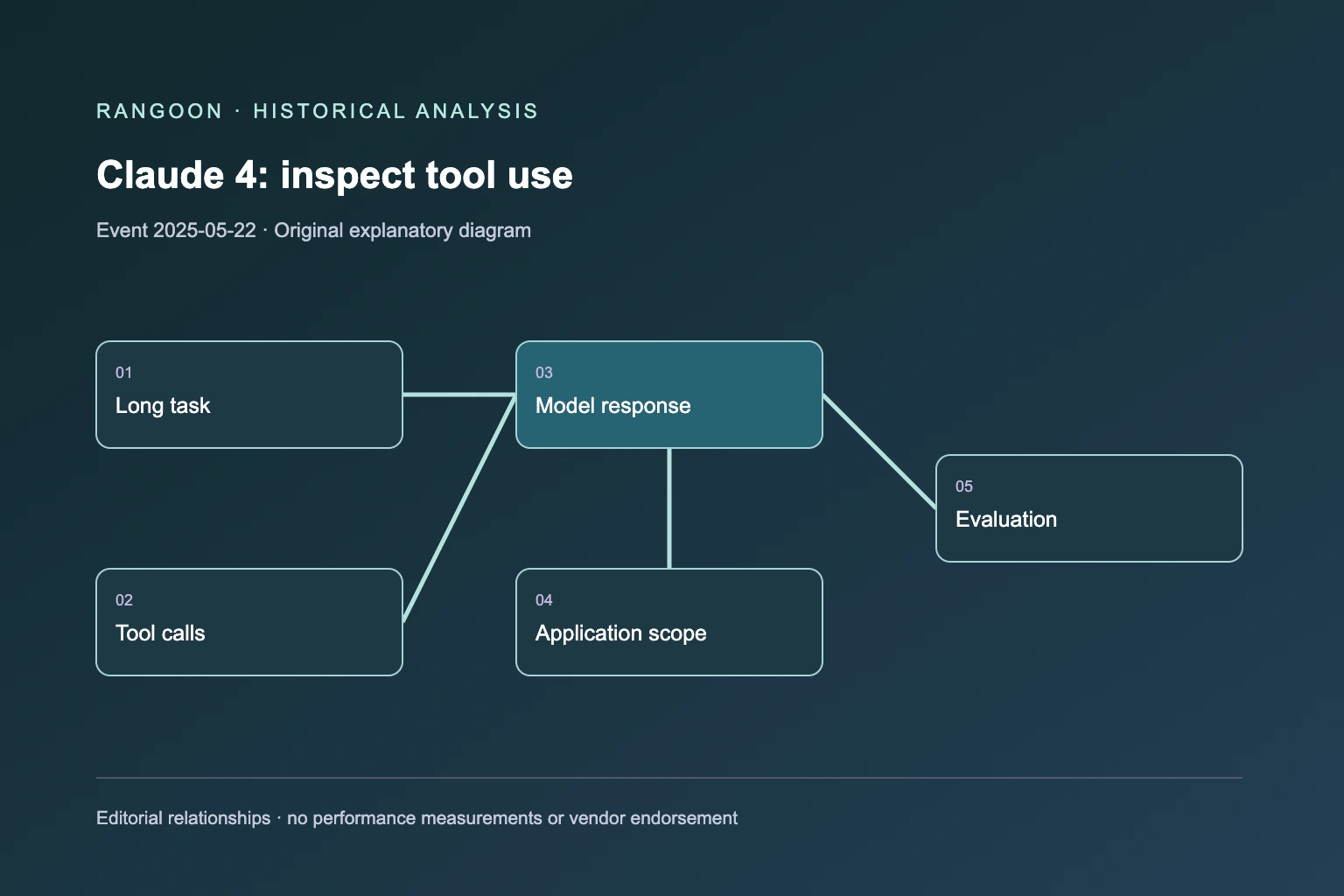
Anthropic introduced Claude Opus 4 and Sonnet 4 in May 2025, including extended thinking with tools. The launch shows why tool calls need a traceable action boundary.
Historical retrospective: Anthropic announced Claude Opus 4 and Sonnet 4 on May 22, 2025; its Claude 4 System Card is dated May 2025. This article does not make current model, tool, pricing or service-availability claims.
Key takeaways
- A model alternating reasoning and tool calls needs an action trace that preserves inputs, outputs and stop reasons.
- Extended thinking with tools is a workflow property, not a substitute for tool authorization.
- Parallel tool execution raises the value of idempotency and target-level review.
Claude 4 connected extended thinking and tool use[source 1][source 2]
On May 22, 2025, Anthropic introduced Claude Opus 4 and Claude Sonnet 4. Its launch post described extended thinking with tool use as a beta capability, saying the models could alternate between reasoning and tools such as web search. The post also described parallel tool use and other API capabilities. Anthropic's Claude 4 System Card, dated May 2025, documents the Opus 4 and Sonnet 4 model family and its safety-evaluation context. The sources establish a historical release, not a promise about later tool behavior.
The launch matters operationally because a tool-capable model creates two related but separate records: a language response and a sequence of attempted actions. A fluent final answer cannot show whether a requested operation was permitted, which arguments were supplied, what a tool returned, or why a tool was retried. Those details need an execution trace designed for the workflow rather than an inferred story after the fact.
Tool traces need causal links and clear stop states
For each tool call, record the parent task, selected tool revision, redacted arguments, authorization decision, target identity, start and finish time, normalized result and error class. Link retries and follow-on calls to the result that prompted them. This makes it possible to reconstruct whether a final output relied on a tool result, a failed call, cached data or an unsupported assumption. Sensitive arguments may stay in protected storage, while their stable digests and access-controlled references remain in the receipt.
A stop state matters as much as a success state. Rate limits, unavailable targets, malformed output, approval denial and ambiguous scope should stop or narrow the action rather than silently fall through to another target. When tools can run in parallel, concurrent requests also need idempotency keys or equivalent target controls. Otherwise, a retry or duplicate plan can become two writes that a later narrative describes as one.
Retrospective lesson: inspect action scope before outcome quality
A review set for tool-enabled workflows should contain successful calls, denied calls, partial failures, timeout recovery and repeated requests against the same target. Test whether the system exposes the difference between a completed action and a proposed action. Also test whether it preserves target identity when a fallback occurs. These cases identify boundary failures that ordinary answer-quality scoring will miss.
An operator can then make a narrow approval decision: this named tool and target class may run under this policy revision, while other tools or targets stay unavailable. The model's reasoning quality does not broaden that permission. Anthropic's 2025 announcement is useful here because it named a capability combination—extended thinking with tool use—that must be evaluated as a workflow. A trustworthy system records what the workflow attempted and why, not only the final prose it produced.
Sources
Continue reading
Related reading
 News analysisAnthropic donated Agent Skills to AAIF: treat open governance as a new supply-chain input3 min read
 News analysisSalesforce introduced Agentforce 3 with Command Center, trace data and MCP direction3 min read
 News analysisAnthropic launched a Claude directory for one-click connector discovery3 min read