DeepSeek-V3’s December 2024 API update made a checkpoint date operational
DeepSeek documented a DeepSeek-V3 upgrade for deepseek-chat on December 26, 2024. A stable endpoint name does not preserve checkpoint identity, prompt behavior, or evaluation.
Historical reporting: DeepSeek’s change log dates the deepseek-chat upgrade to DeepSeek-V3 on December 26, 2024; the model repository supplies separate artifact context. The analysis below is original editorial analysis; it does not claim present availability, performance, or support.
Key takeaways
- DeepSeek’s public change log records that deepseek-chat was upgraded to DeepSeek-V3 on December 26, 2024, while saying the API invocation name remained deepseek-chat.
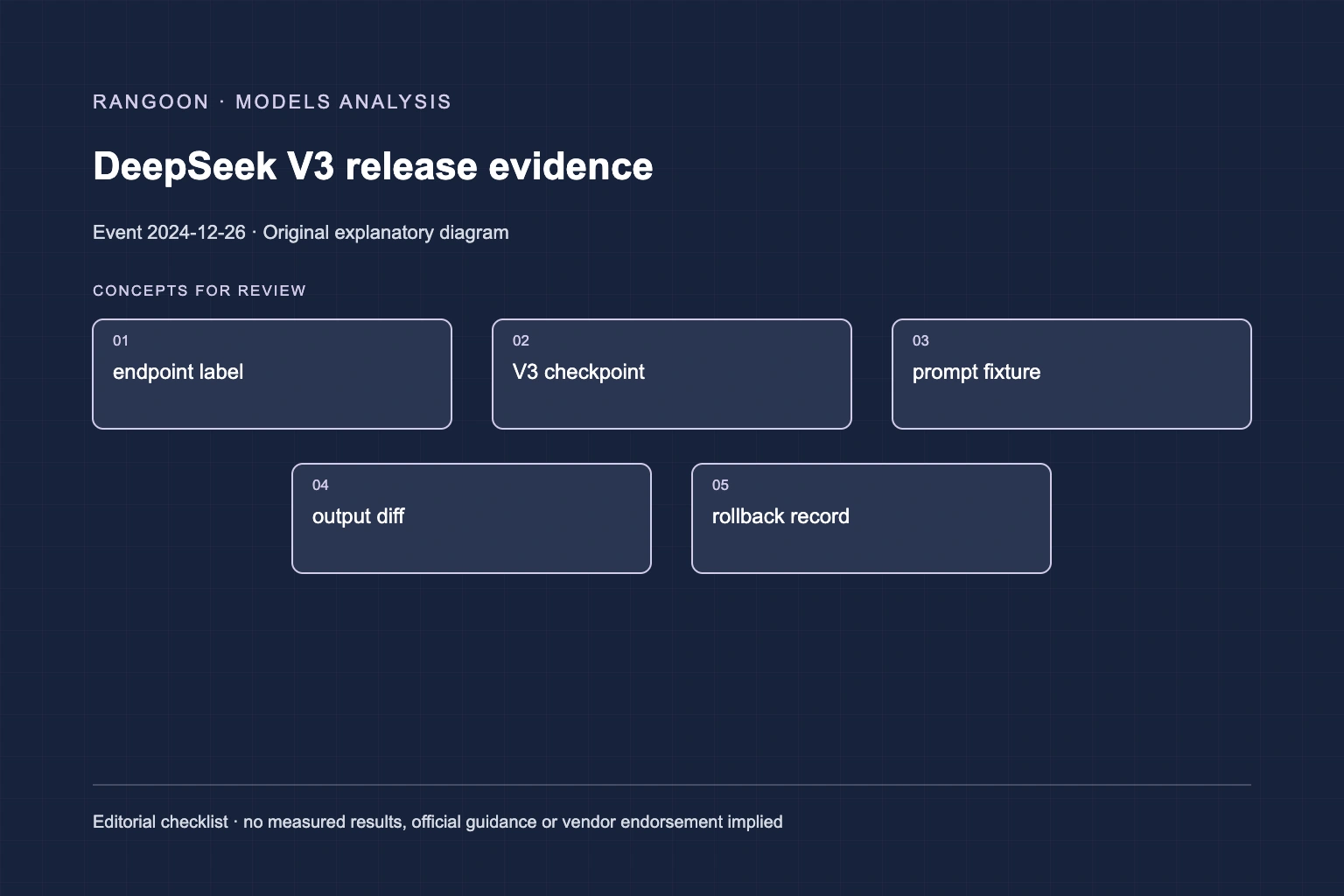
- When a service endpoint changes behind a durable name, retain the request date, endpoint, system prompt, tools, response format, decoding settings, and a small fixture output.
- The December 2024 update is evidence of DeepSeek’s stated API transition on that date. It does not prove current routing, current pricing, later benchmark results, or a particular organization’s deployment outcome.
What DeepSeek recorded[source 1][source 2]
DeepSeek’s public change log records that deepseek-chat was upgraded to DeepSeek-V3 on December 26, 2024, while saying the API invocation name remained deepseek-chat. That is a dated service-model transition, not a claim that every downstream application received the same output behavior without a test. The event matters because an endpoint label can outlive a model revision.
The DeepSeek-V3 repository is a separate primary artifact record for the model family. A repository can identify weights, code, and stated licensing material, while the change log supplies the dated API update. Neither record establishes a result for an outside prompt set, retrieval stack, tool schema, or temperature setting.
Editorial analysis: pin endpoint observations to a revision window
When a service endpoint changes behind a durable name, retain the request date, endpoint, system prompt, tools, response format, decoding settings, and a small fixture output. That turns a later regression report into a comparison against an observed run rather than a comparison against an assumed permanent model.
For extraction or classification work, store both final answers and parse failures. A semantic improvement can still change JSON formatting, refusal patterns, language choice, or tool-call arguments. These are integration properties that require their own checks, separate from vendor-described capability changes.
Editorial analysis: a vendor update is a test candidate
Release notes can identify what a supplier says changed, but they do not replace a local evaluation. Build a fixed set of representative tasks, include expected invariants, and score output quality, latency, token use, structured-output validity, and safety handling under one captured configuration.
Compare like with like. If retrieval data, prompt templates, or orchestration changed at the same time, preserve those variables. Otherwise a model-update conclusion can accidentally attribute a pipeline change to the checkpoint.
Editorial analysis: keep rollback evidence
A change record should name the accepted fixture set, the release date, observed deltas, owners, and rollback condition. This is useful even if a model is only used for drafts: production workflows often depend on stable formatting and action boundaries as much as prose quality.
Historical reporting benefits from the same discipline. The December record states an upgrade, not a timeless property of deepseek-chat. A retrospective should retain that narrow claim and avoid projecting it onto later revisions.
Editorial analysis: retain the release boundary
The December 2024 update is evidence of DeepSeek’s stated API transition on that date. It does not prove current routing, current pricing, later benchmark results, or a particular organization’s deployment outcome.
A concrete failure case is a support workflow whose endpoint name stays constant while the response changes from a strict object to explanatory prose around the object. The first caller may silently accept it; the next parser may fail; a human may see only a generic downstream error. The useful response is not to label the change good or bad. Capture the request and response pair, mark the exact contract break, and decide whether a schema repair, a pinned route, or a rollback is appropriate. For retrieval tasks, retain the evidence passages too. A better answer is not a successful update if its citations no longer point to the selected documents. This is a hypothetical operating example, not a claim about DeepSeek-V3 behavior.
Sources
- DeepSeek API Docs: change log (December 26, 2024)
- DeepSeek-V3 public repository
Continue reading