

FDA’s January AI-device lifecycle draft asked sponsors for an evidence trail, while remaining nonbinding and open for comment
FDA’s January 7, 2025 draft proposed lifecycle and submission documentation for AI-enabled devices, but it was nonbinding draft guidance rather than a new enforceable rule.
Historical reporting: FDA issued this draft guidance on January 7, 2025. Its public landing page and the issued PDF say it was distributed for comment, was not for implementation, and contained nonbinding recommendations. The document proposed material for FDA marketing submissions and lifecycle management of AI-enabled device software functions. It did not itself create a new binding obligation, grant marketing authorization, decide a device’s safety or effectiveness, or replace device-specific review. This article describes the published draft and its stated scope, not legal or regulatory advice.
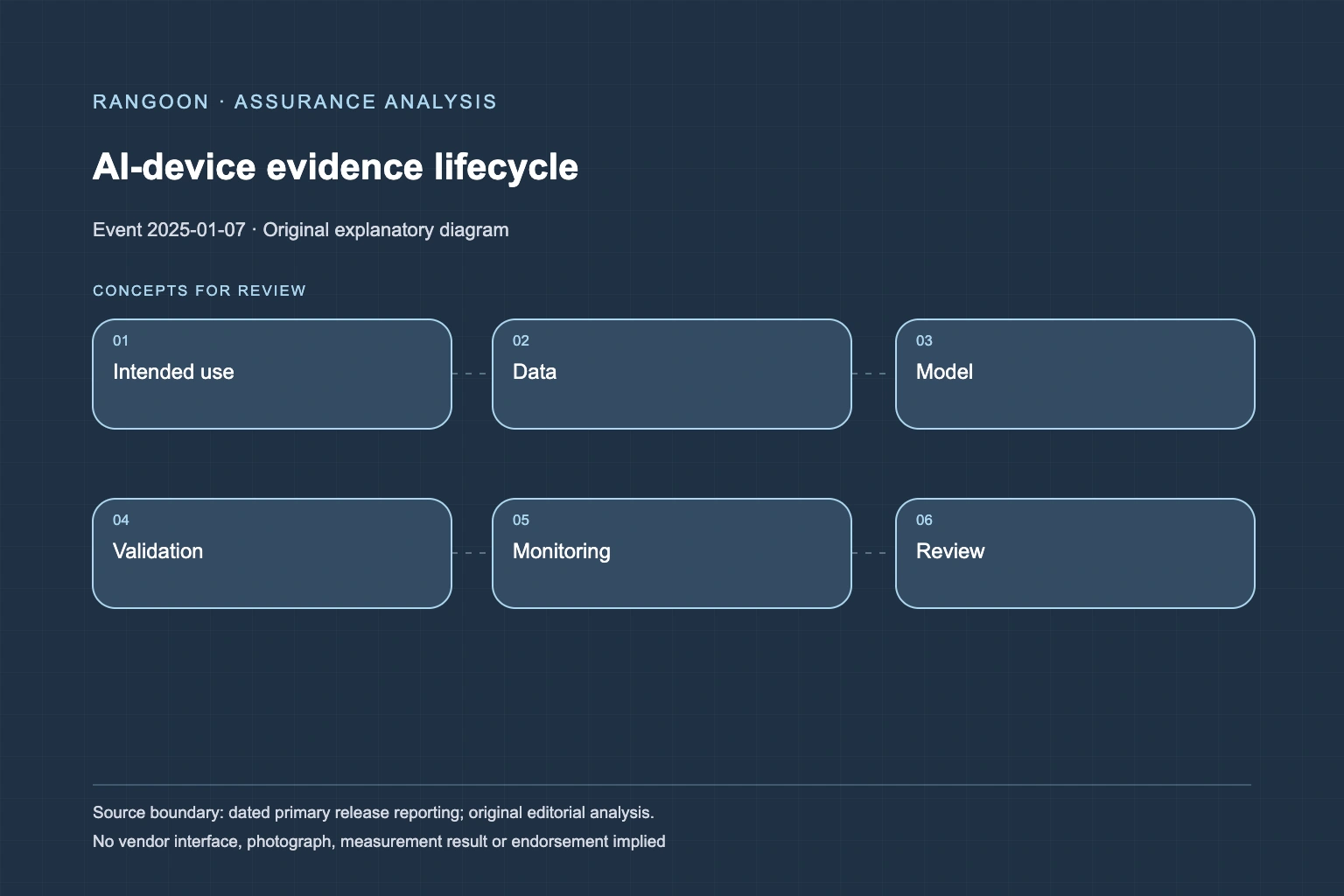
Key takeaways
- January 7 records a draft guidance release, not a final rule, marketing authorization or enforceable new requirement.
- The draft organized submission evidence around device description, risk, data, model development, validation, monitoring and cybersecurity.
- FDA’s stated lifecycle view joined premarket documentation with postmarket performance, transparency and bias considerations.
FDA released a draft for comment rather than a completed compliance regime[source 1][source 2]
FDA dated its Artificial Intelligence-Enabled Device Software Functions draft guidance January 7, 2025. The issued PDF labels it “Draft – Not for Implementation,” says it was distributed for comment purposes only, and directs comments to the related Federal Register notice and docket. That status is central to the event. FDA was putting a proposed common structure for AI-enabled-device submissions into the public record; it was not announcing that every recommendation had become a binding obligation or that a device using AI had received clearance or approval. The agency says guidance documents generally describe its current thinking and do not establish legally enforceable responsibilities unless a statute or regulation is separately cited. The report is therefore evidence of a draft regulatory approach, not individualized compliance advice.
The proposal treated a marketing submission as a connected evidence record[source 2]
The draft’s contents show what FDA proposed to connect in a marketing submission for an AI-enabled device software function. It lists quality-system documentation, device description, user interface and labeling, risk assessment, data management, model description and development, validation, performance monitoring, cybersecurity and a public submission summary. The document also identifies premarket notification, De Novo, PMA, HDE and BLA pathways in describing “marketing submission”; those pathways retain their own statutory and device-specific contexts. This did not reduce review to a model card or a single benchmark. Instead, the proposal links model evidence to intended use, data, human-facing information and ongoing performance. A published table of recommendations is not proof that any particular sponsor supplied adequate evidence or that FDA accepted a particular claim.
Transparency, subgroup evidence and monitoring were framed across the product lifecycle[source 2]
FDA proposed a total-product-lifecycle approach that reaches beyond initial development. Its discussion connects transparency and bias to design through decommissioning, calls out representativeness in development, testing and monitoring data, and describes evaluating performance across intended-use subgroups. It also notes that input differences and data drift can affect performance after deployment. Those details make the event more specific than a generic call for trustworthy AI: the draft positioned lifecycle records as evidence that supports safety and effectiveness assessment for the stated intended use. But it did not publish outcome data for a named device, a universal performance threshold or a complete method for every clinical context. The source supports reporting FDA’s proposed documentation lens, not a conclusion that all AI-enabled devices meet it.
The draft linked planned modifications to a separate predetermined-change-control route[source 2]
The guidance also acknowledges that AI-enabled device performance can change and points sponsors to FDA’s separate predetermined change control plan guidance. It describes that route as a way for manufacturers to prospectively specify intended modifications and seek premarket authorization for them, subject to the relevant plan and authorization. That reference matters because a lifecycle proposal does not turn every later model update into a self-approved change. The January document itself says it is not a complete description of everything a particular submission may need and advises use with applicable statutes, regulations and other guidance. Its historical contribution is a proposed common evidence structure: describe the function and intended use, document development and validation, then retain a performance-management story. It does not settle classification, submission adequacy or postmarket action for any product.
Sources
Continue reading
Related reading
 News analysisUK’s third-party AI assurance roadmap mapped professionalization, information access and a planned innovation fund3 min read
 News analysisOECD launched the Hiroshima AI reporting framework, making comparable company disclosures the event—not proof of compliance3 min read
 News analysisFDA opened a public discussion on regulating GenAI-enabled medical devices3 min read