

FDA opened a public discussion on regulating GenAI-enabled medical devices
FDA issued a GenAI-enabled medical-device discussion paper on August 18, 2026, seeking public input on risk, premarket evaluation and postmarket monitoring.
Historical reporting: FDA dates the GenAI-enabled medical-device discussion-paper announcement to August 18, 2026. The public FDA AI-device page was freshly read for pathway context; a discussion paper and docket are not binding guidance or authorization.
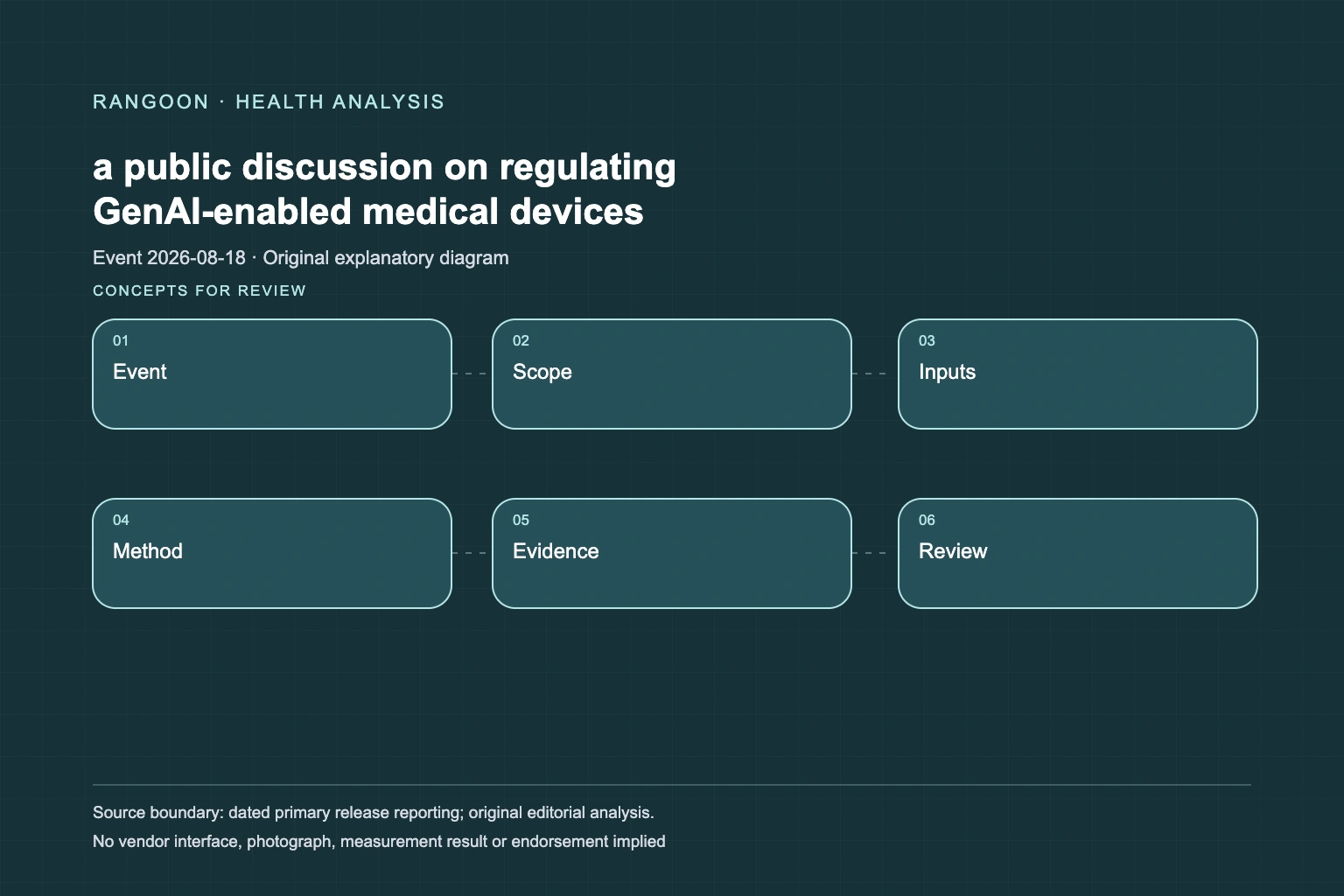
Key takeaways
- FDA’s August event was a request for feedback and discussion paper, not a final rule or cleared device.
- The paper’s stated topics included risk assessment, premarket evaluation and postmarket monitoring.
- A regulatory discussion does not determine an individual product’s safety, effectiveness or marketing status.
FDA issued a discussion paper and opened a public-feedback process[source 1][source 2]
FDA announced on August 18, 2026 that it had issued a discussion paper on generative-AI-enabled medical devices and was seeking public feedback. The announcement names risk assessment, premarket evaluation and postmarket monitoring among the topics. This is a regulatory-science and consultation event. It is not final guidance, a regulation, a marketing authorization or a finding that any particular GenAI device is safe and effective. The archive records the public process and the questions FDA put forward rather than treating a discussion document as a completed regulatory requirement.
The existing FDA pathway context remains device-specific[source 1][source 2]
FDA’s AI-enabled medical-device page explains that the agency regulates medical devices through risk-based pathways such as 510(k), De Novo classification and premarket approval. That general page provides context for why the August discussion matters, but it does not convert a GenAI system into a regulated device by label alone. Whether a product is a device and which pathway applies depend on intended use and characteristics. The two sources therefore serve different roles: the dated announcement establishes a GenAI consultation event; the maintained FDA page explains the broader device-review setting.
The announced framework was exploratory[source 1][source 2]
FDA said the discussion paper considers a possible two-axis risk-assessment framework, competency-oriented premarket evaluation and potential approaches to postmarket monitoring. The wording matters: possible approaches and questions to the public are not settled standards. The announcement also mentions foundation models and agentic systems, but does not approve their use in a specific diagnosis or treatment context. A discussion paper cannot establish that a vendor meets future expectations, that a submission will be accepted or that a device is appropriate for a patient. Those claims need product-specific and final-agency records.
The status change was a consultation, not a binding regulatory action[source 1][source 2]
The August source record marked FDA’s public opening of a GenAI device-policy discussion. Its analytical value is in separating the lifecycle areas FDA asked about—risk, premarket evidence and monitoring—from claims that a rule was finalized. A later guidance, clearance or enforcement record would be a different event with its own legal and technical meaning. The archive preserves that difference. It reports a regulator inviting evidence and comment, not a medical recommendation or a universal safety conclusion about generative AI in healthcare. The docket’s public-feedback function is itself the concrete procedural change: it invited manufacturers, clinicians, consumers and researchers to address questions before FDA selected any final approach. FDA’s press release further identifies the Digital Health Center of Excellence as leading the discussion. That names administrative ownership of the paper, not a conclusion that any software meets a premarket standard.
Sources
Continue reading
Related reading
 News analysisFDA’s January AI-device lifecycle draft asked sponsors for an evidence trail, while remaining nonbinding and open for comment3 min read
 News analysisConnecticut’s SB 10 put clinical-peer review ahead of AI or algorithms for a defined insurer decision3 min read
 News analysisUK’s third-party AI assurance roadmap mapped professionalization, information access and a planned innovation fund3 min read