

Google Cloud detailed Customer Engagement Suite agent building, multimodal inputs and API tools
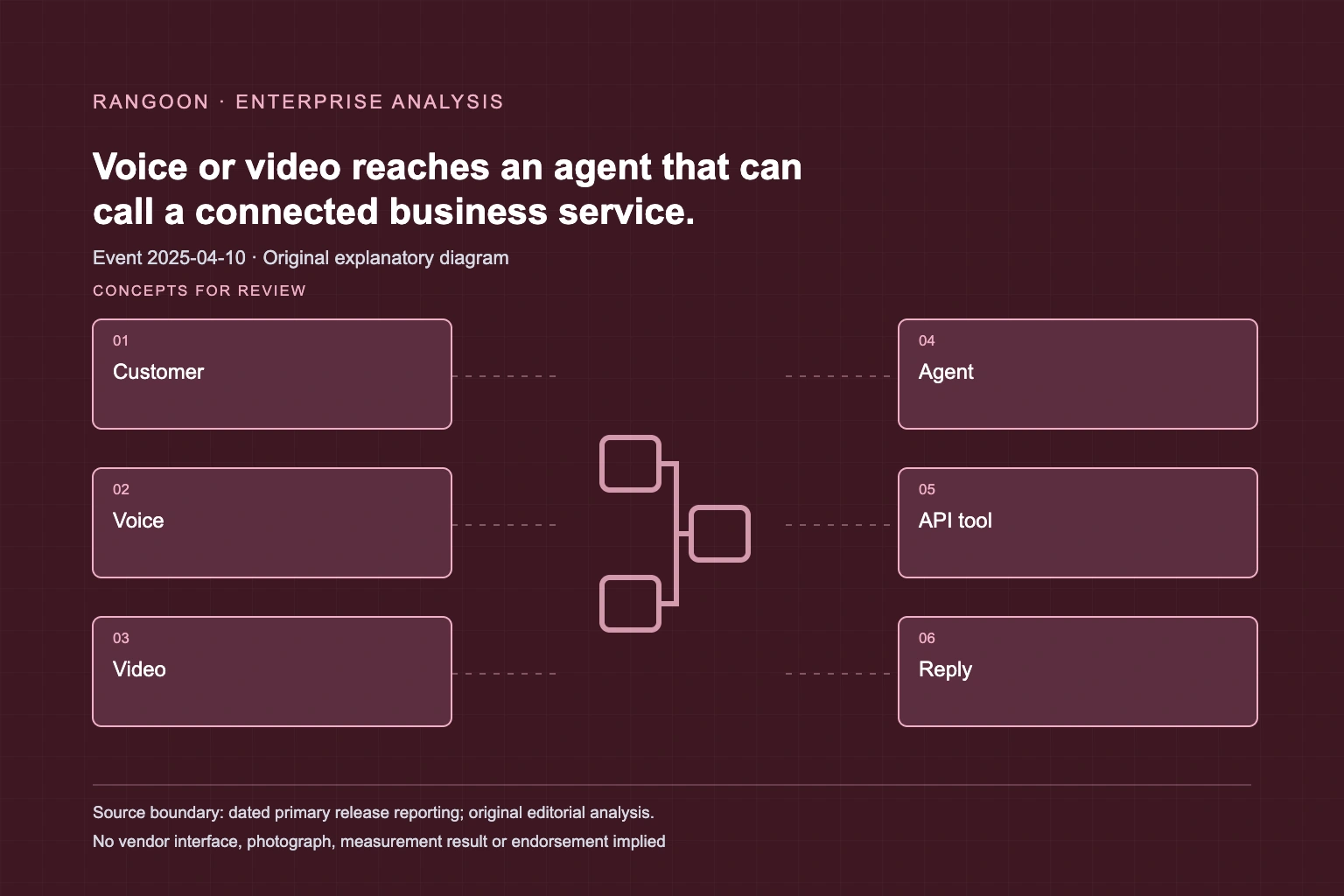
Google Cloud detailed a next-generation Customer Engagement Suite on April 10, 2025, connecting Conversational Agents, agent assistance, insights and contact-center functions.
Historical reporting: Google Cloud’s dedicated Customer Engagement Suite product post dated April 10, 2025 is the event record. The April 9 Next ’25 roundup is prior event context. The product pages describe Google’s announced architecture and supplier claims; they do not prove local availability, consent handling, model behavior, API permissions or customer outcomes.
Key takeaways
- The dated record grouped Conversational Agents, Agent Assist, Conversational Insights and Google Cloud Contact Center-as-a-Service.
- Google tied the redesigned Conversational Agents product to Gemini models, Agent Development Kit, a no-code console, privacy controls and AI observability.
- The April 9 event context added high-definition voice, emotion-related adaptation and customer-device streaming video to the customer-engagement story.
The suite announcement joined four existing customer-engagement surfaces[source 1][source 2]
Google Cloud’s April 10 Customer Engagement Suite post identified four surfaces: Conversational Agents, Agent Assist, Conversational Insights and Google Cloud Contact Center-as-a-Service. The April 9 Next ’25 roundup supplies earlier event context. The grouping is useful because it separates customer-facing virtual-agent work, human agent assistance, interaction analysis and contact-center delivery instead of treating them as one indistinct AI feature. Google said the suite could connect with a business through web, mobile, email or voice. That is a channel claim for the announced product story; it does not state that every channel was available in every deployment or that a conversation retained uniform data across channels.
Google named Gemini, ADK, privacy controls and observability in the builder stack[source 1]
Google described a revamped Conversational Agents product for building and running generative and agentic conversations. The source said it would use Gemini models and Agent Development Kit, alongside privacy controls and AI observability, in a no-code console intended for non-technical employees. This is more specific than a claim that a contact center received a new assistant: it names a model family, a development kit, an administrative surface and two enterprise features. It also leaves important boundaries open. The announcement does not identify which Gemini model a reader would use, what data an individual builder could connect, which observability records a customer retained, or how a particular organization would authorize changes made through a console.
Voice and customer-device video expanded the interaction inputs[source 2]
The prior April 9 roundup said the next generation would support high-definition voices, a greater ability to understand emotions, and streaming video that an agent could interpret when a customer shared it from a device. Those features changed the suite’s stated interaction model from text-only self-service to voice and visual inputs. Google also described the suite as available across web, mobile, email and voice. The source is careful evidence of what Google announced, but it does not show that an emotion-related adaptation was correct for a particular caller, that video was recorded, or that the required customer notice and consent were present. The distinction is especially important for an archive record: a multimodal capability announcement does not demonstrate a deployed media-handling practice.
API tools and connectors extended agents from answers to business operations[source 1]
Google said its redesigned product would let agents use tools to look up products, add items to a cart and check out through application-programming-interface calls. It also referred to connectors for customer-relationship systems, data sources and business messaging platforms, plus prebuilt food-ordering and automotive agents. This is the concrete action scope presented in the release: an agent could be situated between a customer conversation and a business application rather than confined to retrieval. The announcement did not establish that a named connector was enabled for every buyer, that all tool calls were generally available, or that any given cart or checkout operation completed correctly. Google’s customer stories and outcome claims remain supplier examples, useful for identifying intended workloads but not independent evidence of a reader’s deployment.
Sources
- Google Cloud: Customer Engagement Suite product announcement (April 10, 2025)
- Google Cloud: Next ’25 announcement roundup (April 9, 2025)
Continue reading
Related reading
 News analysisNiCE launched CXone Agents with AI Studio creation and CXone data-layer access3 min read
 News analysisAWS introduced a bundled next-generation Amazon Connect across the contact lifecycle3 min read
 News analysisGoogle introduced Agentspace in early access for enterprise search, reasoning and custom agents3 min read